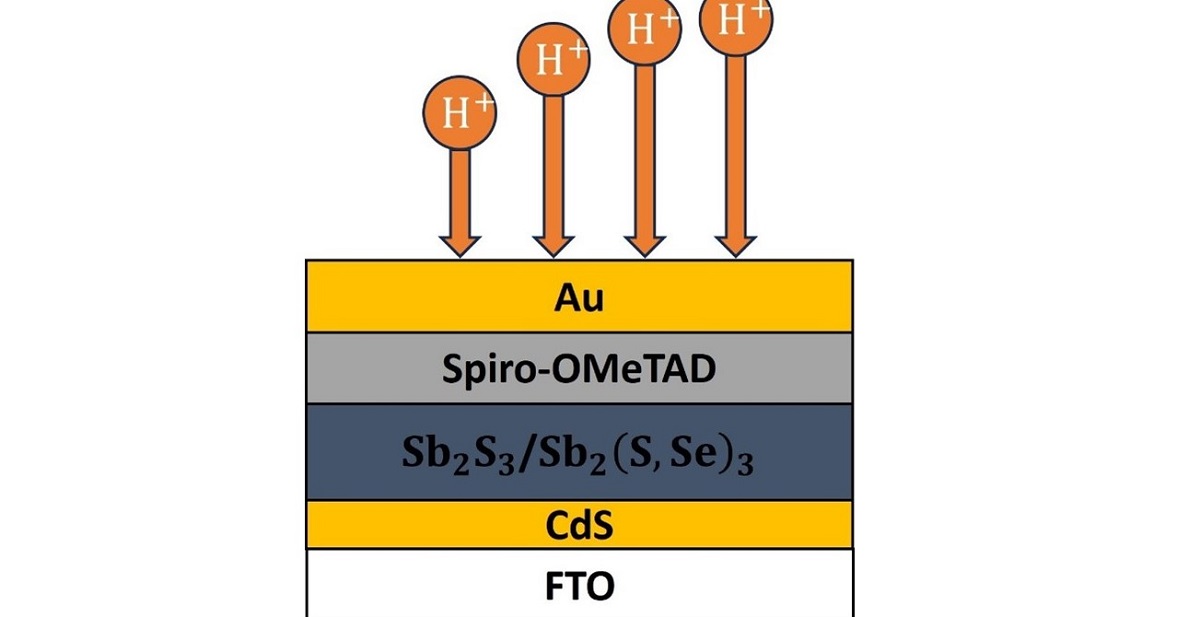





Researchers at the University of Toledo and Auburn University in the U.S. have assessed how well antimony chalcogenide-based solar cells withstand levels of proton radiation at levels typically experienced by solar power arrays in space orbits.
Prior to the study, the team noted the potential to use this type of thin-film solar cell technology in future terrestrial and space photovoltaic applications. “Antimony chalcogenide-based solar cells have garnered significant attention due to their simple composition, suitable bandgaps, high absorption coefficients, low fabrication costs, and material robustness,” corresponding author of the research, Alisha Adhikari, told pv magazine.
To explore the potential for space, the researchers examined the proton radiation tolerance of Sb2S3 and Sb2(S, Se)3-based solar cells, exposing them to proton energy at 100 keV and 300 keV for four fluences (1011 to 1014 protons/cm2).
The devices were irradiated with protons produced by a 6HDS-2 Tandem National Electrostatics Corporation Pelletron particle accelerator with a Source of Negative Ions by Cesium Sputtering (SNICS) source.
The current density voltage (J-V) and external quantum efficiency (EQE) measurements were recorded before and after irradiation, according to Adhikari.
For the simulation aspect of the study, the team used Stopping Range of Ions in Matter (SRIM) Monte Carlo simulation software.
The solar cells were fabricated in a superstrate configuration based on a stack as follows: fluorine-doped tin oxide (FTO) on a glass substrate, a cadmium sulfide (CdS) electron transport layer, absorbers based on either Sb2S3 or Sb2(S, Se)3, a Spiro-OMeTAD transport layer, and gold (Au) back contacts.
Their initial power conversion efficiency was 6% to 8% before bombardment. To predict end-of-life (EoL) performance of the devices in space conditions, the team used EoL-PCE calculations and displacement damage dose (DDD) analysis. They analyzed the retention of JV parameters as a function of DDD for both Sb2S3 and Sb2(S, Se)3 devices.
Subsequently, the team compared the thin film solar cells with state-of-the-art III-V devices, with shielding and without shielding. These devices’ initial PCE ranged from 28% for triple-junction devices to 32% for quadruple-junction devices.
The results of the DDD analysis and EoL-PCE simulations indicated that Sb2S3-based solar cells could be exposed to high-proton-exposure environments.
The devices exhibited “superior radiation robustness” compared to the III-V devices, retaining higher remaining factors of JV parameters after exposure to DDD of up to 1013 MeV/g. The results for Sb2(S, Se)3 solar cells demonstrated a similar tolerance to that of Sb2S3-based solar cells up to a fluence of 1014 protons/cm2.
The researchers noted the “robust tolerance” and the “great potential of antimony chalcogenide solar cells for future space PV applications.” But they also noted the thin film technology’s limitation, its “inferior” PCE performance compared to III-V technology.
“To become more competitive for future space missions, a greater research effort is needed to overcome the efficiency barrier and develop new strategies, such as bandgap engineering, interface optimization, and tandem integration,” they stressed.
The work appears, “Assessing Proton Radiation Hardness of Antimony Chalcogenide Solar Cells,” published by Solar RRL.
Looking ahead, the researchers aim to “further boost efficiency of antimony chalcogenide solar cells utilizing novel deposition techniques,” according to Adhikari.
This content is protected by copyright and may not be reused. If you want to cooperate with us and would like to reuse some of our content, please contact: editors@pv-magazine.com.




By submitting this form you agree to pv magazine using your data for the purposes of publishing your comment.
Your personal data will only be disclosed or otherwise transmitted to third parties for the purposes of spam filtering or if this is necessary for technical maintenance of the website. Any other transfer to third parties will not take place unless this is justified on the basis of applicable data protection regulations or if pv magazine is legally obliged to do so.
You may revoke this consent at any time with effect for the future, in which case your personal data will be deleted immediately. Otherwise, your data will be deleted if pv magazine has processed your request or the purpose of data storage is fulfilled.
Further information on data privacy can be found in our Data Protection Policy.