





Scientists from the University of California, Riverside, have developed a new diagnostic metric for electric vehicles (EVs) that determines whether they can complete an upcoming trip.
Called the State of Mission (SOM), it utilizes both battery data and environmental factors, such as traffic patterns, elevation changes, or ambient temperature, to generate real-time, task-specific predictions. Furthermore, the team has developed mathematical and computational frameworks to calculate the SOM.
“It’s a mission-aware measure that combines data and physics to predict whether the battery can complete a planned task under real-world conditions,” co-author Mihri Ozkan said in a statement. “Our approach is designed to be generalizable. The same hybrid methodology can deliver mission-aware predictions that improve reliability, safety, and efficiency across a wide range of energy technologies from cars and drones to home battery systems and even space missions.”
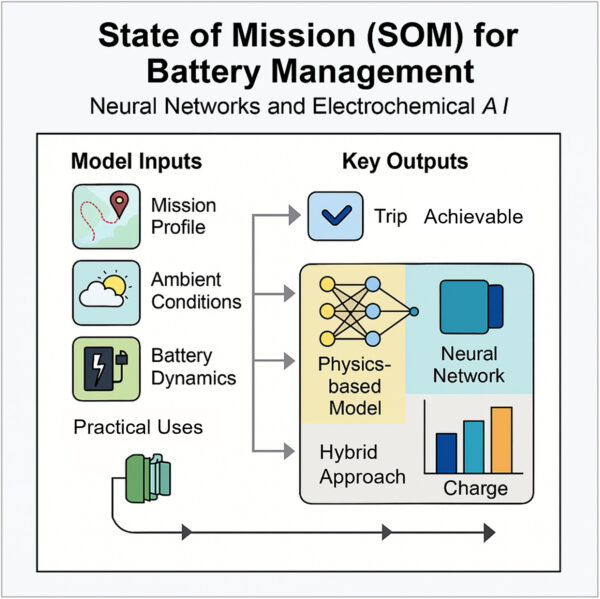
To calculate the SOM, the novel model utilizes three input classes related to the mission profile, ambient conditions, and battery dynamics. It starts by processing historical time-series data to estimate the battery’s initial internal state vector. Then, neural ordinary differential equations (neural ODEs) simulate the continuous-time evolution of electrochemical, thermal, and degradation states. Leveraging physics-informed neural networks (PINNs), the model adheres to the results based on physical laws. Ultimately, utilizing sequential learning architectures yields a cohesive, end-to-end battery state estimation system.
The novel model yields three results: the first is a binary SOM, which indicates whether a battery can complete the mission. The next one is a quantitative SOM, indicating how easily and safely the battery can complete the mission. Lastly, it also yields a probabilistic SOM, representing the probability of the mission being successful. The group has used data from the Oxford battery degradation dataset and the NASA PCoE battery aging dataset to train the model. Part of the data was eventually also used for testing.
“The model learns from how batteries charge, discharge, and heat up over time, but it also respects the laws of electrochemistry and thermodynamics. This dual intelligence lets it make reliable predictions even under stress, such as a sudden temperature drop or a steep uphill climb,” said co-author Cengiz Ozkan. “By combining them, we get the best of both worlds: a model that learns flexibly from data but always stays grounded in physical reality. This makes the predictions not only more accurate but also more trustworthy.”
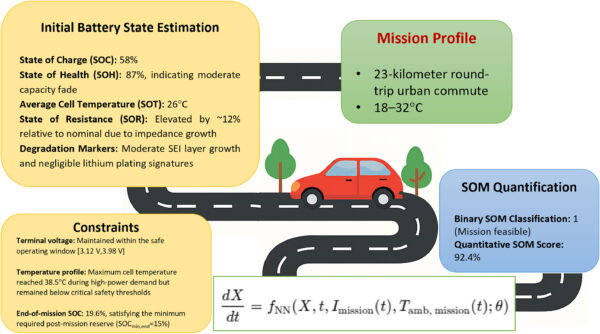
Using a computational framework implemented in Python, the group has simulated two case studies to examine their SOM model. The first included a passenger car, traveling on a 23 km round-trip urban route, with ambient temperatures ranging from 18 to 32 C. The initial battery state of charge (SOC) was 58%, the initial state of health (SOH) was 87%, the state of resistance (SOR) was about 12% and the average cell temperature (SOT) was 26 C. The model has found the mission feasible, with a quantitative SOM score of 92.4%.
The second mission involved a long-haul electric freight vehicle, which traveled a 275 km mixed route that included 110 km in mountainous conditions, with an ambient temperature range of 26-42 C. The SOC in this case was 87%, the SOH was 78%, and the SOT was 33.6 C. The model also found this mission to be feasible, with a quantitative SOM of 73.5%. “Across the evaluated dataset, the model achieves root-mean-square errors (RMSEs) of 0.018 V for voltage, 1.37 C for temperature, and 2.42% for SOC, reflecting strong agreement with empirical data,” the team added.
“Right now, the main limitation is computational complexity,” said Mihri Ozkan. “The framework demands more processing power than today’s lightweight, embedded battery management systems typically provide.” However, she emphasized that she is optimistic and that the model could soon be applied to electric vehicles, unmanned aerial systems, grid storage applications, and other areas.
The novel system was introduced in “State of mission: Battery management with neural networks and electrochemical AI,” published in iScience.
This content is protected by copyright and may not be reused. If you want to cooperate with us and would like to reuse some of our content, please contact: editors@pv-magazine.com.






By submitting this form you agree to pv magazine using your data for the purposes of publishing your comment.
Your personal data will only be disclosed or otherwise transmitted to third parties for the purposes of spam filtering or if this is necessary for technical maintenance of the website. Any other transfer to third parties will not take place unless this is justified on the basis of applicable data protection regulations or if pv magazine is legally obliged to do so.
You may revoke this consent at any time with effect for the future, in which case your personal data will be deleted immediately. Otherwise, your data will be deleted if pv magazine has processed your request or the purpose of data storage is fulfilled.
Further information on data privacy can be found in our Data Protection Policy.