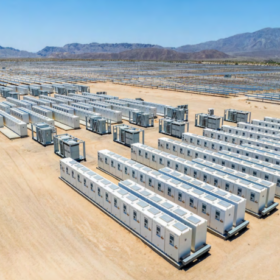
FlexGen moves to expand offerings with acquisition of Clean Energy Services
The move will see CES added as a subsidiary of the parent company, enabling continuation of service to existing customers and opportunities for expansion.
U.S. energy storage shatters records with 58 GWh installed in 2025
A new quarterly report from SEIA and Benchmark Mineral Intelligence highlights a 30% year-over-year growth in the U.S. battery market, even as the industry braces for supply chain restructuring and a shift in the political landscape.
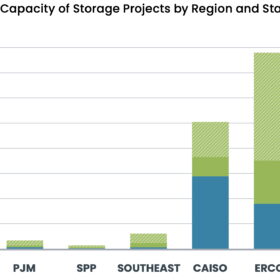
How battery deployment in the Eastern U.S. could scale as in Texas and California
A study led by two energy lawyers documents the causes of “lagging” battery energy storage deployment in the Eastern U.S. and recommends 15 policy solutions that could help scale BESS deployment.
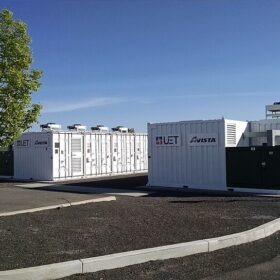
Battery storage management keeps solar in the energy mix
FlexGen’s Jason Abiecunas describes how BESS is at the heart of reliable new capacity.
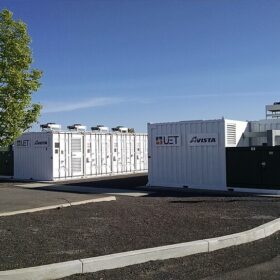
“Made in the USA” batteries might still fail FEOC
Even U.S.-assembled storage systems can carry FEOC exposure via upstream ownership and materials processing, which is forcing developers to rethink diligence, serviceability and replacement strategies.
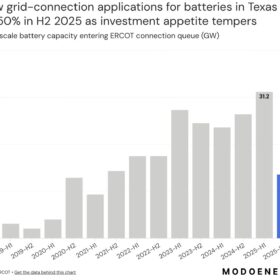
ERCOT BESS interconnection applications drop 50% in H2 2025 as faults in the boom emerge
New data out of Modo Energy suggests only about 85% of large batteries with signed interconnection agreements are likely to be built, as queue timelines stretch beyond four years.
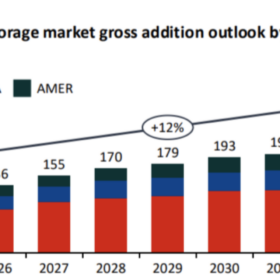
Global BESS capacity tops 250 GW, overtaking pumped hydro for first time
Rystad Energy says it expects global battery energy storage system (BESS) additions to exceed 130 GW/350 GWh in 2026, led by China, the United States, the United Kingdom, Australia, and Germany.
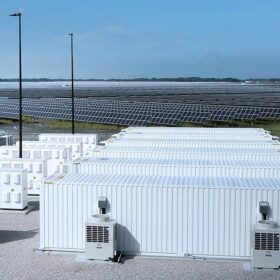
U.S. energy storage developers secure over $2 billion in latest capital infusion
Led by a massive $1.5 billion facility for Aypa Power, a series of new deals for Jupiter Power and PowerBank show that lenders are doubling down on battery energy storage system assets.
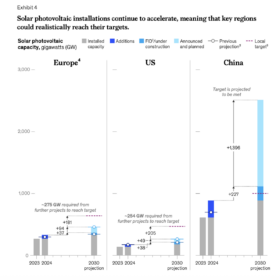
U.S., Europe on track for 2030 solar goals despite pipeline gaps
A report from McKinsey and Company says the relative ease of building out solar projects means the U.S and Europe are likely to meet their end-of-decade deployment targets, despite current pipeline gaps of around 205 GW and 181 GW.
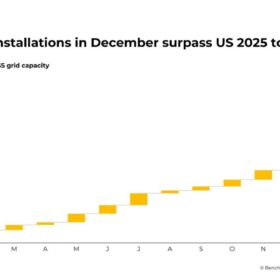
Global BESS demand jumps 51% in 2025 as installations top 300 GWh
Iola Hughes, Head of Research at Benchmark Mineral Intelligence, tells ESS News that 2026 is set to be another strong year for BESS, with forecast additions exceeding 450 GWh and no material supply constraints in sight. Meanwhile, the initial impact of rising lithium prices is already visible at the cell level, but the full effect has yet to ripple through to system pricing.