




Utraviolet (UV) radiation has been long recognized as a key driver of PV module degradation. This factor, however, is significantly underestimated in current testing standards, particularly for modern system designs and high-irradiance regions.
With this in mind, a group of researchers at the University of New South Wales (UNSW) in Australia has developed a high-precision global UV irradiance model on tilted surfaces, capturing the impact of system design, climate, and atmospheric conditions.
“Our new model demonstrates that identical module technologies degrade differently depending on deployment location, highlighting the need for climate-specific reliability assessment,” corresponding author Bram Hoex told pv magazine. “It also offers a pathway to move beyond generic accelerated testing toward regionally relevant degradation modeling and qualification protocols.”
The researchers highlighted that global UV irradiance can range from below 30 W/m² in high-latitude regions to over 80 W/m² in deserts and dry climates. In some locations, the UV dose specified in the IEC 61215 standard, which is just 15 kWh/m², can be reached in less than two months. By contrast, real-world exposure over a module’s lifetime is orders of magnitude higher.
“Current testing thresholds are simply too low to replicate long-term field conditions,” the authors noted, adding that even enhanced protocols fall short of simulating 25–30 years of operation.
One of the most striking findings of the study relates to system design. The researchers compared fixed-tilt installations with single-axis tracking (SAT) systems and found that trackers receive significantly more UV radiation due to their orientation toward the sun throughout the day.
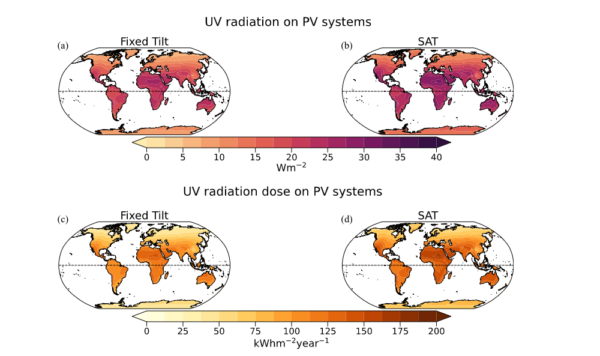
In high-irradiance regions, such as deserts, single-axis tracking (SAT) systems can be exposed to up to 1.5 times more UV radiation than fixed-tilt systems, leading to degradation rates that are nearly twice as high. This results in annual UV-driven degradation rates of up to 0.35% per year for SAT systems, compared with approximately 0.25% per year for fixed-tilt installations.
Over the course of a typical project lifetime, this difference can accumulate to several percentage points of additional power loss, directly impacting the economics and long-term performance of the PV system.
The study also showed that identical PV modules can degrade at markedly different rates depending on their installation location. The key factors driving this variability include UV irradiance, temperature, humidity, and atmospheric conditions such as ozone levels, aerosols, and cloud cover. Among the most challenging environments are tropical and desert regions, where high UV exposure combines with intense thermal and environmental stress, accelerating module degradation.
“Current standards significantly underestimate real-world UV exposure, in some cases by orders of magnitude relative to lifetime conditions,” Hoex stressed. “UV exposure varies significantly with location and system configuration, with tracking systems experiencing up to around two times higher degradation rates in high-irradiance regions. In arid and tropical climates, UV-induced degradation can reach about 0.25–0.35%/year, contributing substantially to long-term performance loss.”
The novel high-precision model to estimate UV radiation in PV systems was presented in the paper “Closing the UV-Induced Photodegradation Gap Through Global Scale Modeling of Fixed Tilt and Tracking Photovoltaic Systems,” pubished in the IEEE Journal of Photovoltaics.
“This work forms part of our group’s broader effort to connect fundamental degradation mechanisms with system-level impacts in the field, combining targeted accelerated testing—such as UV, damp heat, and contamination—with physics-based and data-driven modeling at the system scale to quantify how both established and emerging failure modes translate into real-world energy yield losses across diverse climates and system designs,” Hoex concluded.
This content is protected by copyright and may not be reused. If you want to cooperate with us and would like to reuse some of our content, please contact: editors@pv-magazine.com.




By submitting this form you agree to pv magazine using your data for the purposes of publishing your comment.
Your personal data will only be disclosed or otherwise transmitted to third parties for the purposes of spam filtering or if this is necessary for technical maintenance of the website. Any other transfer to third parties will not take place unless this is justified on the basis of applicable data protection regulations or if pv magazine is legally obliged to do so.
You may revoke this consent at any time with effect for the future, in which case your personal data will be deleted immediately. Otherwise, your data will be deleted if pv magazine has processed your request or the purpose of data storage is fulfilled.
Further information on data privacy can be found in our Data Protection Policy.