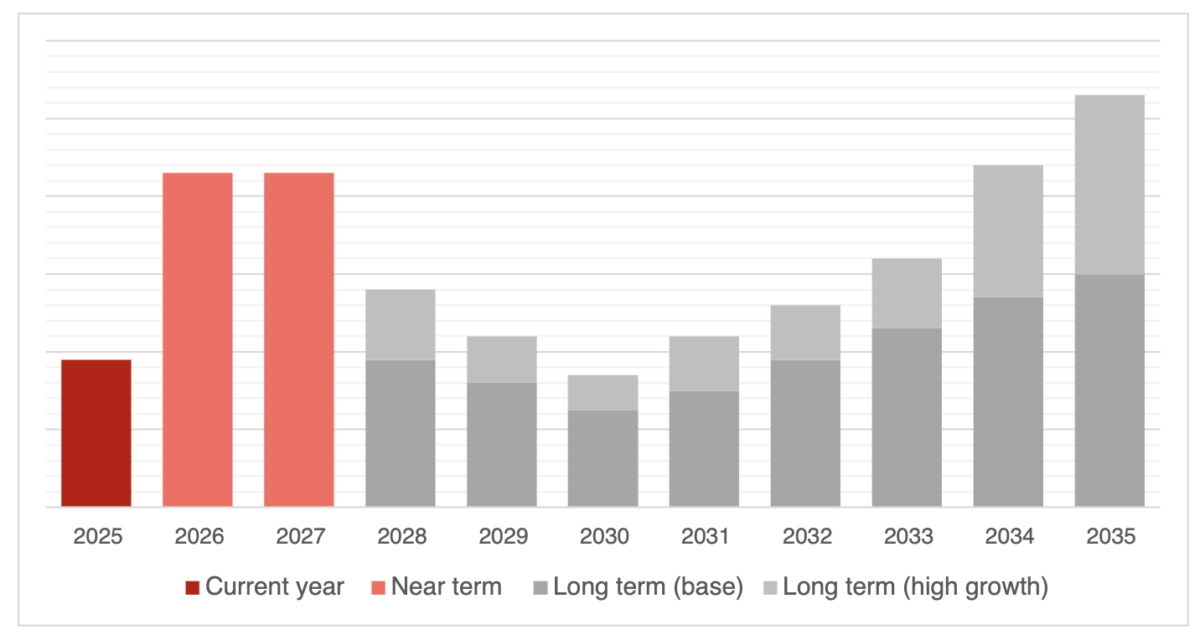





A study by researchers at the University of Louisiana at Lafayette has projected that Louisiana’s utility–scale solar deployment will reach 12.1 GW by 2035, generating electricity equal to 27% of current generation or 17% of the generation projected in 2035.
The study assesses the effects of solar development on employment, tax revenues, land use, and rural communities. NextEra Energy provided research funding.
The researchers assumed that a “large percentage” of the 38 solar projects in Louisiana that have secured interconnection approval from grid operator MISO, totaling 5.6 GW of capacity, will be built before the OBBBA “tax credit cliff” arrives. To receive federal tax credits, projects must begin construction by July 4 or enter service by year-end 2027.
For projects still awaiting interconnection, the researchers generally assumed that 25% of those projects approval will be built, but assumed a lower completion rate for 2028 and 2029. Overall, they projected that annual deployment will decline from 2028 through 2030, and then rise from 2031 through 2035 as electricity demand increases and solar costs continue to decline.
Noting that the Louisiana Energy Users Group, whose members sought to buy clean power, successfully lobbied the Louisiana Public Service Commission to enable “sleeved” power purchase agreements, the researchers also analyzed a high growth case that could result if Louisiana industries further prioritized renewable power, or if there were a return to a favorable policy environment. The high growth case is illustrated in the featured image above.
Louisiana’s direct employment in the utility-scale solar industry is projected to rise from 4,000 jobs in 2025 to 8,000 jobs this year and next, and then decline to an average of 4,600 jobs from 2028 to 2035.
The projected increase in land requirements to build 12.1 GW of solar equals just 1.1% of Louisiana’s agricultural land area, based on a requirement of seven acres per MW.
Local government property tax revenues for a utility-scale solar development would be about 60 times greater than for a comparable agricultural property, the researchers said. That estimate is based on agricultural land property tax rates and a calculation of solar tax revenues by a representative of the Morehouse Parish Economic Development Corporation, who said that a 200 MW solar development in the parish would yield up to $180 million in property tax revenue over the project lifetime.
The researchers said that tax revenue will make “a major impact” on funding for local schools, fire and police departments, and road improvements.
The study also considers the potential for Louisiana to capitalize on supply chain opportunities to support solar projects in Louisiana and beyond.
The study, from researchers at the Kathleen Babineaux Blanco Public Policy Center at the University of Louisiana at Lafayette, is titled “The impact of utility-scale solar power in Louisiana.”
This content is protected by copyright and may not be reused. If you want to cooperate with us and would like to reuse some of our content, please contact: editors@pv-magazine.com.




By submitting this form you agree to pv magazine using your data for the purposes of publishing your comment.
Your personal data will only be disclosed or otherwise transmitted to third parties for the purposes of spam filtering or if this is necessary for technical maintenance of the website. Any other transfer to third parties will not take place unless this is justified on the basis of applicable data protection regulations or if pv magazine is legally obliged to do so.
You may revoke this consent at any time with effect for the future, in which case your personal data will be deleted immediately. Otherwise, your data will be deleted if pv magazine has processed your request or the purpose of data storage is fulfilled.
Further information on data privacy can be found in our Data Protection Policy.