Researchers in Canada found that semi-transparent cadmium telluride and low-transparency crystalline silicon solar panels can boost turnip root and leaf yields in agrivoltaic systems by optimizing light quality, distribution, and heat stress. Their study highlights that PV module type, transparency, and spectral transmission must be carefully matched to plant physiology to maximize both crop productivity and renewable energy generation.
Researchers at the University of Western Ontario in Canada have examined the effects of thin-film cadmium telluride (CdTe) and crystalline silicon (c-Si) solar panels on agricultural yield in agrivoltaic settings and have found that PV transparency and spectral transmission are key to shape optimal crop-atmosphere interactions.
“We took a hard look at agrivoltaic turnips and discovered several semi-transparent treatments that resulted in substantially more food while providing solar energy,” the research’s lead author, Joshua M. Pearce, told pv magazine.
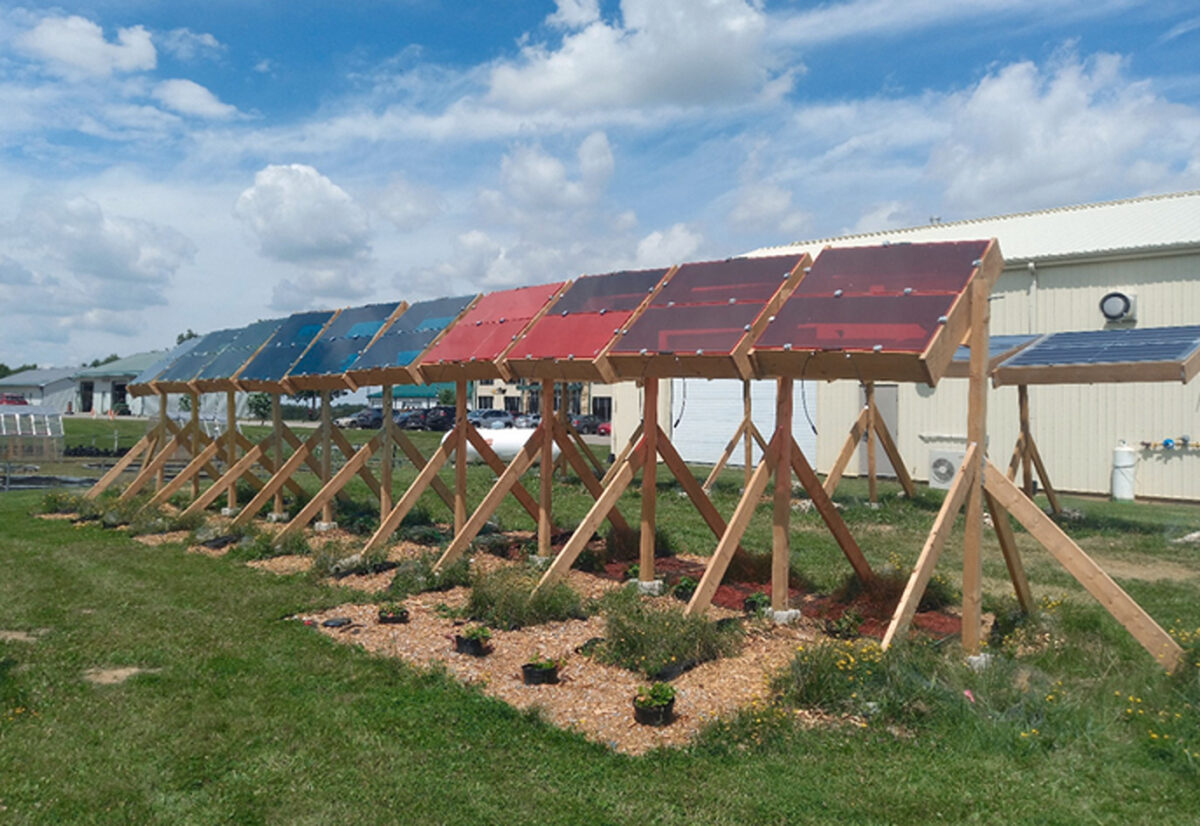
The team investigated, in particular, turnip growth under thirteen types of PV modules with varying transparency and spectral properties. Experiments were conducted outdoors at the Wired facility, Western University Field Station in Ilderton, Ontario, using stilt-mounted PV racks for field-scale agrivoltaic trials.
McKenzie Turnip seeds were sown on May 21, 2025, initially with two plants per pot, later reduced to one after germination. The PV modules included three semitransparent c-Si types with transparency of 8%, 44%, and 69%, respectively, and ten CdTe thin-film modules with blue, green, and red spectral filters, varying in transparency from 40% to 80%. While CdTe modules provided relatively uniform light distribution, c-Si modules produced non-uniform patterns due to their intermittent solar cell arrangement.
Throughout the growing period, key variables such as photosynthetically active radiation (PAR), spectral irradiance, plant height, leaf count, and fresh biomass were measured. These data were analyzed to compare turnip growth across PV treatments and to assess the potential economic impacts of agrivoltaic adoption in Canada.
The analysis showed that turnip fresh weight varied markedly across the thirteen PV treatments, with the highest yield observed under the 60% CdTe module at 176.5 g, followed by the 80% CdTe panel at 130.6 g and the 8% c-Si module at 118.9 g. Moderate yields were recorded under CdTe modules with 50%, 40%, and 70% transparency, as well as the 44% c-Si module.
Leaf biomass mirrored root trends, with 60% CdTe achieving 367 g, and intermediate values observed under 8% c-Si, 40% CdTe, and 80% CdTe. Weekly measurements of plant height and leaf count reinforced these patterns and PAR measurements indicated that light quantity alone did not drive growth differences, as the 60% CdTe treatment achieved the highest yield at a moderate PAR, whereas CdTe modules with similar PAR produced negligible biomass. Overall, CdTe modules with moderate transparency, along with low-transparency c-Si modules, provided optimal conditions for turnip root and leaf development.
The scientists explained that both low-transparency c-Si and moderately transparent CdTe modules improved crop growth by reducing heat stress and providing optimal light distribution. Non-uniform shading from c-Si modules performed better at lower transparencies, while uniform thin-film CdTe modules were most effective at 50–60% transparency.
“These results underscore the significance of synthesizing PV module type with plant physiology when designing agrivoltaic systems,” they also highlighted. “Instead of selecting PV modules based solely on energy output or transparency percentage, system designers should also take into consideration how light is delivered to plant canopy – uniformly or non-uniformly – and how this interacts with plant morphology and stress tolerance. In addition, there is clearly a wide array of potential future work to optimize the spectral transmission of agrivoltaic-specific PV modules.”
“Agrivoltaics simply make technical and economic sense,” Pearce concluded. “As the climate warms stressing even relatively robust crops like turnips agrivoltaics provides a realistic path to a sustainable food system. More work is needed to ensure that the optimal agrivoltaic module, color and racking meet the needs of the farmers, the crops and our greater society to decarbonize.”
This content is protected by copyright and may not be reused. If you want to cooperate with us and would like to reuse some of our content, please contact: editors@pv-magazine.com.
By submitting this form you agree to pv magazine using your data for the purposes of publishing your comment.
Your personal data will only be disclosed or otherwise transmitted to third parties for the purposes of spam filtering or if this is necessary for technical maintenance of the website. Any other transfer to third parties will not take place unless this is justified on the basis of applicable data protection regulations or if pv magazine is legally obliged to do so.
You may revoke this consent at any time with effect for the future, in which case your personal data will be deleted immediately. Otherwise, your data will be deleted if pv magazine has processed your request or the purpose of data storage is fulfilled.
pv magazine USA offers daily updates of the latest photovoltaics news. We also offer comprehensive global coverage of the most important solar markets worldwide. Select one or more editions for targeted, up to date information delivered straight to your inbox.
pv magazine offers daily updates of the latest photovoltaics news. Stay informed. Join our newsletter.
Welcome to pv magazine USA. This site uses cookies. Read our policy.
The cookie settings on this website are set to "allow cookies" to give you the best browsing experience possible. If you continue to use this website without changing your cookie settings or you click "Accept" below then you are consenting to this.








By submitting this form you agree to pv magazine using your data for the purposes of publishing your comment.
Your personal data will only be disclosed or otherwise transmitted to third parties for the purposes of spam filtering or if this is necessary for technical maintenance of the website. Any other transfer to third parties will not take place unless this is justified on the basis of applicable data protection regulations or if pv magazine is legally obliged to do so.
You may revoke this consent at any time with effect for the future, in which case your personal data will be deleted immediately. Otherwise, your data will be deleted if pv magazine has processed your request or the purpose of data storage is fulfilled.
Further information on data privacy can be found in our Data Protection Policy.