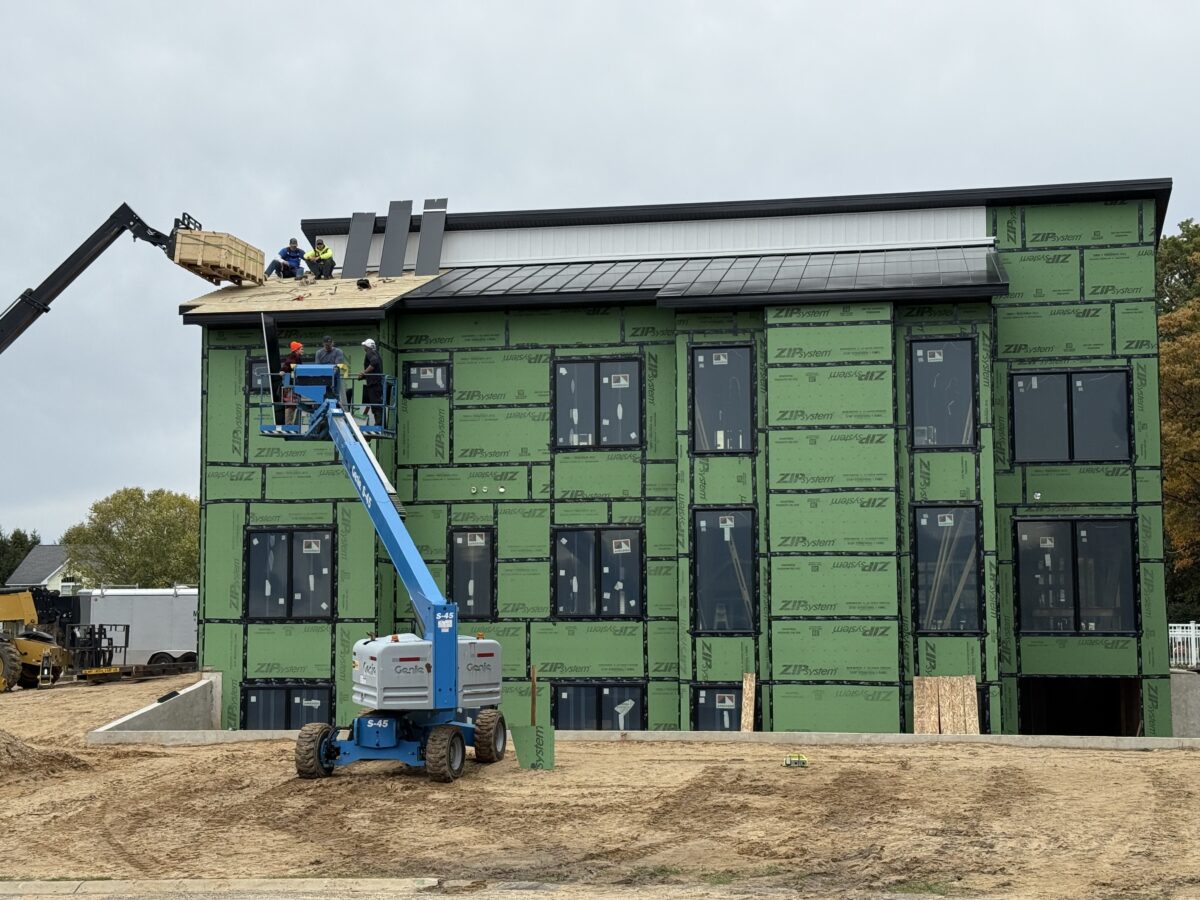





Estonia-based installer of building-integrated PV (BIPV) energy systems Roofit.Solar has completed its first project in Michigan as a prelude to its expansion into the North American market. The residential installation, accomplished in partnership with ArcEdge Power and regional installer Agathon Solar, uses modules integrated into a solar roofing construction.
The BIPV design is intended to maintain the architectural aesthetics of structures, particularly those with landmark significance or communities with appearance sensitivities. Roofit Solar says it has installed over 3,000 projects in 30 countries, primarily in Europe. The company’s inaugural U.S. project saw 12.32 kW of solar power installed at a private residence in Kalamazoo.
Installations use the company’s Velario module with PV cells built into standing-seam metal roofing sheets. The cells are 6.25-in. monocrytalline PERC in a 3 x 10-in. configuration with a conversion efficiency of 16.2%. The basic Velario modules, which are manufactured in Estonia, have a rated power of 145W and are assembled in 66.7 x 21.8-in. mounts (with an additional 11.8 in. of overlap in length for roofing purposes) and weigh 30.8 lbs. Power output is 160 W/m². Microinverters are used for power conversion.
Roofit.Solar has signed an exclusive partnership agreement with ArcEdge Power to manage installations in North America. ArcEdge provides design, logistics and installation services, working with local installers for the latter. The companies are currently working on new building-integrated solar projects in the U.S., including a waterfront residence in Maryland.
Russ Newton, president of ArcEdge, told pv magazine USA that the company initially was looking at composite solar roofing tiles but decided on the virtues of metal BIPV roofing after meeting with Roofit.
“It’s all about aesthetics, at least for the U.S.,” Newton said. “There’s lots of people out there that would not put traditional solar panels on their roof just because they don’t like the appearance. So, that’s the primary driver here.”
Acknowledging that PV integrated into standing seam metal roofing sheets is a more expensive solution that standard module and racking, Newton said that price is not the primary concern for his customers.
“Standing seam is becoming a more popular choice for roofs in the U.S.,” he said. “Architecturally, being able to blend in solar so that nobody can see it the perfect fit for the market we’re looking at right now.”
Greg Grace, chief growth officer for Roofit.Solar, told pv magazine USA that the market for BIPV in Europe is supported by mandates such as the EU’s Energy Performance of Buildings Directive that requires solar on public buildings by 2030, with provisions relating to new construction, existing structures and building size. Some U.S. jurisdictions, such as New York City, have similar mandates for solar on public buildings, but this represents only one aspect of the North American market.
“There are a lot of heritage buildings and protected areas in Europe, so BIPV is the solution,” Grace said. “It’s understood that in terms of output efficiency and cost, a more traditional rack and module approach might have some advantages over BIPV. But our partnership is focused on architectural considerations and aesthetics, where we are sometimes the clear choice.”
He notes that product initiatives such as the Tesla Solar Roof, with which Roofit’s metal roof approach is comparable in price, has expanded awareness of residential BIPV. Moreover, he points out, the aforementioned installation in Maryland is in an area where they weren’t allowed to put conventional solar panels on roofs.
“We believe that solar shouldn’t be an afterthought,” Grace said. “You should have the choice to architecturally design it in.”
Because the Velario modules are manufactured in Estonia, they do not qualify for any U.S. content bonuses. ArcEdge’s Newton points out that the residential Investment Tax Credit is expired anyway, and commercial customers often have other priorities.
“On commercial projects, it would be nice to have it but our research shows that price is third as a priority after aesthetics and environmental impact,” he said. “Whether we get the bonus or not doesn’t swing the deal.”
Beyond aesthetics, Grace says Roofit’s products are North America ready. The company’s experience in snowy climates had verified the load-bearing qualities of BIPV with standing-seam metal construction, with load rating of a one ton per square meter.
“We have passed the highest load tests and wind tests that are out there because it is a very durable product,” Grace said. “It has an HW4 hail rating. We are installing our product in the Alps. We have them in Austria, France, Switzerland, Italy, in the most extreme conditions.”
The Velario modules have received UL certification, which Grace said included rigorous assessments for electrical and fire safety and weather resistance.
This content is protected by copyright and may not be reused. If you want to cooperate with us and would like to reuse some of our content, please contact: editors@pv-magazine.com.



By submitting this form you agree to pv magazine using your data for the purposes of publishing your comment.
Your personal data will only be disclosed or otherwise transmitted to third parties for the purposes of spam filtering or if this is necessary for technical maintenance of the website. Any other transfer to third parties will not take place unless this is justified on the basis of applicable data protection regulations or if pv magazine is legally obliged to do so.
You may revoke this consent at any time with effect for the future, in which case your personal data will be deleted immediately. Otherwise, your data will be deleted if pv magazine has processed your request or the purpose of data storage is fulfilled.
Further information on data privacy can be found in our Data Protection Policy.