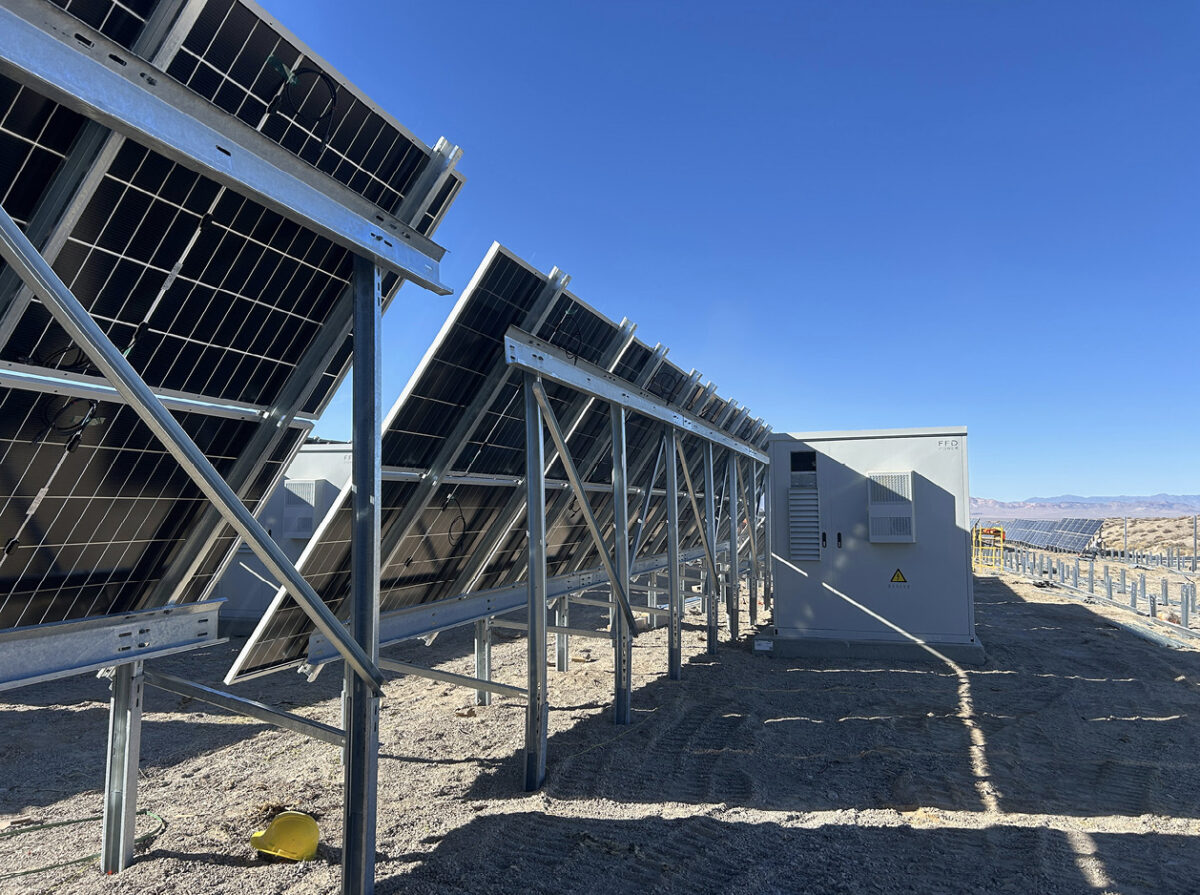





FFD Power has been contracted to build an off-grid solar-plus-storage solution in Tonopah, Nevada. Headquartered in Dongguan, China, the BESS provider specializes in modular, string-based, all-in-one cabinet solutions. The client, TeslaWatt, is a Nevada-based company that operates data center infrastructure for cryptocurrency mining.
FFD Power is deploying a customized system that will comprise a 215 kWh BESS cabinet tied to a 56 kW solar array and five hybrid inverters with 10 kW AC of power and 12 kW of PV input. FFD Power CEO Ang Li told pv magazine that project development for the microgrid began in late 2024.
“We have deployed the first 10 MWh, and we are continually working on it until 2027,” Li said.
FFD Power’s BESS cabinet architecture is designed as a fully independent energy storage unit, containing the battery, battery management system, power conversion system, native energy management system interface, thermal management system and fire detection and suppression, as well as protection, sensing and communication systems.
Mega microgrid: GW Ranch, Texas
Remote challenges
FFD Power’s off-grid solar-plus-storage solution is designed to overcome the challenges related to its remote desert location, such as extreme temperature swings and high levels of dust exposure, to provide continuous power to the data center without requiring a grid connection. It is also backed by parallel battery packs, cabinet-level thermal control and dust-resistant engineering, ensuring the system can sustain operations even if one pack is isolated.
The fully autonomous solar-plus-storage unit is ideal for deploying in the desert, according to Li, charging in the daytime and deploying at night. One year after the first phase was commissioned, things seem to be going well.
“It began to operate from February last year and until now there are no problems,” Li said, explaining that TeslaWatt has purchased 1,000 hectares of land in the same location that the company plans to use for renewable energy deployment.
TeslaWatt said a second generation of its off-grid solar crypto mining system in Tonopah is nearing completion. The project is set to have a solar capacity of 7 MW, which TeslaWatt said is enough to power approximately 80 bitcoin miners, and takes the company’s total off-grid power in Tonopah to nearly 9 MW. The new solar mining system is expected online in spring 2026. TeslaWatt said it expects the renewable miners to benefit from stable power costs as low as $0.029/kWh, which it argues makes solar-hosted mining “one of the few viable ways to sustain profit margins today.”
Risk management
Li said the biggest challenge during the construction phase to date has been maintaining uninterruptible power supply (UPS) while accounting for all potential risks. “As the computers could not be shut down for technical reasons, we deployed 15 battery packs and five hybrid inverters. Each inverter was connected to three battery packs in parallel, and all five inverters were also connected in parallel,” Li said. “As a result, if any battery pack or inverter enters protection mode, the remaining units continue operating, providing sufficient time for on-site maintenance staff to respond.”
FFD Power has now delivered over 2,000 BESS units globally across 30 countries. Li explained that the company’s systems are designed not only for data centers but also for PV arbitrage, frequency containment reserve, intraday trading, and microgrid applications. He added that FFD Power is working on similar projects to the off-grid solar-plus-storage solution it is developing for TeslaWatt, including a site in Chile.
This content is protected by copyright and may not be reused. If you want to cooperate with us and would like to reuse some of our content, please contact: editors@pv-magazine.com.




We should have local, state, and federal consideration of regulations to require hyperscalers to submit an Availability Model showing how their behind-the-meter assets will improve grid stability as an active participant and not just consumer. We recently published a Masters paper at SMU Data Science Review on this topic here.
https://scholar.smu.edu/datasciencereview/vol9/iss3/3/