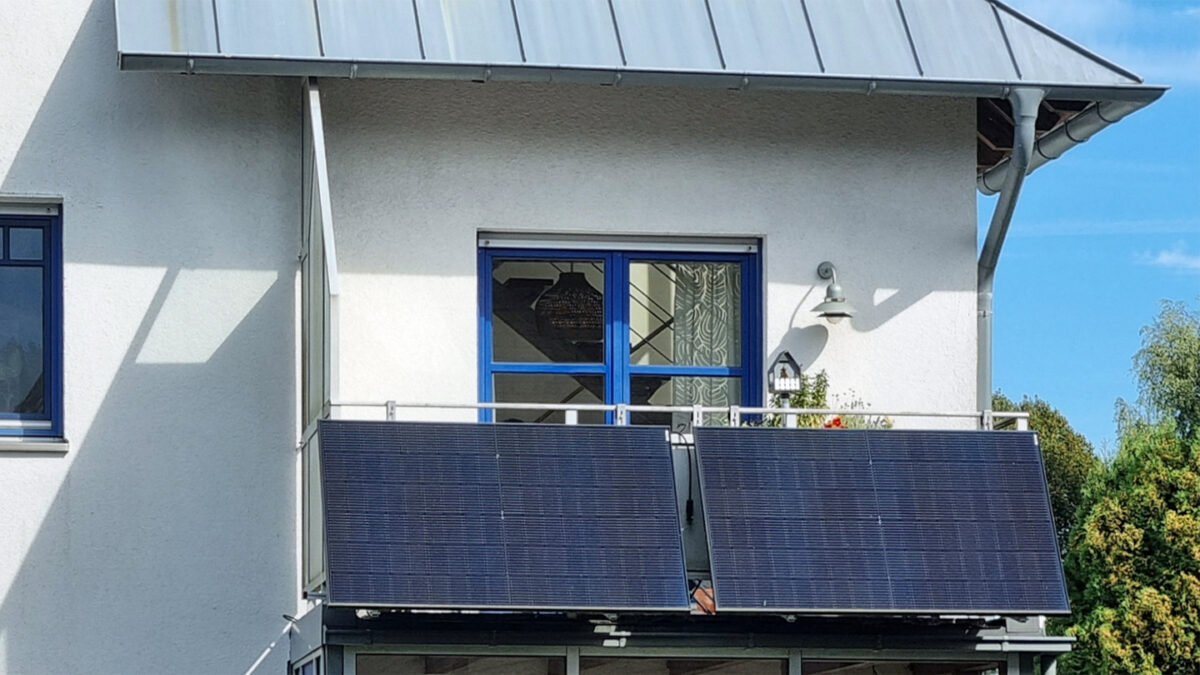





Virginia is poised to become the second state in the nation to establish a dedicated regulatory framework for what state lawmakers have referred to as “small portable solar generation devices” — commonly referred to as “plug-in solar panels” or “balcony solar.”
Just a few days from the end of the 2026 legislative session, the state’s General Assembly has passed two identical bills to establish rules around the use of such devices: House Bill 395 and Senate Bill 250.
The bills, which passed with overwhelming bipartisan support in both chambers, are the first pieces of plug-in solar legislation to pass both houses of a state legislature since Utah’s HB 340 on March 12, 2025.
Efforts are currently underway to pass plug-in solar bills in at least 27 other states as of this writing, something that has been described as a nationwide movement. But bills in Arizona, Georgia, Indiana, Oregon, Washington and Wyoming have failed to move forward this legislative session, and efforts in many other states have been slow-going.
Still, plug-in solar advocates are thrilled about this latest victory. “It’s clear that Virginia’s leadership understands that renters and homeowners alike need relief from rising energy bills now,” said Cora Stryker, co-founder of plug-in solar nonprofit Bright Saver. “Virginia is leading the pack toward a cleaner, more affordable future – but it certainly won’t be the last to reach this milestone.”
Virginia Governor Abigail Spanberger has touted the portable solar legislation as part of her “Affordable Virginia” agenda, which aims to reduce costs for Virginians by ensuring the state’s citizens “are making use of the resources currently available to them to lower their energy bills.”
The governor must act on passed bills within 30 days of session adjournment on March 14 adjournment. If she signs the portable solar legislation as expected, the law will take effect on January 1, 2027.
Key provisions of the Virginia bills
The Virginia bills create a definition that allows a “moveable photovoltaic generation device” that is designed to connect to an electrical outlet on a utility customer’s side of the electric meter, with a maximum of 1,200 watts of power output per dwelling.
In addition, the definition requires such a device to include a device or feature that prevents the device from affecting or exporting power to the electrical system of the building during a power outage, meet the standards of the most recent National Electrical Code (NEC) and be certified by “a nationally recognized testing laboratory” — a term defined by federal law that applies to UL, Intertek, and other such groups.
The bills would exempt devices that meet these standards from utility interconnection requirements, and prevent utilities from charging fees or requiring prior approval before a customer installs or operates a qualified plug-in device. However, the law requires customers to notify the utility before installing a portable solar device, and directs the State Corporation Commission to develop and publish a notification form to include the customer’s name and contact information, electric service provider account number and meter number and information about the device and its third-party certification.
The legislation clarifies that utilities are not liable for any damage or injury caused by the customer-owned and operated devices, and permits utilities to install an automatic, locking disconnect switch at any property with more than one small portable solar generation device.
In recognition that renters are one of the primary audiences for these devices, the bill contains a provision to prohibit landlords and property managers with more than four rental dwelling units from banning the use of these panels by tenants. However, the bill allows for “reasonable restrictions” regarding the size, placement, and aesthetics of the devices. Tenants will be required to notify their landlord and utility provider of their intent to use the devices.
The law also classifies small portable solar generation devices as “goods” under the Virginia Consumer Protection Act, making them subject to rules that prohibit companies from misrepresenting quality or using deceptive advertising practices and providing consumers with clear rights of recourse for defective products.
Looking ahead
One company gearing up to serve Virginia consumers is EcoFlow, which currently sells its STREAM plug & play solar system in Utah.
“We’re encouraged to see Virginia and states across the country embracing plug-in solar,” said Ryan Oliver, head of communications for EcoFlow North America. “There’s a real demand for an affordable solar option to offset rapidly rising energy rates whether you live in a house, apartment or condo. We look forward to expanding availability of EcoFlow plug-in solar solutions as states continue to remove barriers and allow residents to experience energy independence.”
While Virgnia’s passage of these laws represents a huge leap forward for the nascent plug-in solar industry, consumers will have to wait until at least 2027 before they can begin legally harvesting solar power from their balconies, patios and backyards.
Before that time, the bill directs the Secretary of Commerce and Trade to convene a stakeholder group that includes representatives from the government, utility and business sectors alongside environmental advocacy organizations, fire fighters and realtors. Stryker said Bright Saver intends to apply to join the group.
The group is tasked with reviewing the NEC, national safety code and national laboratory certifications “to evaluate and develop recommendations regarding the safety standards and requirements applicable to small portable solar generation devices.
Erika Ginsburg-Klemmt, VP of Operations at plug-in solar company GismoPower, had this to say:
Stakeholder processes can be constructive, but the outcome often depends on which technical perspectives are represented. Plug-in solar discussions frequently rely on assumptions derived from older generator technologies, while modern inverter-based systems operate under very different protection architectures. If the working group includes engineers familiar with inverter standards, anti-islanding protection, and plug-connected generation models, it could help clarify the safety questions that often stall these bills.
Ginsburg-Klemmt also noted that many of the state laws related to plug-in solar (including Virginia’s) focus on these smaller-scale balcony systems, while GismoPower’s work has focused on larger 240-volt systems. The company has pivoted to working with sovereign First Nations partners such as the Oglala Lakota Nation, which has installed the company’s MEGA solar carports on the Pine Ridge reservation.
The stakeholders will likely address issues of fire- and touch-safety raised in a recent UL whitepaper on plug-in photovoltaic (PIPV) systems. The UL whitepaper raises the idea of creating a “PIPV unique configuration plug and receptacle” to address worries that the blades of a standard plug may remain energized for up to two seconds in system designs that adhere to current IEEE 1547 utility export limits.
Crucially, the Virginia bills omit the word “standard” when describing the electrical outlet to which a small portable solar generation device may be allowed to connect. This wording gives the members of the work group something to discuss, but the 1,200-watt size limit will keep that discussion limited to 120-volt architecture.
The secretary must deliver the group’s findings and recommendations to state officials by November 15, 2026.
This content is protected by copyright and may not be reused. If you want to cooperate with us and would like to reuse some of our content, please contact: editors@pv-magazine.com.





All that is needed is a dedicated circuit with a current limiting device such as a circuit breaker or a fuse and a cord cap the retracts the blades into a protective cover when unplugged.