




Though it’s usually prudent to avoid dropping F-bombs when in polite company, they are (occasionally) called for. For U.S. solar buyers, it is one of those times to say the F-word: FEOC, also known as foreign entities of concern.
Recently-issued interim guidance regarding material assistance restrictions from FEOCs and other prohibited foreign entities (PFEs) has left solar developers and manufacturers scrambling to assess the FEOC risks they face and what that could mean for their business. What’s particularly worrisome for many in the solar space is the fact that non-compliance can be applied retroactively, causing a project to lose its investment or production tax credit (ITC and PTC, respectively) years after starting commercial operations.
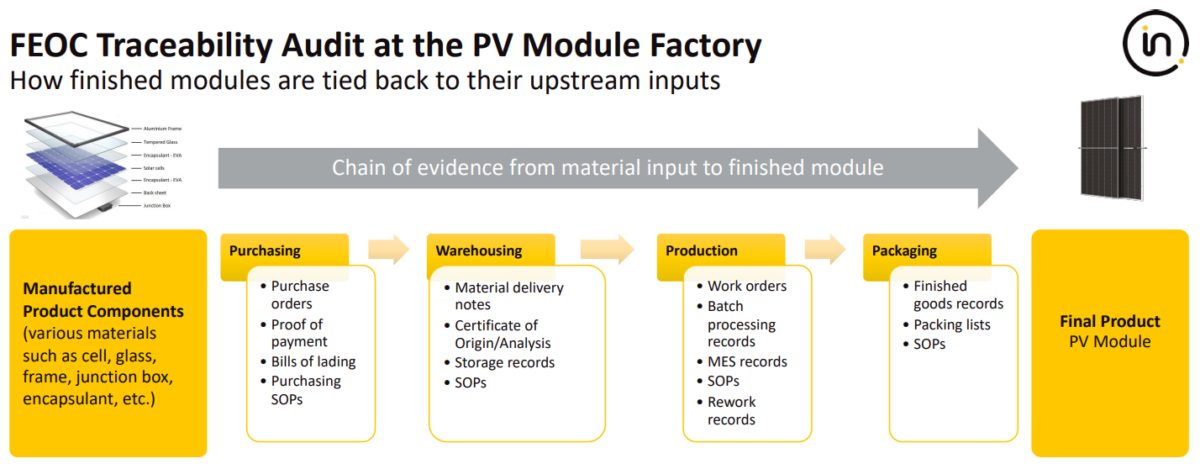
“Practically speaking, Section 3.01(5) of IRS Notice 2026-15 requires developers to look beyond finished equipment and into the components embedded within it,” explained Paula Jara Mediorreal, a solar and storage market intelligence consultant at Intertek CEA. She told pv magazine USA that even when a manufactured product itself is not produced by a prohibited foreign entity (PFE), it’s still critical to determine if any of the underlying components were in order to calculate the material assistance cost ratio (MACR) correctly. MACR regulations don’t prohibit the use of products from PFEs, though it does limit their usage.
“The underlying framework for calculating MACRs is the detailed tracking methodology in Section 3,” Mediorreal said, noting that this “requires identifying manufactured products and their components, tracking direct costs and determining which of those costs are attributable to PFEs.”
Final guidance from the Internal Revenue Service (including safe harbor tables) is set to drop before the end of the year. Still, with IRS Notice 2025‑08 being the current reference, Mediorreal recommends developers focus on the cells within the modules when looking into components.
“The primary challenge in complying with FEOC is gaining clear visibility into ownership structures across the solar supply chain,” she explained, as ownership restrictions for specified foreign entities (SFE) and foreign influenced entities (FIE) can quickly make a project noncompliant. “Developers must rely heavily on supplier documentation that is often commercially sensitive and not always fully accessible to independent reviewers.”
While many companies have restructured ownership since late 2025 to avoid prohibited classifications, Mediorreal explained, and may be willing to provide access to internal data and documentation, this might not always be enough. According to a recent report out of Intertek CEA, “past experience with U.S. Customs shows that self-certifications alone are not a sufficient burden of proof” to guarantee FEOC compliance, with unsupported supplier declarations not always able to clear enforcement reviews.
Many companies may also have complex governance structures and/or be less willing or able to share detailed corporate records around ownership and effective control. Still, it’s worth the time and effort to prepare as much as possible.
“Developers should approach upstream supplier assessment as a structured, risk-based due diligence program,” Mediorreal said, noting that this process should include diligence on ownership structures, entity listings, corporate bylaws and debt holdings, as well as verifiable official records. Even so, from her perspective, “documentation reviews are inherently a desktop exercise” and having third-party verifications and/or targeted chain-of-custody reviews for higher-risk components can go a long way.
“Until clearer regulatory standards or market precedents emerge, developers should approach FEOC compliance as a continuous risk-management process rather than a one-time review,” she added.
This content is protected by copyright and may not be reused. If you want to cooperate with us and would like to reuse some of our content, please contact: editors@pv-magazine.com.


To be clear, if we are using US Cell in the modules which are manufactured by a US company, we would have 38% non-FEOC compliance (according to the latest DOE Safe Harbor Table for Roof-mounted String Inverter). Correct?