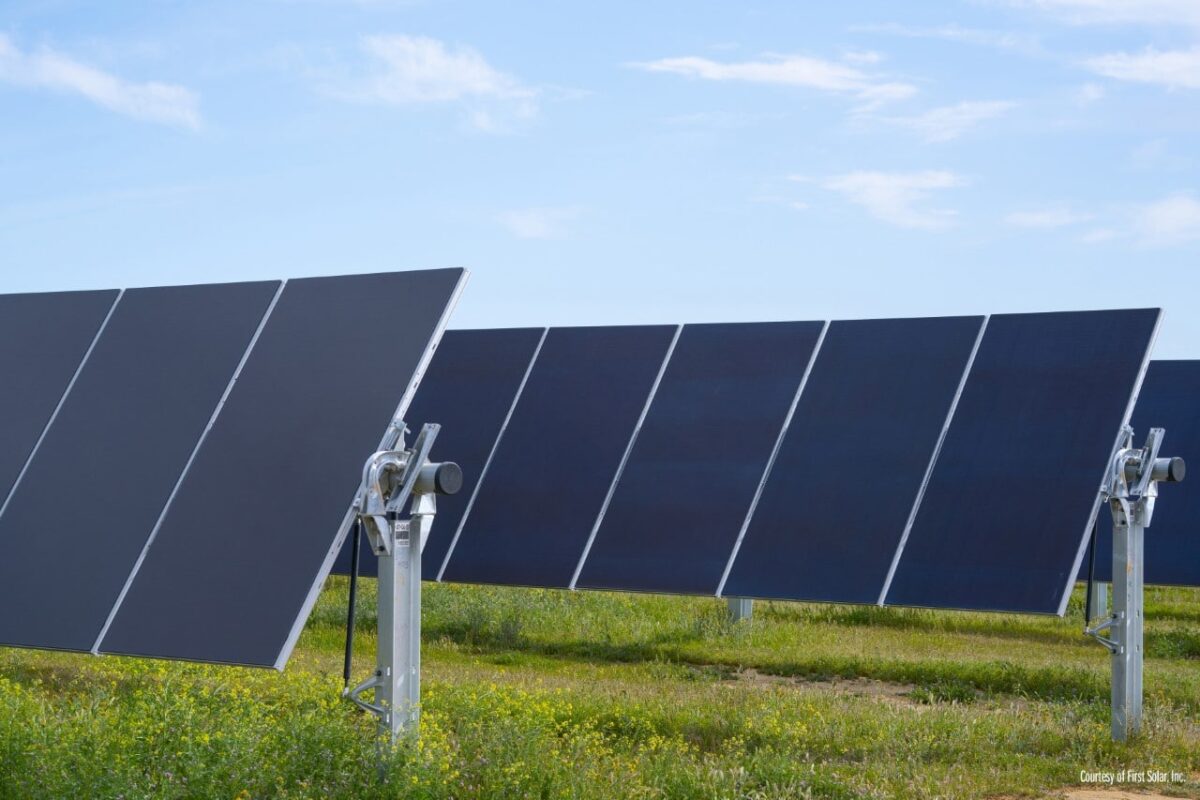





First Solar reported its financial results for the fourth quarter and full year of 2025 on Tuesday, highlighting $5.2 billion in annual net sales and issuing guidance for 2026.
The U.S. solar manufacturer simultaneously announced a patent licensing agreement with Oxford PV to advance its perovskite solar technology development.
Importantly, the 2026 guidance was lower than analysts expected, leading to a drop in the price of First Solar’s NASDAQ-listed shares of more than 12% in extended trading.
On the company’s earnings call, CEO Mark Widmar discussed the reasons for lower guidance, which he explained was partially due to the company’s strategic underutilization of its Southeast Asian factories. Widmar described the company’s strategy as “buying some time to see how these tariffs ultimately get played out.”
Widmar also revealed that First Solar had filed an action with the U.S. International Trade Commission the day of the call, alleging infringement of its TOPCon patents against ten “foreign-headquartered manufacturers.”
Financial results and 2026 guidance
First Solar’s full-year net sales represent an $1 million increase over the $4.2 billion it reported in 2024. The company attributed the growth primarily to a 24% increase in third-party module volume. For the fourth quarter of 2025, net sales reached $1.7 billion — an increase of $0.1 billion from the prior quarter.
The company reported a fourth-quarter net income of $4.84 per diluted share, bringing the full-year net income to $14.21 per diluted share. First Solar ended 2025 with a gross cash balance of $2.9 billion and a net cash balance of $2.4 billion.
The increase in cash from the prior quarter was largely driven by proceeds from the sale of advanced manufacturing production tax credits under Section 45X of the Internal Revenue Code, along with operating cash flows.
Looking ahead to 2026, First Solar anticipates net sales between $4.9 billion and $5.2 billion on a volume of between 17.0 GW and 18.2 GW of modules sold.
The guidance is nearly identical to the company’s 17.5 GW of modules sold in 2025, a fact that Widmar attributed partly to the company’s facility underutilization, and partly to the fact that it is shipping manufacturing equipment to the United States for use in future module production facilities.
In addition company CFO Alex Bradley discussed that First Solar’s gross margins for components would remain historically low due to tariffs and materials costs. Bradley said the company’s transition to its new CuRe (copper replacement) thin film tech, which reduces degradation over time, will result in about 3 percent lower gross margin than its current tech.
The company expects the CuRe tech to roll out slowly to a limited number of facilities in 2026.
Oxford PV perovskite agreement
Alongside its financial results, First Solar announced it entered into a non-exclusive patent licensing agreement with Oxford PV for U.S. markets. The agreement grants First Solar access to Oxford PV’s existing issued patents and pending patent applications for perovskite solar technology.
The license covers the potential manufacturing and distribution of photovoltaic solar devices using perovskite semiconductors for U.S. utility-scale, commercial, industrial and residential markets. The agreement excludes crystalline silicon semiconductors.
First Solar has invested more than $2 billion in thin-film research and development, including perovskite technology. The company currently operates a perovskite development line at its Perrysburg, Ohio, campus.
In prepared remarks during the call, Widmar categorized Oxford PV’s as “the most fundamental portfolio of perovskite-related patents.”
Later in the call, in response to an investor question, he outlined the company’s attempts to bring perovskite technology to commercial readiness, describing First Solar’s current test prototypes as “best in class,” but lamenting the state of currently available products from China, which often exhibit problems of degradation and delamination of the encapsulant.
Widmar said First Solar has already put together a pilot production line to make full-size perovskite modules, and expects the company will eventually be able to produce “commercial-ready” perovskite thin-film modules with efficiency of 20% and bifaciality of 70% and an ultra-low temperature coefficient “in the mid teens” (between one and two tenths of a percent power output loss per degree C).
Patent infringement and trade cases
The First Solar call took place on the same day the the U.S. Department of Commerce announced preliminary CVD (countervailing duties) tariffs of between 80.67% and 125.87% on crystalline silicon solar cells from India, Indonesia and Laos.
Widmar’s prepared remarks included commentary about the CVD duties, noting that other forthcoming anti-dumping (AD) rates likely to come in April will be additive and “support a level playing field against the illegal and unfair trade practices of Chinese-headquartered and other crystalline silicon manufacturers who strategically evade U.S. trade laws.”
Widmar also pointed to the company’s filing of a complaint with the U.S International Trade Commission, alleging infringement on one of First Solar’s TOPCon patents.
The ten companies named in the filing are:
- AXITEC
- Canadian Solar
- JA Solar
- JinkoSolar
- Mundra Solar / Adani Green Energy
- Philadelphia Solar
- Hanwha Q CELLS
- Runergy
- Trina Solar / T1
- VSUN / Toyo
“If our case is successful,” the CEO read, “the ITC may issue a general exclusion order preventing importation of infringing TOPCon products made by foreign entities… in addition, the ITC may issue a cease and desist order, preventing the sale of infringing TOPCon products currently in the United States.”
This content is protected by copyright and may not be reused. If you want to cooperate with us and would like to reuse some of our content, please contact: editors@pv-magazine.com.







By submitting this form you agree to pv magazine using your data for the purposes of publishing your comment.
Your personal data will only be disclosed or otherwise transmitted to third parties for the purposes of spam filtering or if this is necessary for technical maintenance of the website. Any other transfer to third parties will not take place unless this is justified on the basis of applicable data protection regulations or if pv magazine is legally obliged to do so.
You may revoke this consent at any time with effect for the future, in which case your personal data will be deleted immediately. Otherwise, your data will be deleted if pv magazine has processed your request or the purpose of data storage is fulfilled.
Further information on data privacy can be found in our Data Protection Policy.