




Missouri State Senator Cindy O’Laughlin (R-18) introduced Senate Bill 849 (SB 849), which would halt all ongoing and new utility-scale solar construction in the state until environmental rules governing construction, placement, and operation are established.
The bill imposes an immediate moratorium on “new and current” solar projects statewide. It states:
The act provides that there shall be a moratorium on the construction of new and current solar projects in the state beginning the effective date of the act. The Department of Natural Resources shall promulgate rules concerning environmental issues with respect to the construction, placement, and operation of a solar project. The moratorium shall end on December 31, 2027. However, if the Department does not promulgate the rules before such date, the moratorium shall continue until such rules have been promulgated.
On LinkedIn, attorney Marshall Harkins suggested the bill “would invite considerable potential liability to the state, especially for extant projects in process.” Maria Bries, Legal Partner at Fox Swibel Levin & Carroll LLP, said that the Missouri original 1820 constitution was structured with an “underlying repugnance to the retrospective application of laws”.
Underlying the veracity of already approved permits, especially for projects under construction, are that all five U.S. offshore wind turbines whose leases were recently rescinded by President Trump, have all been given permission to at least temporarily restart construction at their respective sites through the rulings of different judges.
pv magazine USA has written to the Senator’s office asking questions on their positions.
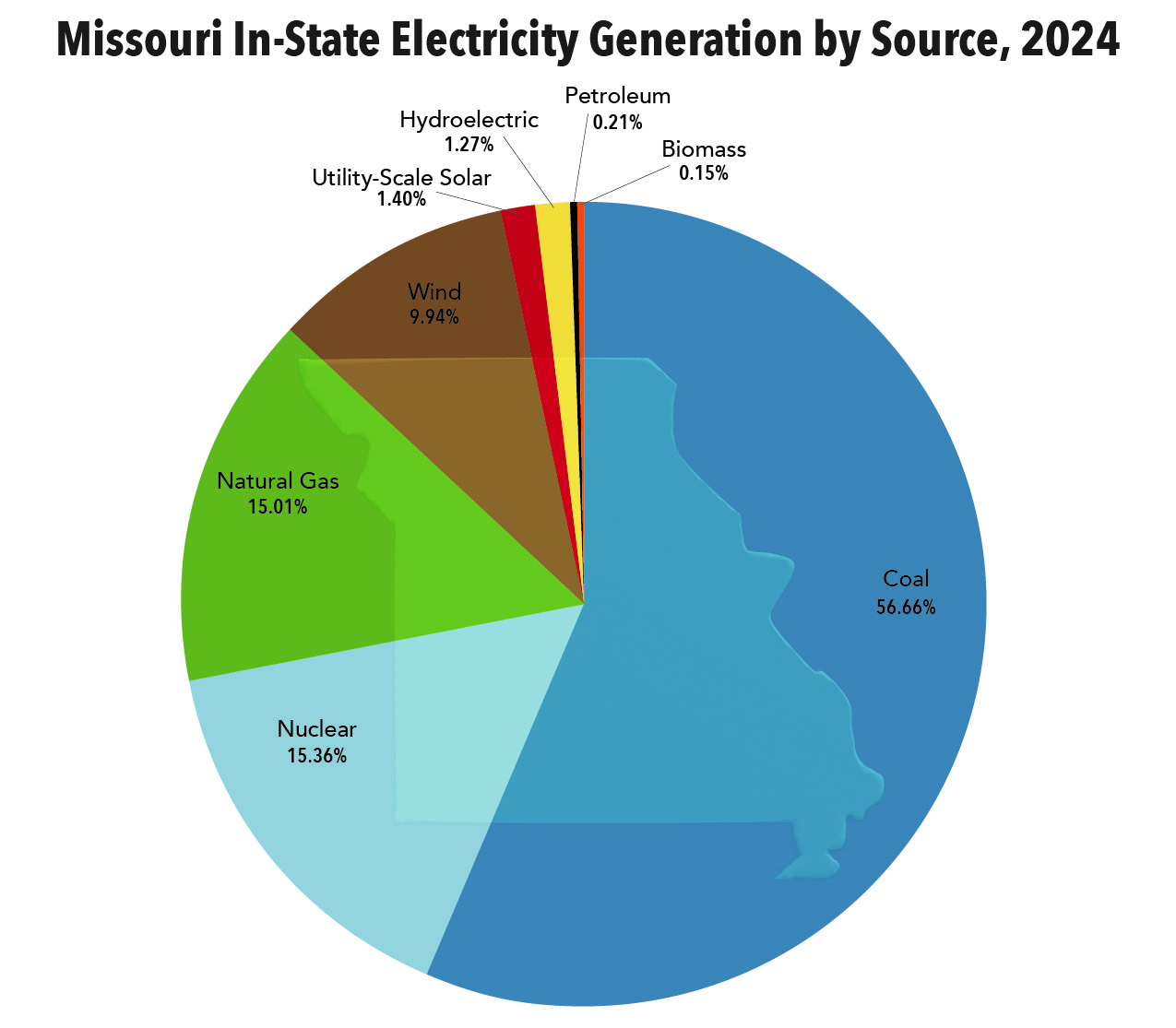
Source: U.S. Energy Information Administration
According to the U.S. Energy Information Administration, Missouri generated just over 56% of its electricity from coal, 15% from nuclear power, 15% from natural gas, about 10% from wind, and approximately 1.4% from utility-scale solar in 2024. The state imports nearly all of its fossil fuel supply due to minimal in-state production of coal, oil, or gas.
EIA data ranks Missouri 39th out of 50 states for the amount of electricity it gets from solar power, setting it just (technically, but not really) beyond solar laggard territory. Construction started recently on a 430 megawatt solar power plant which will roughly double the state’s total deployed capacity.
The state recently enacted a law protecting the solar rights of homeowners. Home Owner Associations are not allowed to make laws that “prevent the installation of the (solar) device, impair the functioning of the device, restrict the use of the device, or adversely affect the cost or efficiency of the device.” The bill does allow associations to adopt ‘reasonable rules’ limiting the placement of solar panels. However, the Missouri Supreme Court has ruled in favor of home owners who wish to install solar panels outside of established HOA guidelines.
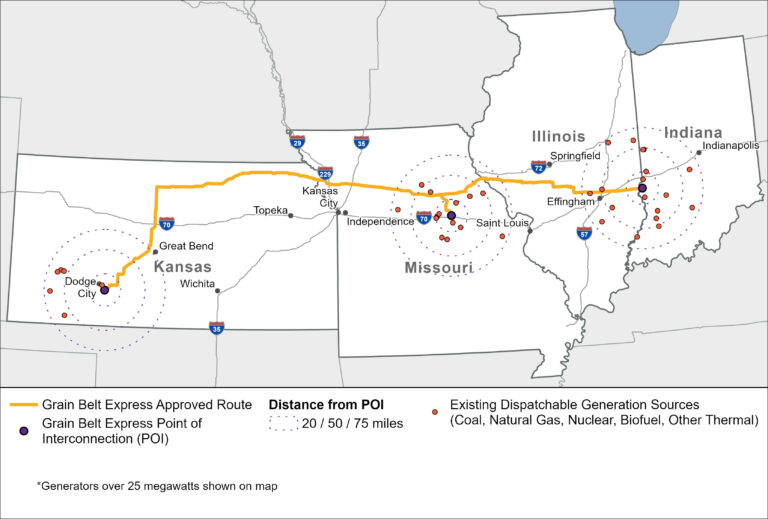
Source – Invenergy
In recent years, the state’s various political leaders have worked hard to block the Grain Belt Expressway. The multi-billion dollar powerline is designed to bring wind power from western Kansas to feed the power grids of Missouri, Illinois, and Indiana. Missouri Attorney General, Andrew Bailey, suggested to the Missouri Public Service Commission to rescind the permit for the Grain Belt Expressway and insisted that Invergy submit documents to support claims of the project’s economic benefits.
In an interview with Politico, Bailey stated:
I think the project needs to be killed. It doesn’t benefit the people of the state of Missouri. It was sold under false pretenses.”
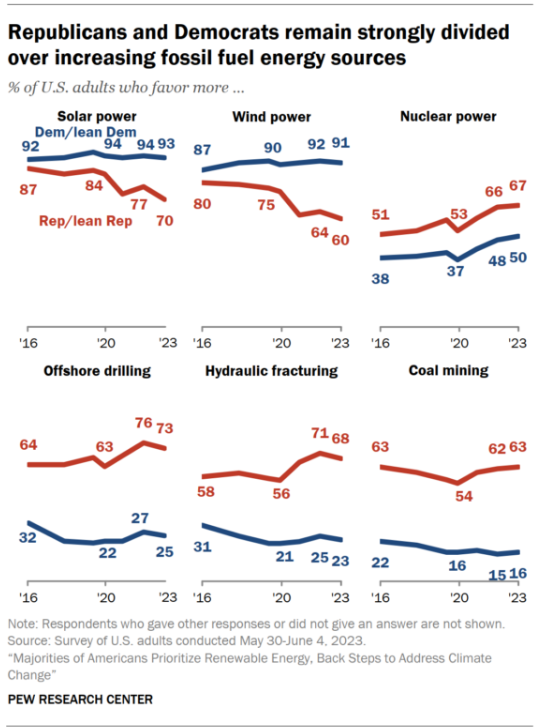
Clearly, the “war on renewables” continues. In all of this – solar power has held onto its title as the nation’s most popular source of energy, even while actively shedding some support.
Nationally, attacks against renewable energy have grown – starting with strategically named, coal funded groups like “Citizens for Responsible Solar” who first started gaining prominence working in Virginia. This group has funded and trained copy-cat locals to create a faux grassroots resistance.
During the Biden years, this ramped-up local opposition began tearing at the edges of solar development. State level law changes, like decommissioning requirements that only apply to wind and solar in Texas, have spread across the nation.
Interestingly, while folks might complain prior to solar being installed – they don’t seem to mind it when it’s well communicated, and once it’s installed.
Now under Trump, Federal attacks on the development process have also increased. Not all hope is lost of course, as even Texas doesn’t want to bite its wind, solar, and storage grid ability gift horse – and nationally as well, with another near 50 gigawatts of capacity deployed expected.
This content is protected by copyright and may not be reused. If you want to cooperate with us and would like to reuse some of our content, please contact: editors@pv-magazine.com.


This if for Grid Tied Solar. Off Grid, residential and commercial solar that does not get fed back to the grid would not be banned by the bill. Great reason for Solar plus storage “off grid” systems that in 2027 could be placed onto the grid as an option. Install the system with full house our property backup and just leave the circuit breaker out of the main panel going back to the meter.
One can only shake ones’s head at the shortsightedness of certain points of view. Every day that wind and solar is not harnessed is money wasted burning fossil fuels the are by nature a limited resource. When they are consumed they are gone forever. As a finite resource they should be used in as constrained a way as possible to extend their use for future generations. Not maximizing the bounty of nature: wind, water and sun is a kind of blindness to long term consequences .
There are inaccuracies in this article. Mike Parson is not the current Governor of Missouri. The utility-scale solar developers are 100% responsible for this mess that they have created. They preferentially select prime farmland, despite numerous federal and state guidelines that prohibit use of prime farmland for solar energy generation. Leasing landowners are forced to sign non-disclosure agreements, which keep the impacted neighbors & community entirely in the dark until construction is about to move forward. County commissioners are bullied into signing agreements without time for meaningful public input. They are repeatedly threatened with litigation, and they are unable to mount a significant defense because the rural community lacks sufficient revenues to pay the associated high legal fees. They are trapped and not able to represent the citizens who elected them. The transmission lines required to pick up and carry this electricity require additional prime farmland, which is seized from landowners under Eminent Domain law. Solar developers could have chosen to work with the community, establish reasonable siting guidelines from non-leasing occupied residences, and they could have supported testing of soil and water to assure the surrounding community that their installations would be safe. They chose to ignore the neighbors, dismiss their concerns as trivial, and treat the whole process as “non-occupied fly-over country”. They made a huge mistake. Rural Missouri is in the fight now, and our rights will not be denied. Governor Kehoe and Senator O’Laughlin have taken courageous action to right a terrible wrong. It didn’t have to go down this way — the developers chose this path. They deserve to fail.
I am very much pro solar but your arguments resonate. Nothing like an arrogant corporation to turn a community against a project. I have mixed feelings about placing large solar installations on productive farmland. We already dedicate vast amounts of farmland, not to mention fertilizer and fuel, to produce a piddling amount of ethanol. Solar panels can produce many times more energy on the same acreage, and it seems like the land could be converted back to farmland at some point in the future. Even so, as someone from a farming background I feel your pain on this one, as well as your larger point about an unfeeling corporation that ignores community concerns. Sounds to me like the company blew a good opportunity.
Respectfully, if a land owner ( ie farmer) can get a better income from their land by harvesting electricity rather than traditional crops, why should the government get in the way of this ? Solar farms do not degrade adjoining farms nor to they permanently degrade the land they are built upon. At best, the arguments against them are cosmetic . Rights of way for transmission lines are still farmable and in fact are a potential source of income in an equitable negotiation process.
It’s interesting to see how dependent Missouri still is on coal, but that new 430 MW solar project sounds like a big step forward. Doubling solar capacity could really shift the balance over time. Energy transitions take time, but progress is progress.
This is good for Missouri and the US to block tax funded solar scams. Most of the panels come from China, the projects are tax dollar funded, they take up good agricultural land and weaken our energy grid while ruining communities.
A legitimate natural gas powered energy plant takes up maybe 20 acres and produces way more reliable power for a longer period of time.
Solar is a scam and wouldn’t exist if it wasn’t for the government using our money to fund it.