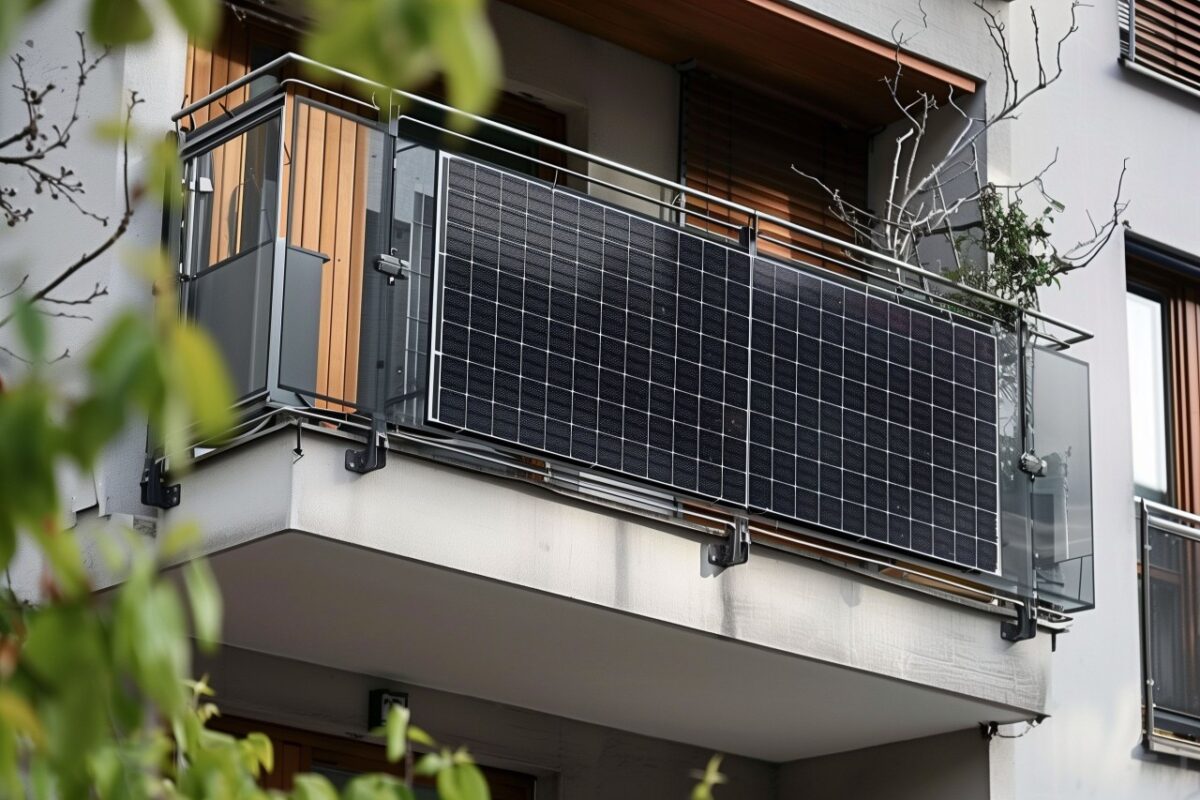





If legislative momentum is any indication, 2026 may become known as the year plug-in solar finally broke through in the United States.
That’s because legislators in at least 24 states have introduced bills to specifically allow small solar installations of up to 1,200 watts to operate in connection with standard outlets in residential homes and multi-unit buildings.
Cora Stryker, the co-founder of plug-in solar nonprofit Bright Saver, calls it “a movement.”
In a press briefing on January 29th, 2026, Stryker joined Environmental Working Group California vice president Bernadette Del Chiaro, California state Senator Scott Wiener and Utah state Representative Raymond Ward to discuss Senate Bill 868, also called the Plug Into the Sun Act.
Stryker stressed that passing the California bill is key to expanding balcony solar nationwide. “The nation is watching what happens in California,” she said, “if we get this across the finish line, the market will change permanently. We’ll have economies of scale. We’ll have manufacturers come into the American market, and it will never be the same.”
Bringing balcony and backyard solar to the U.S.
Similar plug-in solar installations are extremely popular in other countries, especially European countries like Germany, where more than a million such systems are registered. But the idea has been slow to catch on in the U.S., where there are few established rules to allow plug-in solar devices to operate in connection with a home’s wiring.
The exception is Utah, where the state legislature unanimously passed H.B. 340 in 2025. The state now allows plug-in solar installations of up to 1,200 watts output to connect with standard household outlets, as long as the systems are UL-certified and comply with NEC Code.
The Utah law was introduced by Rep. Ward, who offered some advice on how other states could replicate Utah’s success. Ward said the subject of the bill “was not one that my fellow legislators had heard of,” adding that he got “some good support” from other people on the call to help educate the lawmakers.
Another key factor in the Utah bill passing was meeting with representatives of the state’s largest electric utility, Rocky Mountain Power. Ward says the utility reps delineated “what I would need to put in the bill so that they would not oppose it,” and, as evidenced by the bill’s unanimous legislative support, they stayed true to their word.
States considering plug-in solar legislation
The number of states considering plugin solar laws quickly ballooned in late 2025 and early 2026 as new congressional sessions began.
An early mover was Vermont, where the state Senate passed its solar law, S. 202, on January 28th. Bills in other state legislatures have been referred to various committees or are being prepared for introduction.
The table below shows the states where pv magazine USA is tracking proposed plug-in solar laws.
| State | Bill Number(s) | Maximum AC Output |
|---|---|---|
| Alaska | H.B. 257 | 1,200 watts |
| Arizona | H.B. 2843 | 1,200 watts |
| California | S.B. 868 | 1,200 watts |
| Colorado | HB 26-1007 | 1,920 watts |
| Hawaii | H.B. 2435 | 1,200 watts |
| Illinois | H.B. 4371 | 1,200 watts |
| Indiana | S.B. 74 | 1,200 watts |
| Iowa | H.F. 2046 | 1,200 watts |
| Maine | L.D. 1730 | 1,200 watts |
| Maryland | H.B. 0345 | 1,200 watts |
| Missouri | H.B. 2444 | 1,200 watts |
| New Hampshire | S.B. 540 | 1,200 watts |
| New Jersey | S. 2368 | 1,200 watts |
| New Mexico | SB 157 | 1,920 watts |
| New York | S. 8512 | 1,200 watts |
| Oklahoma | HB4060 | 1,200 watts |
| Oregon | HB 4080 (pending) | Not yet specified |
| Pennsylvania | H.B. 1971 | 1,200 watts |
| Rhode Island | H 7269 | 1,200 watts |
| South Carolina | HB 4579 | Not yet specified |
| Vermont | S. 202 | 1,200 watts |
| Virginia | H.B. 395 | 1,200 watts |
| Washington | S.B. 6050 | 1,200 watts |
Carrying the momentum forward
Thousands of bills introduced into state legislatures every year fail to make it out of their first committee. In order for the plug-in solar bills in the above states to become law, they’ll need to pick up support from legislators and avoid the ire of utility companies.
To that end, solar advocates are working to bring awareness and recommendations to lawmakers across the country.
Some have developed policy guidebooks to help state policymakers develop model legislation. UL Solutions has released a white paper detailing how plug-in solar devices can be certified as safe.
And Senator Wiener is counting on help from the EWG and Bright Saver to get California’s law passed as soon as possible.
In the briefing, Wiener said that SB 868 represents “an amazing opportunity to allow people to take control of their energy future and lower their costs,” while Del Chiaro spoke of “urgency and the need to put real energy affordability solutions in the hands of consumers now.”
Stryker pointed out the practical matter of bringing technology to the U.S. market that has been popular in Germany for a decade. She said passage of the California bill would cause plug-in solar equipment manufacturers to “jump in full force, invest in R&D and make this happen quite quickly.”
But even in sunny California, Wiener doesn’t expect passing this bill to be easy.
“We know that the same monopoly players who don’t want to give up an ounce of control are likely to oppose this.” He said. “I hope they don’t, but they may… We’re going to fight for it, because this is about people’s ability to control their own lives and to lower their energy costs. It’s really important.”
This content is protected by copyright and may not be reused. If you want to cooperate with us and would like to reuse some of our content, please contact: editors@pv-magazine.com.



I truly don’t understand any of these statements. When has the Utility Monopoly ever had a dog in-the-fight as long as your generation system is behind the meter on your private property and you are still hooked to the grid with just a few if the wattage users attached and you are putting nothing back into the Grid. They do not have the right to tell you when you can and can’t do without electricity once it’s on your own property they don’t have any say they have no permitting. They have no jurisdiction on your private property. Why would anyone need to care what the utility Monopoly has to say about this they’re not involved.
It is only because the utilities would be used instead of a battery to send the excess power to. Off grid systems, that have their own battery charging charge controller and inverters are already on the market and do not connect to the utility grid. There are times the house load is less than what is produced and that power from the “plug in systems” and it has to be addressed. The idea of plugging in a balcony type system like one would plug in a refrigerator or microwave without needing an electrical permit required a UL approved system that addresses fire safety and worker safety at the same time and that is why it has taken so long for these systems to be approved.
And when an uneducated consumer installs 10 of these in their home, overloads the circuits and burns it down or pushes power back to the grid and electrocutes a lineman, will you all still think this is a great idea?
One of the prerequisite items is anti-islanding so not to put power onto dead utility lines keeping workers safe. The send thing is a “dedicated 15 amp circuit” going directly to circuit breaker or fuze panel would also be needed so other devices do not have two feeds and lose the fuzing protection. Singing up with utilities for their NEM program will need to be addressed since these systems are 120 volt and utilities like 220 volts on NEM systems to balance loads.
This is possibly the cusp of a “good” disruption of a complacent industry that has hidden behind governmental fiat for guaranteed profits year over year for the past century. Plug and play solar could/should have happened 2 decades ago as the technology involved is not particularly new or innovative.
Calling it a “movement” makes sense — lowering barriers is clearly unlocking demand.
But I think the bigger question is what kind of solutions this movement will ultimately favor, especially in dense urban areas.
Plug-in solar is great for accessibility, but it still comes with:
visible installations (often a friction point in apartments)
DIY setup and user responsibility
inverter + grid dependency
and relatively limited system impact
We’ve been working on a different approach in Europe (Romania), specifically for apartments:
Photovoltaic windows that:
generate energy exactly where it’s consumed (mainly hot water)
require no inverter, no batteries, no grid interaction
are fully integrated into the building (invisible from outside)
and are installed once → then basically forgotten
But the key isn’t just simplicity — it’s the stacked benefits:
✔️ direct consumption (no conversion losses)
✔️ ~45–50% hot water coverage (real apartment data, family of 4)
✔️ reduced cooling demand in summer (solar shading)
✔️ elimination of hot water distribution waste (a major hidden inefficiency in cities)
✔️ no permits / no friction with neighbors
So maybe this movement is just the first step.
The real shift might be from “adding solar” → to integrating energy directly into the building itself.
Curious if you see plug-in as the endgame —
or just a transitional phase toward more integrated urban solutions?
Happy to share real-world data if relevant.