





The U.S. Energy Information Administration (EIA), Short-Term Energy Outlook of January 2026 finds that electricity generation in the United States totaled about 4,260 billion kilowatt hours (kWh) in 2025. Additionally, EIA expects U.S. electricity generation will grow by 1.1% in 2026 and by 2.6% in 2027, reaching an annual total of 4,423 billion kWh in 2027.
While natural gas, coal and nuclear accounted for 75% of total generation in 2025, EIA expects the share of generation from these dispatchable sources to fall to about 72% in 2027, as solar and wind generation rise. The Outlook forecasts that the combined share of generation from solar and wind power to rise from about 18% in 2025 to about 21% in 2027.
Utility-scale solar is the fastest growing source of electricity generation in the U.S, according to the forecast, increasing from 290 billion kWh in 2025 to 424 billion kWh by 2027. This exceeds the forecast in last year’s Outlook that anticipated solar generation to grow 75% from 2023 to 2025 to reach 286 billion kWh in 2025.
The Outlook forecasts that nearly 70 GW of new solar generating capacity projects are scheduled to come online in 2026 and 2027, which will amount to a 49% increase in U.S. solar operating capacity compared with the end of 2025.
Texas is the state that will see much of the utility-scale solar generation capacity additions. Managed by the Electric Reliability Council of Texas (ERCOT), EIA expects it will grow from 56 billion kWh in 2025 to 106 billion kWh by 2027.
Utility-scale solar generation is also expected to rise in the Midwest by the Midcontinent Independent System Operator (MISO) region, expected to grow from 31 billion kWh in 2025 to 46 billion kWh in 2027.
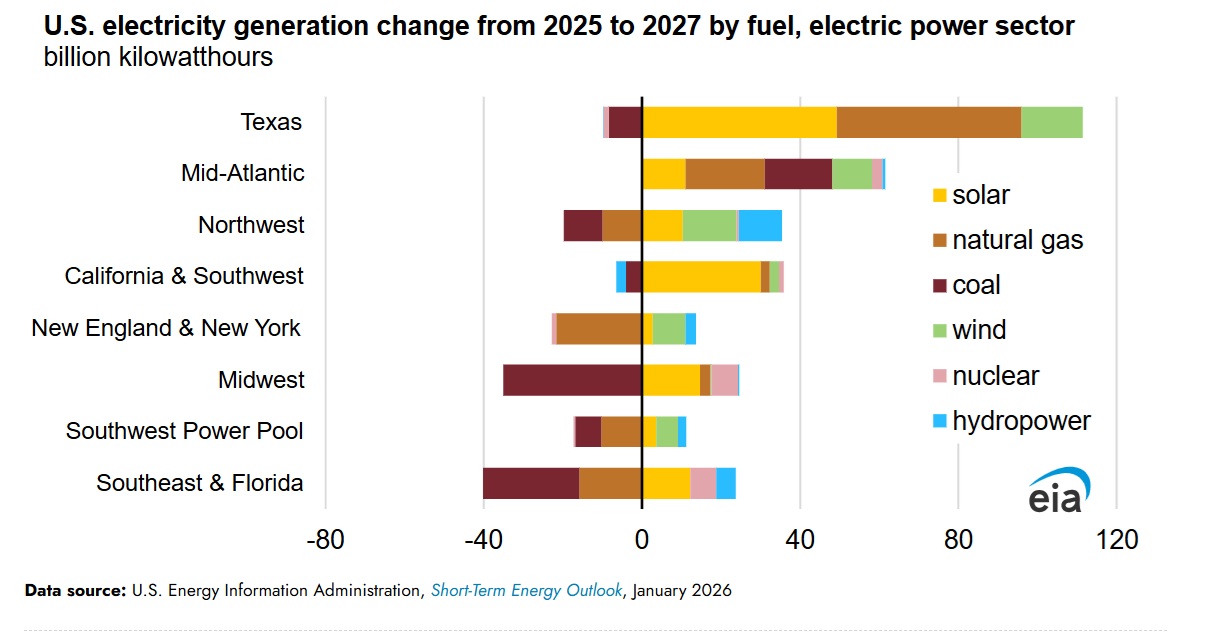
Coupled with increased utility-scale solar will be expanded battery capacity to support the intermittency of solar. In ERCOT territory, for example, EIA finds that increasing amounts of battery storage capacity will expand from about 15 GW in 2025 to 37 GW by the end of 2027.
The Outlook expects generation from natural gas and coal to increase in the near term and then forecasts that their share of total U.S. generation will fall. U.S. natural gas-fired generation totals 1,696 billion kWh in 2026, according to the Outlook. This is about the same as in 2025, but it is expected to increase to 1,711 billion kWh in 2027 as overall power demand increases due mostly to data center demand.
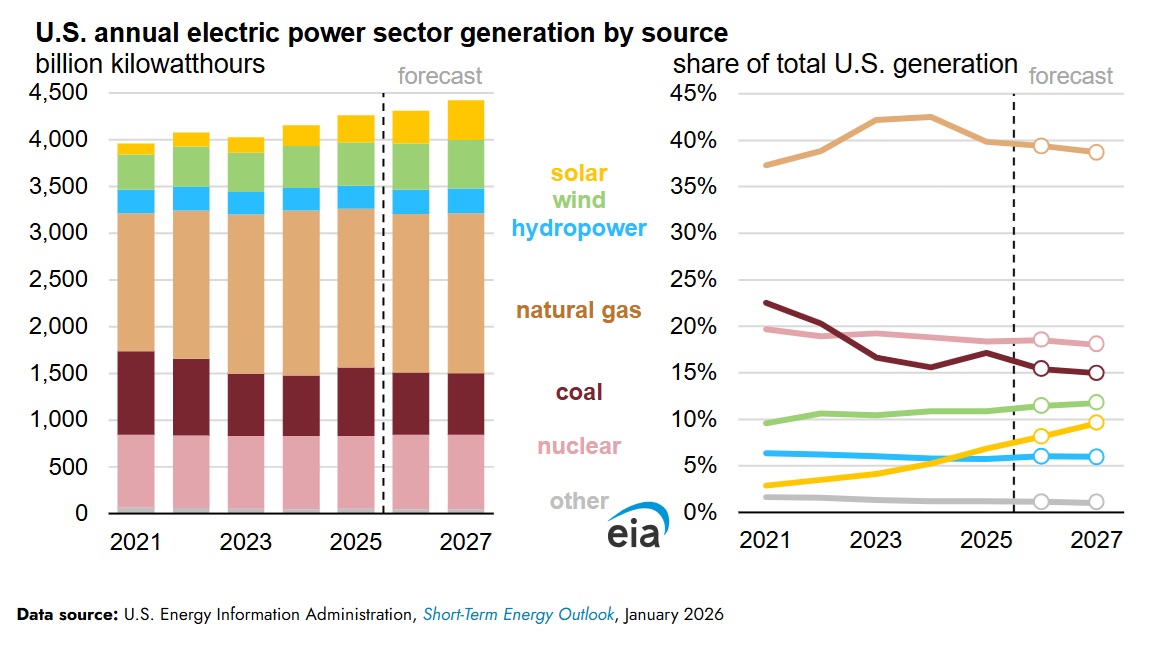
While natural gas is currently the largest source of electricity, EIA finds that its contribution to total generation has been declining from a peak share of 42% in 2024 and its share is expected to fall to 39% in 2027 compared to 40% in 2025.
Due to cold temperatures in 2025 and high prices of natural gas, electricity generation fueled by coal increased by 13% in 2025 to 731 billion kWh. However, that growth will be short lived as the Outlook expects coal-fired generation to drop 5% annually over the next two years, producing 661 billion kWh in 2027. The EIA Outlook indicates that scheduled retirements of coal plants is what will lead to the decrease in coal-fired generation.
This content is protected by copyright and may not be reused. If you want to cooperate with us and would like to reuse some of our content, please contact: editors@pv-magazine.com.




By submitting this form you agree to pv magazine using your data for the purposes of publishing your comment.
Your personal data will only be disclosed or otherwise transmitted to third parties for the purposes of spam filtering or if this is necessary for technical maintenance of the website. Any other transfer to third parties will not take place unless this is justified on the basis of applicable data protection regulations or if pv magazine is legally obliged to do so.
You may revoke this consent at any time with effect for the future, in which case your personal data will be deleted immediately. Otherwise, your data will be deleted if pv magazine has processed your request or the purpose of data storage is fulfilled.
Further information on data privacy can be found in our Data Protection Policy.