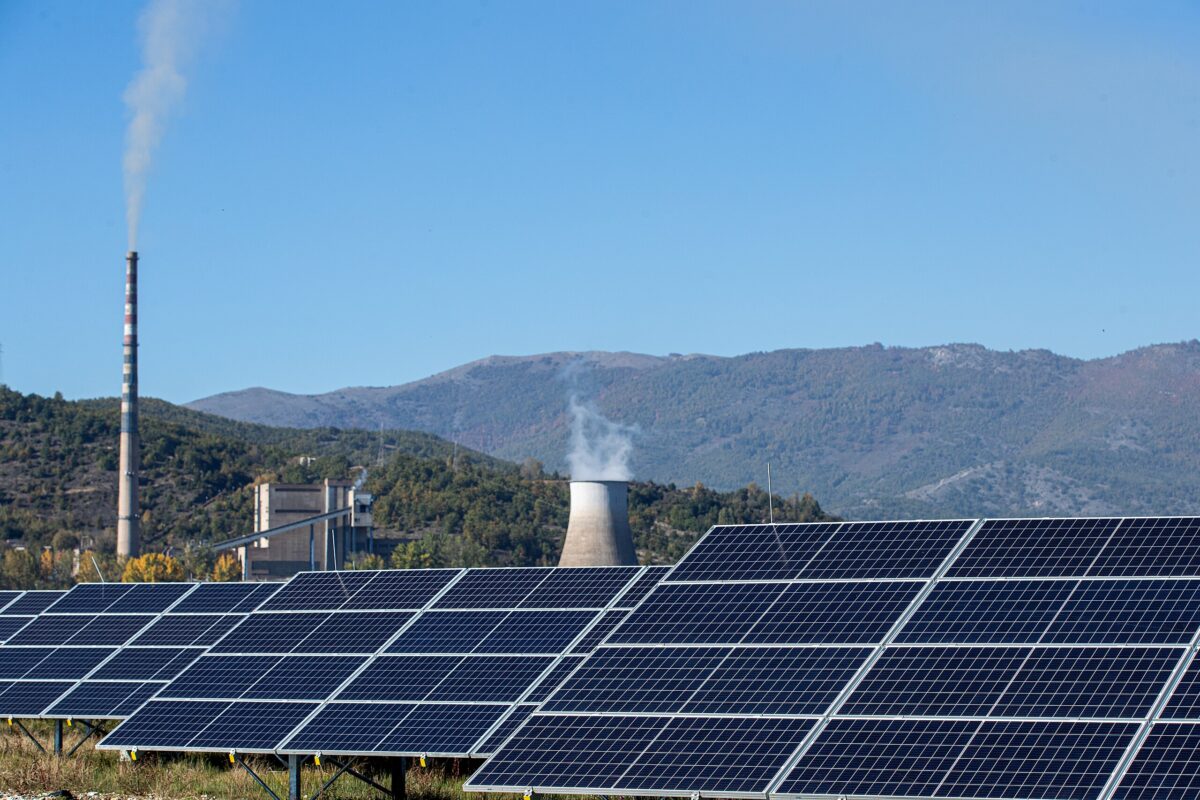





Global greenhouse gas emissions increased 9% between 2015 and 2024, driven by rising energy demand from data centers and industrialization, found a report by McKinsey & Company.
The analysis of nine key decarbonization technologies across the U.S., Europe, and China finds that less than 15% of the low-emissions capacity required for 2050 targets has been deployed to date.
In the United States, solar and battery energy storage systems are the leading technologies for new generating capacity. U.S. solar deployment has accelerated due to low technology costs, though the sector faces headwinds from rising interest rates which have increased financing costs by 10% to 20% since 2020. Despite these costs, solar is expected to remain the largest source of new generating capacity added to the U.S. grid over the next two years, said the report.
U.S. energy storage has seen a significant increase in installations, with deployments exceeding full-year 2024 levels within the first nine months of 2025. Utility-scale projects have led this growth as developers utilize storage to firm intermittent renewable generation and provide ancillary services.
McKinsey noted that battery energy storage system (BESS) projects are materially faster to site and interconnect than other grid-scale technologies like nuclear or gas with carbon capture.
“BESS remains the dominant question mark as the current pipeline is not sufficient to meet targets,” said Diego Hernandez Diaz, McKinsey Partner and co-author of the report. “But because BESS can be sited, permitted, constructed, and interconnected far faster than technologies like nuclear or gas with CCUS, it has accelerated sharply in the past five years. Our analysis suggests that the business case is proven for both large operators and households pairing it with rooftop solar.”
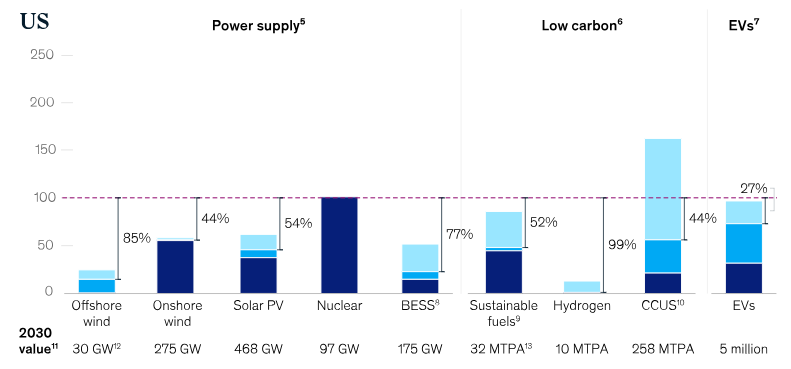
As an intermediate step towards a net-zero economy, the U.S. targets 773 GW of solar and 175 GW of battery energy storage by 2030.
To reach 2030 targets, the United States must overcome a 154 GW gap in battery storage and a roughly 150 GW shortfall in solar capacity, said the report. The gap is based on the disparity between current project pipelines, including those operational, under construction, or having reached a final investment decision, and the deployment levels required for a net-zero trajectory by 2050.
McKinsey also highlighted a shift in the U.S. policy landscape following the January 2025 withdrawal from the Paris Agreement. Federal priorities have increasingly shifted toward energy security and affordability. This trend is mirrored globally as defense budgets rise, potentially reducing the public resources available for large-scale decarbonization projects.
Regional data shows China leading in total volume, having already met its 2030 target of 1.2 TW of combined wind and solar capacity. McKinsey estimates China will need 3.4 TW by 2030 to remain on its net-zero pathway. In contrast, offshore wind is lagging across all regions. Higher capital costs and inflation led to the cancellation of multiple tenders in Europe and a lack of bids for Danish projects. The U.S. offshore wind sector currently lacks the project volume needed to play a meaningful role in the 2030 energy mix.
McKinsey concluded that while solar and storage pipelines are expanding, the number of projects reaching the final investment decision stage is insufficient. With less than five years remaining until the 2030 milestone, the report says the transition is moving at roughly half the pace required to meet Paris-aligned goals.
This content is protected by copyright and may not be reused. If you want to cooperate with us and would like to reuse some of our content, please contact: editors@pv-magazine.com.







By submitting this form you agree to pv magazine using your data for the purposes of publishing your comment.
Your personal data will only be disclosed or otherwise transmitted to third parties for the purposes of spam filtering or if this is necessary for technical maintenance of the website. Any other transfer to third parties will not take place unless this is justified on the basis of applicable data protection regulations or if pv magazine is legally obliged to do so.
You may revoke this consent at any time with effect for the future, in which case your personal data will be deleted immediately. Otherwise, your data will be deleted if pv magazine has processed your request or the purpose of data storage is fulfilled.
Further information on data privacy can be found in our Data Protection Policy.