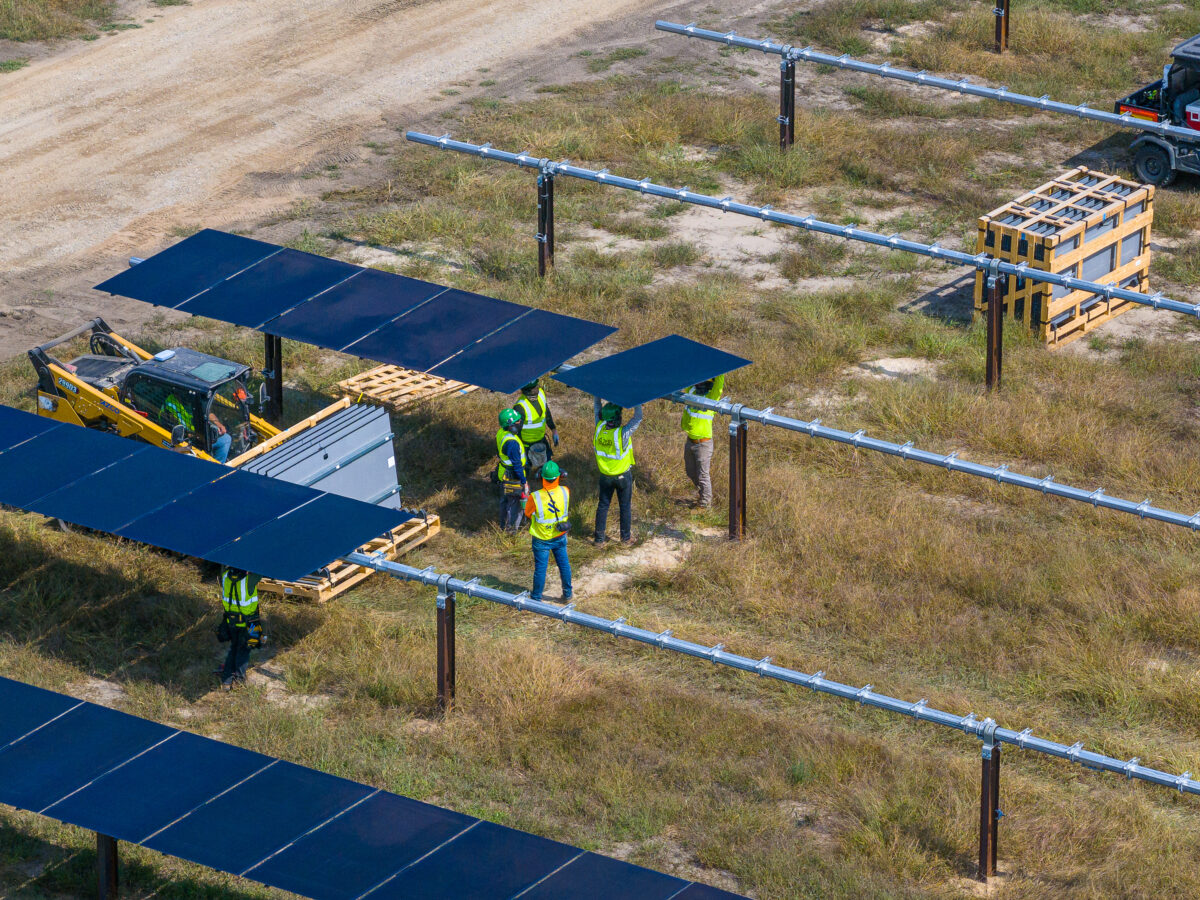





Consumers Energy has energized the Muskegon Solar Energy Center, a move that underscores the industry’s shift toward developing large-scale utility assets on unconventional landscapes.
Located in Moorland Township, Michigan, the 250 MW facility now stands as the largest solar installation in the utility’s fleet, marking a significant milestone in the state’s transition toward a coal-free capacity mix by 2025.
The project was led by owner-operator Consumers Energy and engineering, procurement and construction firm Burns & McDonnell. To execute the build, Burns & McDonnell utilized its union self-perform arm AZCO to manage the onsite construction alongside local Michigan labor.
First Solar supplied over 550,000 Series 7 bifacial modules and Array Technologies provided the horizontal single-axis tracking systems. Essential electrical balance-of-system (EBOS) components were provided by Shoals Technologies Group and CAB Solar, while Siemens Gamesa supplied the high-capacity inverters required to convert the site’s DC generation for the grid.
The project serves as a case study in land-use efficiency by “stacking” utility functions. Sited on 1,900 acres of the Muskegon County Resource Recovery Center, a functional wastewater treatment footprint, the array proves that solar can thrive alongside critical municipal infrastructure.
Rather than competing with prime agricultural land, the project utilizes the treatment center’s existing buffer zones and irrigation fields, providing a stable revenue stream for the county, Moorland Township, and the Ravenna School District.
To move power to the grid, the Burns & McDonnell team constructed a dedicated open-air 34.5/138-kV collector substation. The facility features a single main power transformer (MPT) stepping up generation to a 138-kV dead-tank circuit breaker and a single takeoff structure. A 20-by-40-foot control enclosure houses the site’s relaying, protection, and control systems.
The final link to the MISO grid is a new, half-mile single-circuit 138-kV transmission line connecting the collector substation to the remote interconnection switchyard. Built with local union labor through AZCO, the project provided over 200 jobs during construction.
The project is expected to generate enough electricity to power the equivalent of 40,000 Michigan homes.
This content is protected by copyright and may not be reused. If you want to cooperate with us and would like to reuse some of our content, please contact: editors@pv-magazine.com.


By submitting this form you agree to pv magazine using your data for the purposes of publishing your comment.
Your personal data will only be disclosed or otherwise transmitted to third parties for the purposes of spam filtering or if this is necessary for technical maintenance of the website. Any other transfer to third parties will not take place unless this is justified on the basis of applicable data protection regulations or if pv magazine is legally obliged to do so.
You may revoke this consent at any time with effect for the future, in which case your personal data will be deleted immediately. Otherwise, your data will be deleted if pv magazine has processed your request or the purpose of data storage is fulfilled.
Further information on data privacy can be found in our Data Protection Policy.