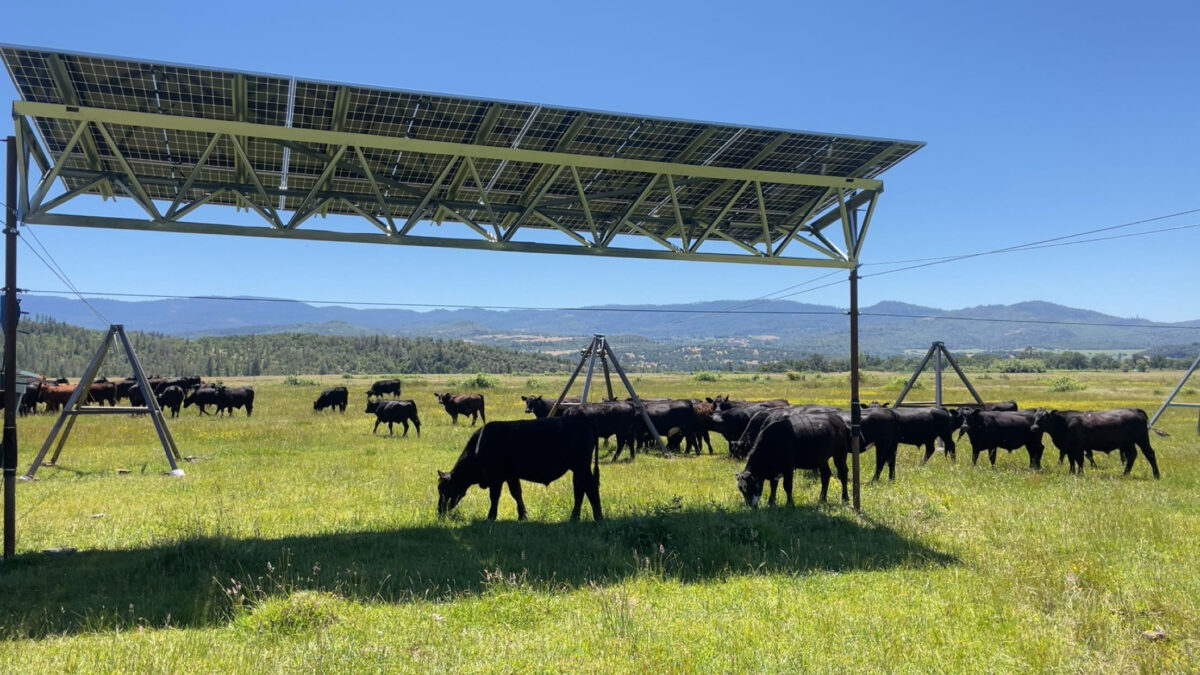





Oregon-based RUTE SunTracker has commissioned its first commercial solar photovoltaic project designed for cattle ranchland. The 120 kW, one-acre solar array is deployed on an Angus ranch in Jackson County Oregon and is interconnected with the Pacific Power grid. The project is another example of how agrivoltaics is benefiting farmers and the solar sector alike.
Agrivoltaics, the practice of integrating PV arrays with pollination, farming and grazing land is becoming a popular method of opening up suitable sites for solar power. The hosts for most of these projects are on land given over to pollinators or sheep, which tend to be placid grazers. Having cattle in and among the arrays is more of a challenge.
RUTE SunTracker’s system mounts PV panels on a cable trellis, poles and trusses that elevate them with a clearance of 13 feet. The piping used in the pole supports is surplus from fracking operations and the footings are made from recycled wind blades. The company provides the support structure, incorporating company-sourced tracking components.
RUTE President Doug Krause told pv magazine USA that support structure is high and secure enough to allow cattle to graze unhindered and hold up to their weight when rubbing up against the poles. Moreover, the height of the PV panels also produces a shading effect on the ground that benefits both the animals and the grass they feed on. He points out that the United States has 120 million acres of cattle pasture, with much of it under increasing heat and water stress.
“Cooler ground produces more and better grass varieties and water retention, so more beef per acre, Krause said. “That cooler ground and 13-ft elevation in turn cools the panels, so more electricity.”
Of course, elevation comes at the cost of greater wind loads on the supports. RUTE worked with scientists at the National Laboratory of the Rockies (formerly NREL) to perform computational fluid dynamics analyses on its designs to evaluate wind resistance under a variety of conditions.
One result of this analysis is that the company’s early vertical mount systems are now in a single-axis S-facing configuration. The trackers incorporate automatic hail and wind stowage modes.
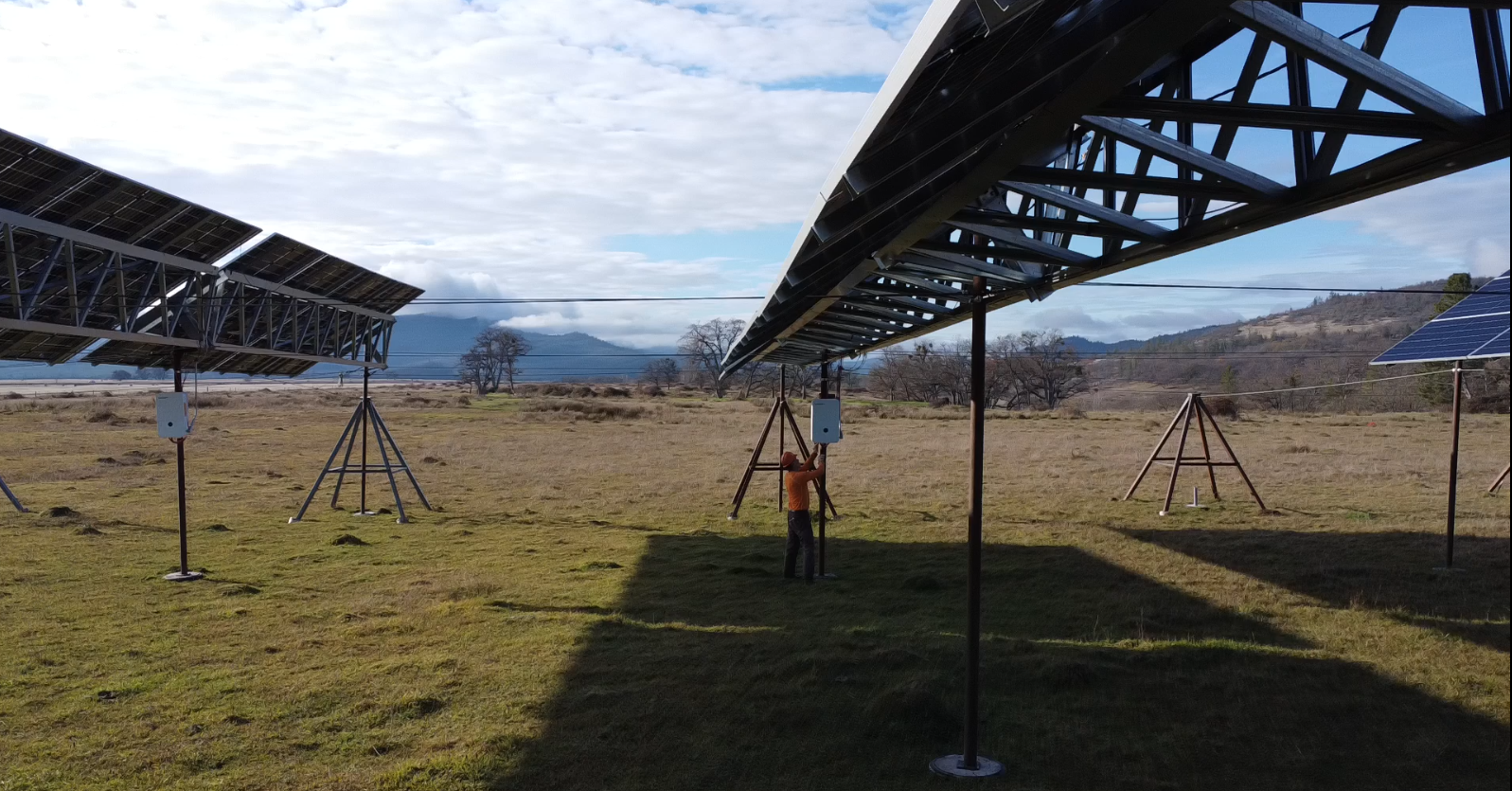
RUTE SunTracker is a division of RUTE Foundation Systems, which provides anchoring support for wind turbine towers. The company says it pioneered the use of modular, pre-cast box-girder foundations to reduce the amount of cement used in traditional poured-in concrete foundations. It installed its first foundation using the technology for a wind farm in 2018. RUTE SunTracker came to its first commercial deployment after a number of pilot projects. Going forward, Krause said the company intends to produce its SunTracker systems commercially in standard blocks of 1.3 MW (DC), which covers six acres. So, if a project requires 130 MW, the EPC would assemble 100 field kits.
“We have a couple years to go to get to utility scale,” Krause said, given the company’s existing development program. “For the next year we’ll be doing 1-acre projects of 120 to 150 kW on ranches around the U.S. to get the product out in front of the ranch and IPP [independent power producer] community.”
While Krause describes Pacific Power as being very accommodating on the aggregated net-metering and interconnection for his Oregon ranch project, the company has had a harder time with other sites getting commercial demonstrations up and running. Interconnection queues and the looming deadline imposed by the One Big Beautiful Bill Act on solar projects are complicating matters.
“That’s why we are looking to build regional projects behind the meter to power ranch irrigation, like pivot pump energy,” he said. “That will allow us to get started on several projects before next July’s deadline, and get the technology in many ranching regions so the IPPs can see the systems in action. We have a development affiliate LLC to develop and operate these demonstration projects.”
This content is protected by copyright and may not be reused. If you want to cooperate with us and would like to reuse some of our content, please contact: editors@pv-magazine.com.


By submitting this form you agree to pv magazine using your data for the purposes of publishing your comment.
Your personal data will only be disclosed or otherwise transmitted to third parties for the purposes of spam filtering or if this is necessary for technical maintenance of the website. Any other transfer to third parties will not take place unless this is justified on the basis of applicable data protection regulations or if pv magazine is legally obliged to do so.
You may revoke this consent at any time with effect for the future, in which case your personal data will be deleted immediately. Otherwise, your data will be deleted if pv magazine has processed your request or the purpose of data storage is fulfilled.
Further information on data privacy can be found in our Data Protection Policy.