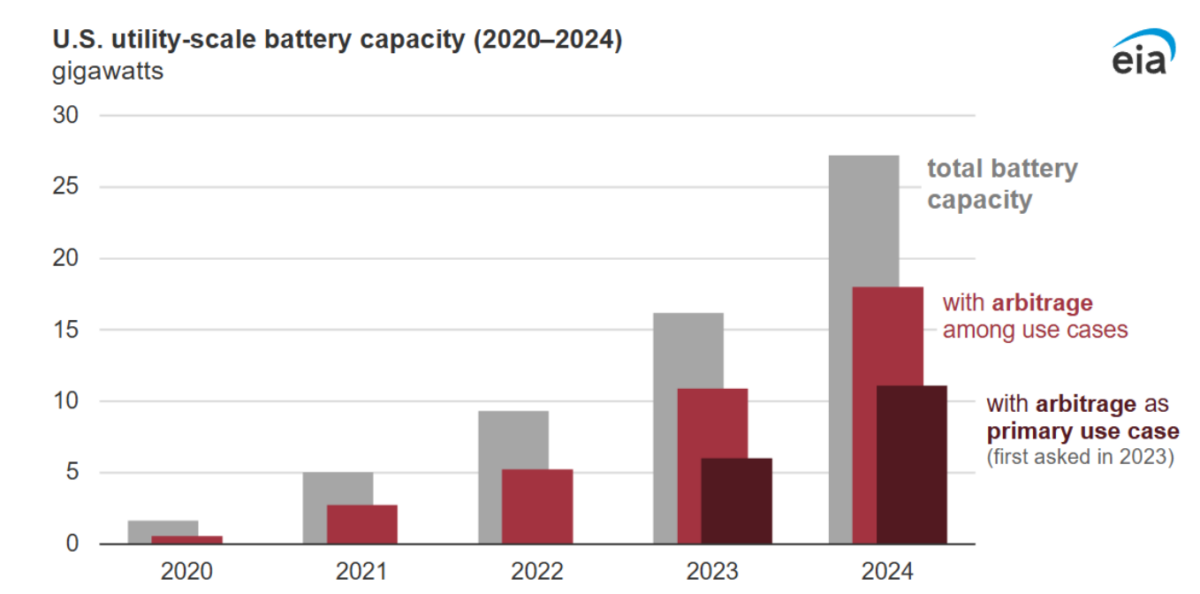





The latest data from the U.S. Energy Information Administration (EIA) confirms that arbitrage – the practice of buying electricity when prices are low and selling it when prices are high – remains the dominant use case for utility-scale battery energy storage systems in the US.
In 2024, operators reported that 66% of all utility-scale battery capacity included arbitrage among its applications, while 41% of total capacity was used primarily for arbitrage. The next most common application was frequency regulation, which was the primary use for 24% of battery capacity. Frequency regulation plays a critical role in maintaining the grid’s stability by keeping it operating at a steady 60 cycles per second.
To read the full story, please visit our ESS News website.
This content is protected by copyright and may not be reused. If you want to cooperate with us and would like to reuse some of our content, please contact: editors@pv-magazine.com.




Do you have equivalent data for residential solar? Industrial & Commercial?