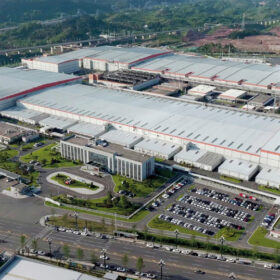
First Solar reaffirms 2026 guidance as CuRe launch and record India sales drive Q1 margin expansion
Thin-film manufacturer First Solar delivered a robust start to 2026, posting record first-quarter revenue of $1.04 billion and maintaining its full-year outlook despite signaling a seasonal dip in second-quarter profitability.
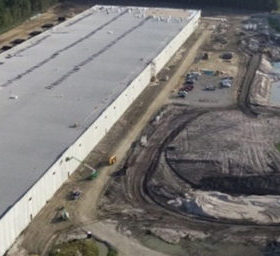
Boviet Solar sells U.S. PV module factory to Indian manufacturer Inox Solar
The divestment, already partially secured via escrow, reflects regulatory pressure from U.S. FEOC policy changes. Boviet Solar also continues negotiations to sell a separate U.S. cell project.
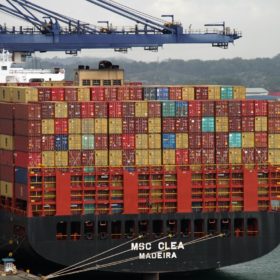
Commerce sets preliminary anti-dumping duties on solar imports from India, Indonesia, and Laos
The U.S. Department of Commerce has issued preliminary anti-dumping determinations for three key solar-exporting nations, establishing duties of up to 123% on crystalline silicon photovoltaic cells and modules.
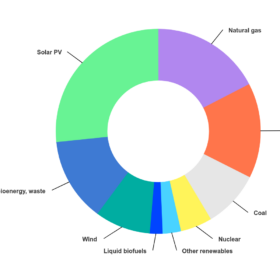
Solar PV led world energy demand growth in 2025, but the U.S. turned to fossil fuels, says IEA report
The International Energy Agency’s latest Global Energy Review shows solar PV accounted for 27% of all energy demand growth, while demand grew 62% faster in the U.S. than the world total, largely driven by a 10% increase in coal use, as the world enters what the report’s authors call the “Age of Electricity.”

Solar developers face high-stakes tax credit risks as FEOC rules tighten
New restrictions under the One Big, Beautiful Bill Act are reshaping project bankability, with developers facing a steep learning curve on effective control and material assistance limits.

U.S.-Israeli conflict with Iran tests solar supply
The U.S.-Israeli conflict with Iran is unlikely to materially affect solar manufacturing projects in the Middle East for now, as most of these investments remain at an early stage. OPIS analyst Brian Ng sees the most immediate risk in logistics. If disruptions persist, shipments of solar products into the region could be delayed and export pricing may turn volatile.

Maxeon filing reveals the company has applied for restructuring in Singapore court
Company statements in the filing indicate it will seek an arrangement between itself and creditors that may allow it to survive “as a going concern.”

U.S. ITC opens Section 337 probe into global TOPCon supply chain
The U.S. International Trade Commission (ITC) has opened a Section 337 investigation into tunnel oxide passivated contact (TOPCon) solar cells, modules, panels, and related products following a complaint by First Solar, naming 47 entities across 11 countries as respondents.
U.S. determines China not undercutting domestic battery anode makers
The U.S. International Trade Commission (ITC) has blocked the imposition of anti-dumping and countervailing duties on Chinese active anode material (AAM), providing a massive sigh of relief for the domestic battery storage sector.
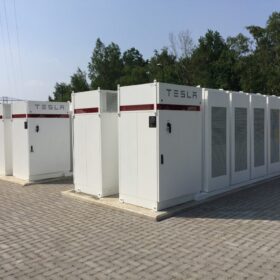
U.S. government confirms Tesla as mystery buyer in $4.3 billion LG Energy Solution LFP deal
The Department of the Interior has ended months of speculation, identifying Tesla as the counterparty for a massive domestic lithium iron phosphate battery contract aimed at scaling U.S. energy storage production.