




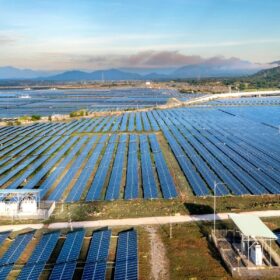
Hail awareness is now a front-and-center concern for the utility-scale solar industry, with insurers, engineering firms and owner-operators all confronting hail-related damage, energy production shortfalls and financial liability. Industry reports show that hail is now the number one cause of financial loss for PV projects and this has only increased in recent years.
The problem was a long time coming. Martin Pochtaruk, CEO of Canada-based PV module maker Heliene Inc., told pv magazine USA that hail appeared on his radar over ten years ago when he received a report from a customer that production from a PV array was down to 30% of what it should have been. Production had been steady day after day until a sudden drop occurred in the wake of a big wind storm.
“We investigated as part of the insurance claim what had happened to our modules,” Pochtaruk said. “Electroluminescence scans of the modules showed cracks in the cells. We keep image records of modules when we ship them, so we could show that they were damaged by a hail event.”
One of the problems with hail, Pochtaruk continued, is that tracker stow modes in the face of a high-wind event is to lock in a position where the module surface is facing skyward essentially perpendicular to the ground. This is great if you don’t want the tracker assembly to act like a sail. It’s exactly the wrong thing to protect against wind-driven ice balls falling from the sky.
Engineering consulting companies, such as VDE Americas, work with plant operators, tracker manufacturers and weather experts to improve storm modeling and develop stow modes that dynamically reduce the effects of high winds and damaging hail, as required. However, Pochtaruk said module manufacturers also have a role to play in making their products more hail resistant.
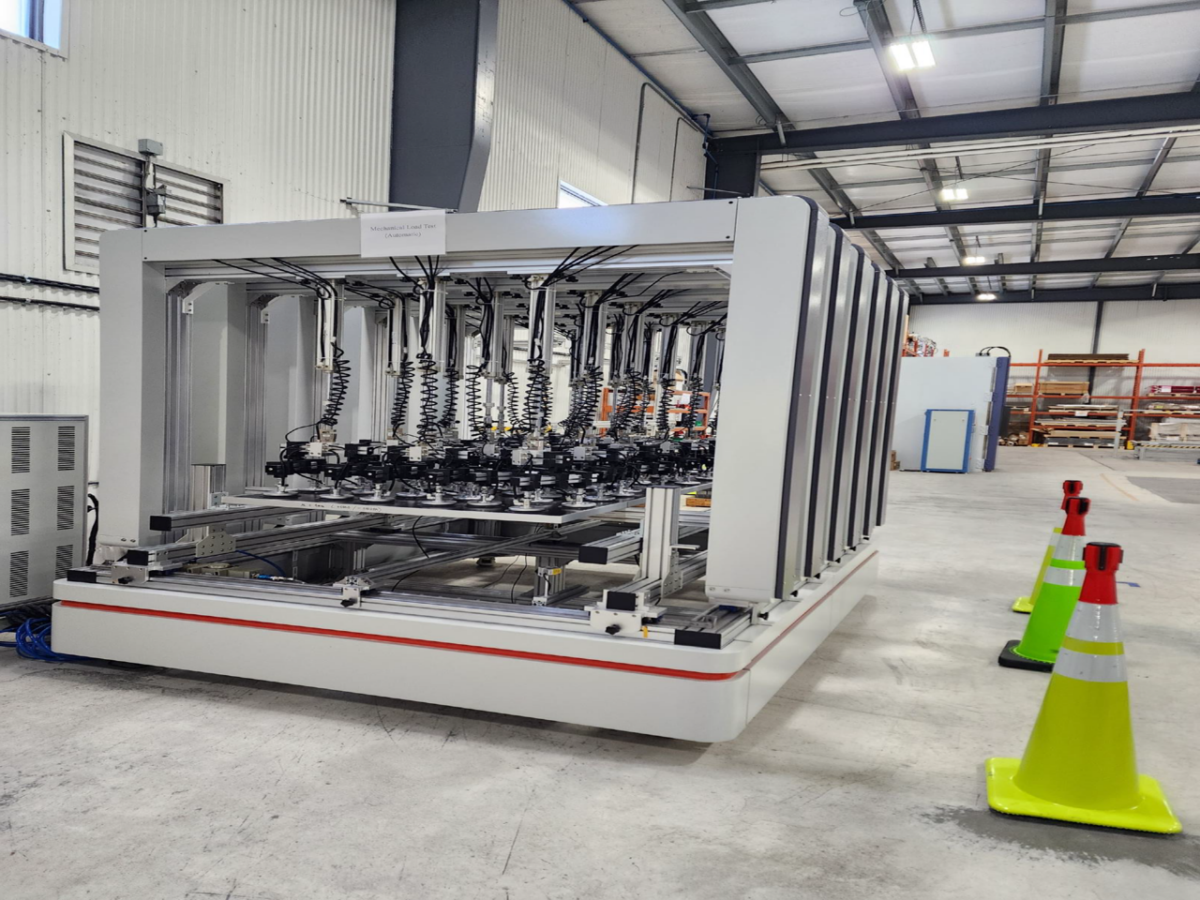
Heliene, which produces modules in the U.S. at its Minnesota factory, has a significant research and development organization at its Onterio headquarters because the Canadian government offers a 35% investment tax credit for R&D. Because of this, Pochtaruk said, Heliene is able to conduct extensive testing, including destructive testing, and thereby build up a database of module performance under different conditions.
“We collaborate with Sandia National Labs on testing, providing modules for them to use,” he said. “In return, we use their mathematical models and validate those with our own destructive testing, which we also share with them.”
According to Pochtaruk, Heliene uses 3.2mm front glass exclusively on all of its modules, which he says has a good combination of lightness, transparency and hardiness in the field. In addition, the company uses aluminum module frames, which are intended to provide a balance of strength, lightness and cost-effectiveness.
Interestingly, one of the reasons hail is more of an issue now than a couple of decades ago is because the first large utility-scale solar arrays appeared in California and then Arizona where the solar resource was excellent and damaging hail was relatively rare.
Brian Grenko, president and CEO of VDE Americas, told pv magazine USA in a March interview that people really weren’t giving much thought to hail twenty years ago because industry drivers like the renewable portfolio standard in California were new: “So, we started building utility scale projects in locations like Southern California and Arizona and west of the Rockies generally where, comparatively speaking, the hail risk is low.”
In a relatively hail-free environment, expansion in the solar industry was driven largely by the decreasing cost of PV modules and to a lesser degree balance of system equipment. Front glass for modules routinely became as thin as 2mm or 2.5mm because these were less expensive, lighter and offered better transparency and thus more efficiency than thicker glass. When utility-scale PV projects moved east of the Rockies, particularly in the U.S. Midwest and South, modules with thinner glass met higher incidence of damaging hail.
Pochtaruk said investments in R&D and cooperation with engineering firms and research institutions results in products that are not only productive and durable but that also will satisfy insurance company standards, which are becoming much more stringent due to recent losses.
At the same time, insurance rates can’t be the final arbiter because the project still has to make sense for the owner-operator. Insurance companies may prefer modules to be covered in rubber, Pochtaruk said, but this doesn’t mean they can be.
“Quality attributes build the bankability of the project,” he said, adding that thicker glass verified by testing and better engineered module frames and trackers can all offset insurance costs. “There has to be a financial advantage for the owner to invest in a more sophisticated product, and part of this comes down to better research, in which we are proud to participate.”
This content is protected by copyright and may not be reused. If you want to cooperate with us and would like to reuse some of our content, please contact: editors@pv-magazine.com.



By submitting this form you agree to pv magazine using your data for the purposes of publishing your comment.
Your personal data will only be disclosed or otherwise transmitted to third parties for the purposes of spam filtering or if this is necessary for technical maintenance of the website. Any other transfer to third parties will not take place unless this is justified on the basis of applicable data protection regulations or if pv magazine is legally obliged to do so.
You may revoke this consent at any time with effect for the future, in which case your personal data will be deleted immediately. Otherwise, your data will be deleted if pv magazine has processed your request or the purpose of data storage is fulfilled.
Further information on data privacy can be found in our Data Protection Policy.