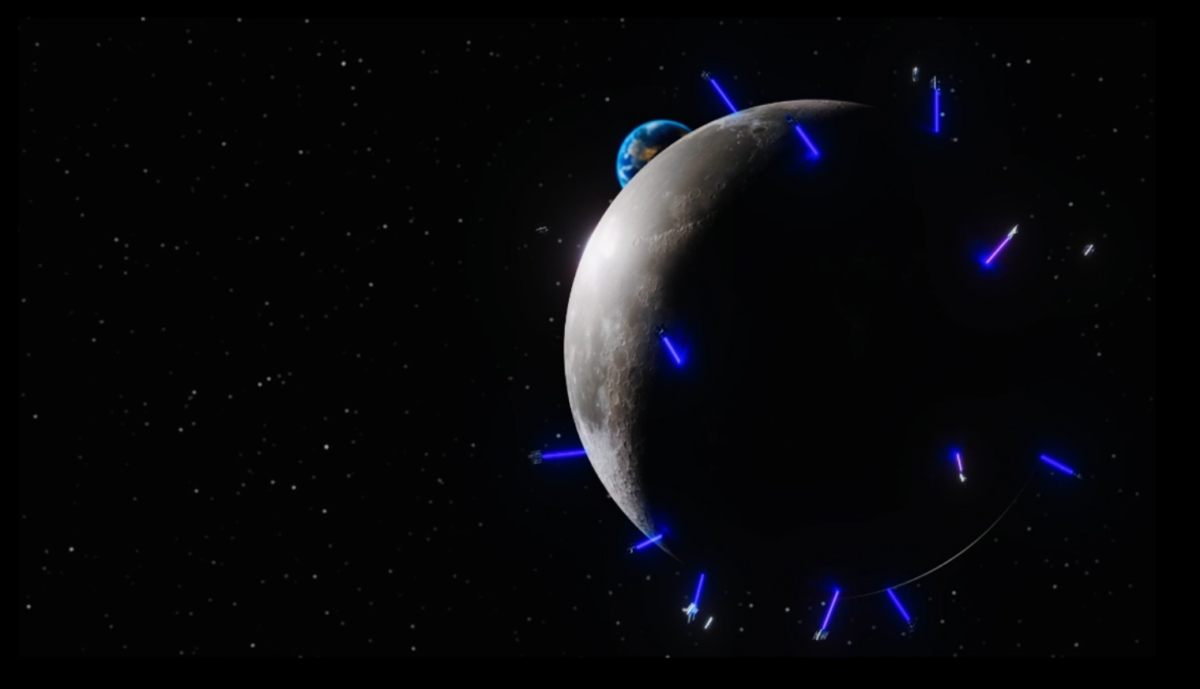





Volta Space Technologies, has announced the development of its Laser-Enabled Power Transmission Orbital Network (LEPTON), a solution to the challenge of providing power to missions on the surface of the moon during so-called “lunar nights” — periods in which half of the lunar surface is faced away from the sun that can last as long as 14 days.
The LEPTON system uses “a satellite-hosted, high-power, collaboratively pointed laser payload” in orbit to deliver power to a “high-efficiency, tuned photovoltaic receiver” on the surface via optical wireless power transfer (OWPT).
The Montreal-based technology startup is planning a demonstration project for 2028 in which the LEPTON system will complete the long-distance delivery of power to the moon’s surface from satellites in low-lunar orbit.
To that end, the company has booked a spot for its LightPort wireless power receiver on the upcoming Blue Ghost Mission 2 being planned by space and defense technology company Firefly Aerospace. The LightPort receiver will be integrated into the Firefly lander’s top deck.
Blue Ghost Mission 1, which took place in early 2025, resulted in the first successful landing of a private spacecraft on the moon.
Technology and potential applications
The LEPTON system is designed to transmit electric power across hundreds of kilometers, which the company says will reduce the cost and mass represented by large batteries currently needed to power lunar missions, allowing exploration into permanently-shaded regions like the inside of deep craters.
The company also envisions this technology could be used for surface-to-surface power distribution from remote sources, such as fission surface power reactors or vertical solar arrays in lieu of traditional cables for future missions to the moon and Mars, and could also be used terrestrially for defense applications or delivery of power to disaster-stricken regions.
However, before any of that can occur, much is left to be proven by OWPT. On its website, Volta touts demonstrations in which it successfully used the technology to power a lunar rover from 200 meters away in an indoor test, and the laser delivery of power from a distance of 880 meters in an outdoor test.
Other experiments in the space-based solar field include those from Overview Energy, who seek to beam power not over lasers, but through near-infrared beams from space, and researchers from Caltech, who tested power transfer over microwaves.
This content is protected by copyright and may not be reused. If you want to cooperate with us and would like to reuse some of our content, please contact: editors@pv-magazine.com.



By submitting this form you agree to pv magazine using your data for the purposes of publishing your comment.
Your personal data will only be disclosed or otherwise transmitted to third parties for the purposes of spam filtering or if this is necessary for technical maintenance of the website. Any other transfer to third parties will not take place unless this is justified on the basis of applicable data protection regulations or if pv magazine is legally obliged to do so.
You may revoke this consent at any time with effect for the future, in which case your personal data will be deleted immediately. Otherwise, your data will be deleted if pv magazine has processed your request or the purpose of data storage is fulfilled.
Further information on data privacy can be found in our Data Protection Policy.