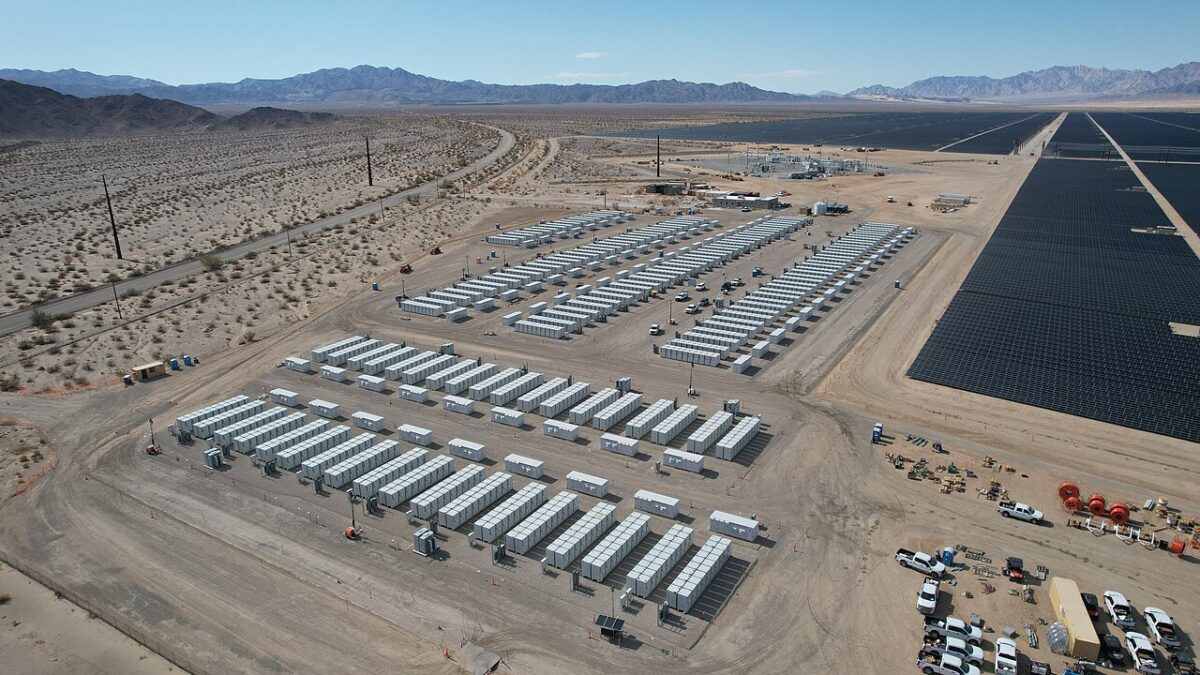





According to a report by Aurora Energy Research, “increasing battery charging demand is raising mid-day prices” in the California Independent System Operator (CAISO) electricity market region.
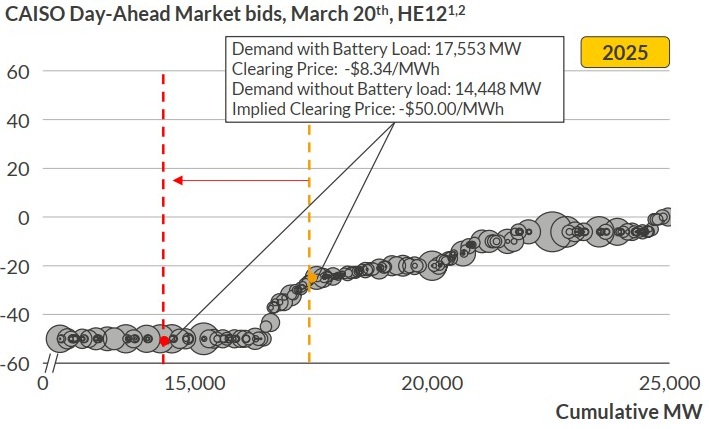
The chart below shows CAISO wholesale electricity rates during a March 20th five-minute bidding window. The gold line shows the actual pricing that was cleared for the electricity at negative $8.34 per MWh. The red line shows a hypothetical clearing rate rate of -$50 per MWh, if there were no batteries bidding. The $42 per MWh spread was driven by the more than 3 GW of energy storage buying electricity at that moment.
Source – Aurora Energy Research
For the five-minute period noted above, at $42 per MWh, the 3,100 MW of energy storage assets injected $10,850 into the solar market.
For the whole of the day, March 20, 2026, batteries purchased 52,777 MWh of electricity, according to CAISO supply data. If they were all purchased at a $42 per MWh premium, the batteries would have paid solar asset owners an additional $2.2 million.
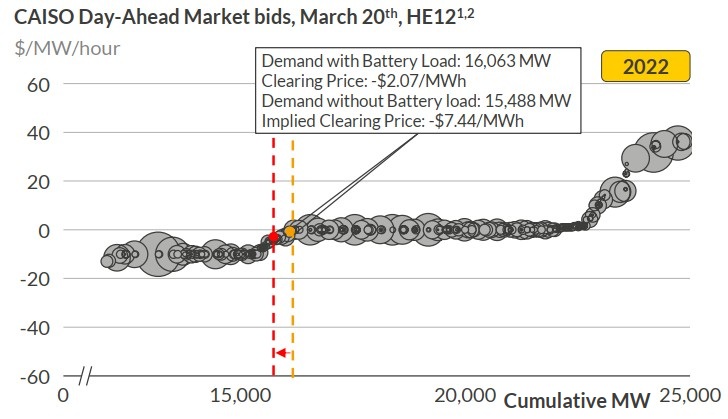
According to Aurora, the same grid three years prior had only 0.6 GW of energy storage capacity buying electricity. At that level of storage penetration, as noted in the chart below, Aurora observed only a $5 per MWh increase in price.
Source – Aurora Energy Research
Aurora warns that rising midday charging demand may cause further battery revenue challenges. First, the group said renewable (mainly solar) capacity additions may slow within the state in the near term. Concurrently, they project further battery additions. If battery capacity demand growth outpaces solar output, additional upward pricing pressure will follow.
California is seeking significant new capacity, including 6 GW at the end of the decade.
Compressed on both ends
Battery competition has also lowered the rates at which electricity can be sold.
Evening peak rates have declined measurably. According to Aurora, peak electricity prices were above $70 per MWh 14% of the time in 2022. In 2025, the $70 per MWh level was rarely breached.
According to Aurora, batteries earned an average of $115 per kW-year of capacity deployed in 2022, with most of this revenue coming from selling into the evening peak period. In 2025, with pressure from higher solar costs and lower peak rates, this revenue is expected to decline to $52 per kW-year.
CAISO recently stated that battery discharge volume has increased in all non-solar hours, including the early morning hours. In a recent development, batteries were the largest morning electricity source.
Solar power plants can offer electricity at negative wholesale prices because spot market revenue is only one component of their total income. A fixed-price power purchase agreement pays a contracted rate per MWh regardless of real-time conditions, while federal production tax credits, renewable energy credits, and state-level incentive payments all accrue per unit of output. Curtailment forfeits real money even when the market price goes negative.
This content is protected by copyright and may not be reused. If you want to cooperate with us and would like to reuse some of our content, please contact: editors@pv-magazine.com.


By submitting this form you agree to pv magazine using your data for the purposes of publishing your comment.
Your personal data will only be disclosed or otherwise transmitted to third parties for the purposes of spam filtering or if this is necessary for technical maintenance of the website. Any other transfer to third parties will not take place unless this is justified on the basis of applicable data protection regulations or if pv magazine is legally obliged to do so.
You may revoke this consent at any time with effect for the future, in which case your personal data will be deleted immediately. Otherwise, your data will be deleted if pv magazine has processed your request or the purpose of data storage is fulfilled.
Further information on data privacy can be found in our Data Protection Policy.