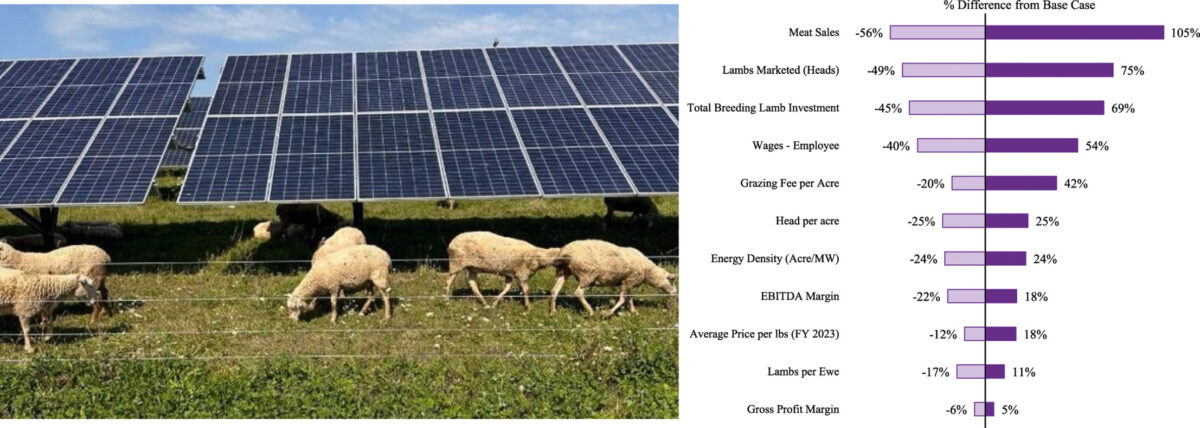





Researchers at Western University have released a comprehensive financial study indicating that the co-location of sheep grazing and solar PV arrays, a practice known as agrivoltaics, offers a robust solution to the tightening profit margins of modern agriculture.
The study, published in Applied Energy, suggests that these integrated business models provide a hedge against market volatility, with performance metrics consistently outstripping the broader agricultural industry’s average EBITDA margin of 7.32%.
The research team, led by Joshua Pearce of Western University, modeled two distinct operational strategies to determine their viability within the North American energy and agriculture markets: a year-round “Breeding Model” and a seasonal “Auction Model.”
The Breeding Model focuses on maintaining a permanent flock of ewes on-site. While this approach requires significant upfront capital investment for breeding stock and infrastructure, as well as year-round labor, it offers the highest level of financial stability. By producing lambs on-site, operators eliminate the fluctuating costs of purchasing external feeder lambs.
According to the study, this model can achieve EBITDA margins between 22% and 40%, depending on the scale and efficiency of the operation. The high margins are driven by the elimination of procurement costs and the ability to capture the full lifecycle value of the livestock.
In contrast, the Auction Model is designed for lower overhead and seasonal flexibility. In this scenario, farmers purchase young lambs at auction, graze them under the solar panels for a five-month pasture season, and sell them once they reach market weight. While this model is more susceptible to the volatility of livestock auction prices, it requires significantly less year-round management and offers a superior return on investment (ROI).
The researchers found that in optimized high-performance scenarios, the Auction Model can reach an ROI of up to 43%.
A leading driver of favorable economics is the dual-revenue nature of the business. In addition to livestock sales, farmers receive vegetation management fees from solar asset owners. The fees, which the study identifies as averaging between $212 and $374 per acre, provide a “revenue floor” that traditional farmers rarely enjoy. The guaranteed cash flow allows producers to offset the rising costs of inputs such as fuel, fertilizer, and specialized equipment.
From an operations and maintenance (O&M) perspective, the study highlights that sheep are a technically superior tool for vegetation control compared to mechanical mowing. Sheep effectively manage weeds and grasses without the risk of “throw” damage, where rocks or debris kicked up by mowers strike and crack solar modules. Furthermore, biological control eliminates the carbon footprint associated with diesel-powered maintenance equipment.
The solar arrays, in turn, provide a beneficial microclimate for the flock as the shade from the panels reduces heat stress and water consumption, which researchers noted can lead to improved animal welfare and weight gain.
The Western University report suggests that a wide-scale buildout of solar-integrated sheep farming could address a significant trade imbalance in the meat industry. Currently, North American markets rely heavily on imported mutton and lamb, which can cost nearly twice as much as domestic production. By utilizing the millions of acres slated for solar development, the domestic sheep industry could see a $170 million infusion into the rural economy, creating specialized agricultural jobs and strengthening local food security.
The study concludes that as land-use conflicts between energy developers and agricultural communities intensify, agrivoltaics provides a pragmatic path forward. By transforming solar sites into active, high-margin agricultural producers, the industry can preserve farmland while securing the long-term financial resilience of the family farm.
This content is protected by copyright and may not be reused. If you want to cooperate with us and would like to reuse some of our content, please contact: editors@pv-magazine.com.


By submitting this form you agree to pv magazine using your data for the purposes of publishing your comment.
Your personal data will only be disclosed or otherwise transmitted to third parties for the purposes of spam filtering or if this is necessary for technical maintenance of the website. Any other transfer to third parties will not take place unless this is justified on the basis of applicable data protection regulations or if pv magazine is legally obliged to do so.
You may revoke this consent at any time with effect for the future, in which case your personal data will be deleted immediately. Otherwise, your data will be deleted if pv magazine has processed your request or the purpose of data storage is fulfilled.
Further information on data privacy can be found in our Data Protection Policy.