
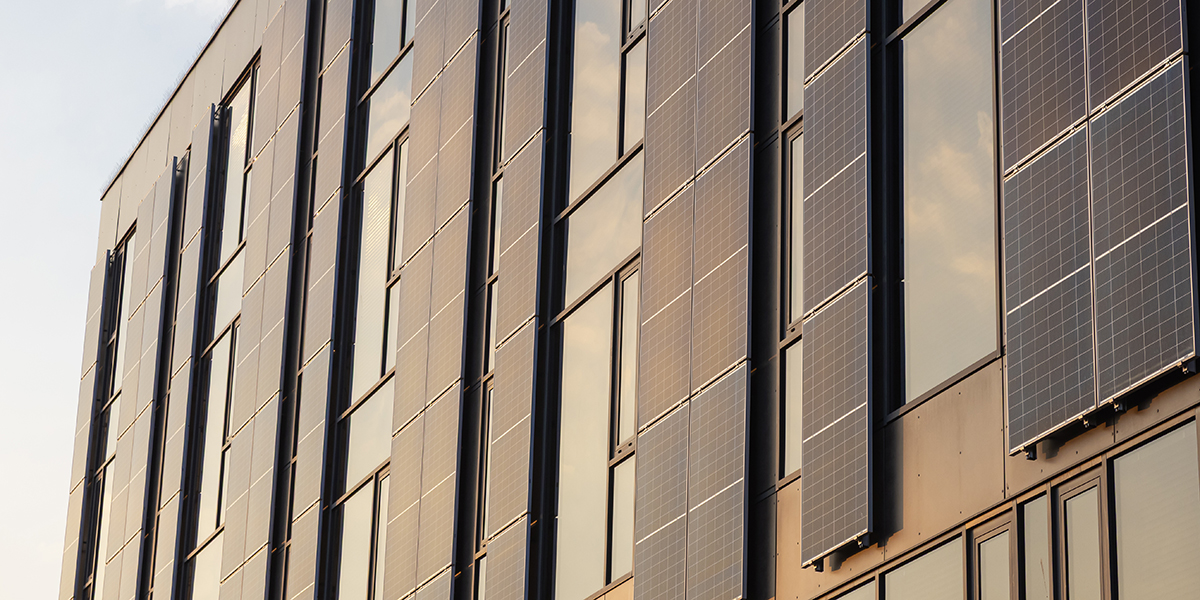





Building-integrated photovoltaic (BIPV) façade systems are transforming the aesthetics and energy profiles of modern high-rise buildings. However, their unique construction introduces new fire safety challenges. FM, leaders in commercial property insurance, recently evaluated the fire performance of five BIPV façade systems by conducting large-scale tests to investigate their fire safety challenges.
The research – presented at Interflam 2025, an international conference in London on fire science and engineering – revealed that cavity fire spread, glass shattering, the burning of plastic encapsulants, and falling debris are the primary fire hazards related to cavity-wall BIPV facades. Large-scale tests using the 16-foot high parallel panel method of ISO 3957 showed that most BIPV systems exceeded the standard’s acceptable fire size criterion, with flames rapidly propagating through wall cavities, causing glass modules to shatter within minutes. These cavity fires fueled intensified combustion by releasing pyrolysates from the encapsulant and degrading adhesives, leading to PV module collapse. This introduced additional oxygen into the system, further accelerating fire growth.
When PV modules were tested under maximum-power load conditions, fire hazards increased significantly for those with relatively thin glass modules. For these BIPVs, electrical preheating accelerated glass shattering and cavity fire propagation, with peak fire size rising by 50%-60% compared to when tested with modules in a no-load (open-circuit) state. These results suggest that real-world outdoor fire scenarios could be even more severe than indoor tests indicate.
Flexible BIPV modules examined in FM’s research, which lack glass superstrates and cavities, exhibited extremely rapid vertical flame spread, with peak fire size far exceeding those of cavity-wall BIPV systems. The study found that existing fire certifications of BIPV modules, such as EN 13501 and ANSI/UL 1703, do not reliably correlate with their large-scale façade fire performance.
The findings highlight the importance of evaluating the entire BIPV façade assembly – including PV modules, cables, insulation, air cavities, and mounting systems – to accurately assess fire risks. As BIPV adoption grows, these insights will inform future standards, installation guidelines, and product development, helping architects, engineers, and building owners make safer, more informed choices.
FM’s research sets a new benchmark for fire safety in BIPV façade systems, paving the way for more resilient, code-compliant solar facades. The results will contribute towards developing a new FM Approvals Examination Standard 4483 for wall-mounted BIPV systems.
The study was authored by Gaurav Agarwal, Dong Zeng, and Yi Wang of FM’s research division.
A full technical report related to this research is available on FM.com.
This content is protected by copyright and may not be reused. If you want to cooperate with us and would like to reuse some of our content, please contact: editors@pv-magazine.com.

By submitting this form you agree to pv magazine using your data for the purposes of publishing your comment.
Your personal data will only be disclosed or otherwise transmitted to third parties for the purposes of spam filtering or if this is necessary for technical maintenance of the website. Any other transfer to third parties will not take place unless this is justified on the basis of applicable data protection regulations or if pv magazine is legally obliged to do so.
You may revoke this consent at any time with effect for the future, in which case your personal data will be deleted immediately. Otherwise, your data will be deleted if pv magazine has processed your request or the purpose of data storage is fulfilled.
Further information on data privacy can be found in our Data Protection Policy.