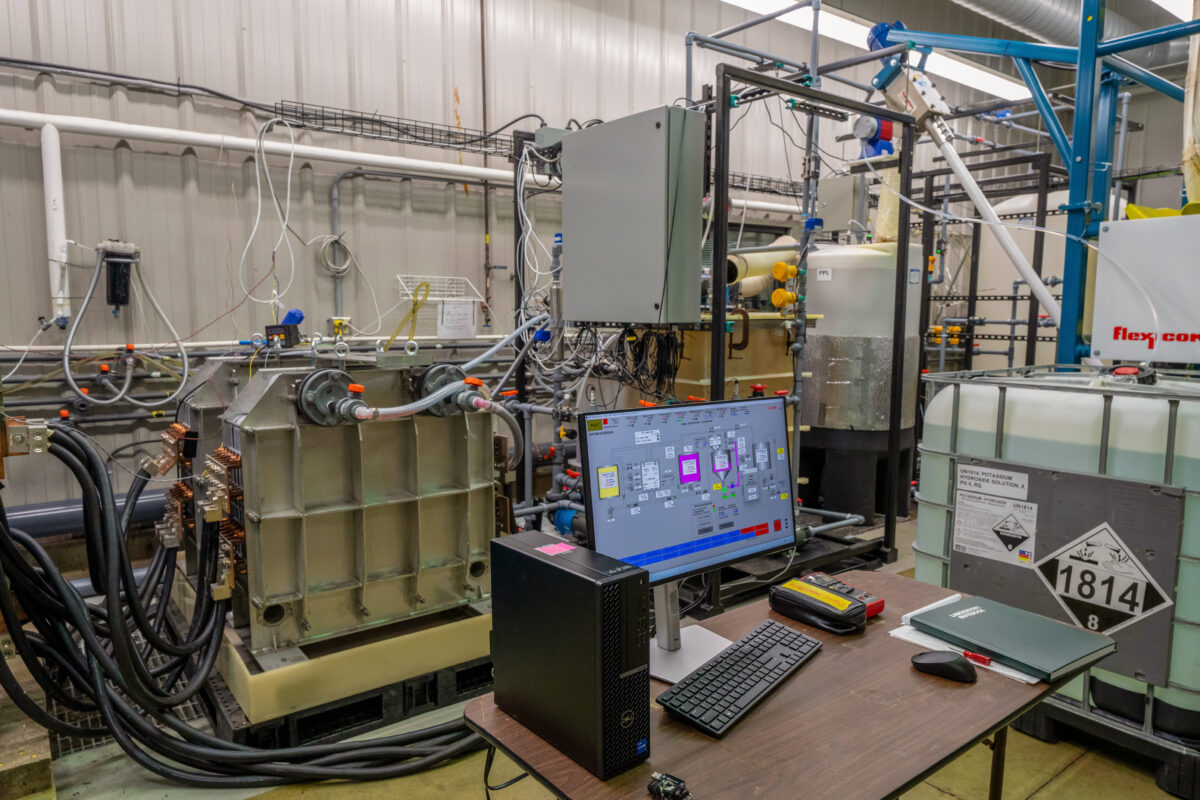





California-based Quino Energy has signed a joint development agreement with Germany-based Jena Flow Batteries to provide the former’s electrolyte for the latter’s energy storage hardware.
Quino’s electrolyte chemistry is based on quinone, an organic compound, and is intended to replace vanadium in flow batteries to compete with lithium-ion batteries for grid energy storage. Jena, a subsidiary of China-based Suqian Time Energy Storage, develops and markets flow battery systems for industrial and utility applications, primarily in Europe.
Eugene Beh, CEO of Quino, told pv magazine USA that the Jena deal is an aspect of his company’s strategy to focus on electrolyte production while partnering with manufacturers of commercially available flow-battery stacks in order to deliver battery-based energy storage (BESS) systems. He said the companies had been working together for about two years on the technical side, and the announcement is more of a formalization of an existing arrangement.
“Jena’s battery hardware is currently optimized for a different electrolyte,” Beh said. “Like tuning your engine for different fuels, we will work with them on optimizing their hardware for our formulation.”
Quino’s electrolyte formulation is non-toxic, derived largely from relatively inexpensive and abundant dyestuff chemicals, and is rated for deployment in locations with high populations or environmental sensitivity. While Jena’s batteries are working with an existing metal-free electrolyte formulation, these may not be appropriate for all applications. Beh said the EU has stringent rules for toxicity and Quino’s formulation will open up new deployment opportunities for Jena.
At the same time, Jena’s flow battery stacks will enable Quino to pursue commercial BESS projects in the U.S. and elsewhere. In 2025, Quino was awarded $10 million in grant funding from the California Energy Commission for an 8 MWh flow battery project at the High Desert Regional Health Center, designed to provide critical emergency backup power and resilience. Beh said Quino hasn’t selected a hardware supplier for that project, but Jena’s system would be a strong contender.
“In fact, we are going to be using their hardware in some commercial demonstrations as well, the first of which you’ll see in the second half of this year,” he said.
One potential issue in selecting Jena as a supplier is ownership by China’s Suqian, which manufactures most of the battery hardware. This triggers U.S. content requirements as well as China’s status as a foreign entity of concern, both of which could affect federal financial incentives.
According to Beh, if you pair made-in-USA electrolyte with hardware made outside of the U.S. for domestic commercial projects, then the systems qualify for incentives under the Inflation Reduction Act (IRA) and other regulations.
“You never know; the rules could be revised again, right?” he said. “But at the current cost structure, key components can come from manufacturers in China and still qualify for IRA credits.”
The key benefit of joint development deals with hardware makers like the one with Jena is that Quino can focus on manufacturing a single formulation that will work across multiple battery types. Beh pointed out that any changes in electrolyte formulation would require a new round of chemical permits and toxicology approvals for each variation.
Quino produces electrolyte on a test basis at its headquarters facility and on a larger scale – approximately 25 MHh per year – at its manufacturing partner’s Electrosynthasis plant near Buffalo, New York. Last year, the company signed a deal with Atri Energy Transition to produce electrolyte in India, which could amount to 150 MWh per year.
“Actually, 150 MWh is not very much when you think about the energy storage industry,” Beh said. “But we have the knowhow to replicate that model in other locations very quickly. As long as the customers are there and our hardware suppliers manufacture flow battery stacks, we’ll keep our end of the bargain and make electrolyte.”
This content is protected by copyright and may not be reused. If you want to cooperate with us and would like to reuse some of our content, please contact: editors@pv-magazine.com.





By submitting this form you agree to pv magazine using your data for the purposes of publishing your comment.
Your personal data will only be disclosed or otherwise transmitted to third parties for the purposes of spam filtering or if this is necessary for technical maintenance of the website. Any other transfer to third parties will not take place unless this is justified on the basis of applicable data protection regulations or if pv magazine is legally obliged to do so.
You may revoke this consent at any time with effect for the future, in which case your personal data will be deleted immediately. Otherwise, your data will be deleted if pv magazine has processed your request or the purpose of data storage is fulfilled.
Further information on data privacy can be found in our Data Protection Policy.