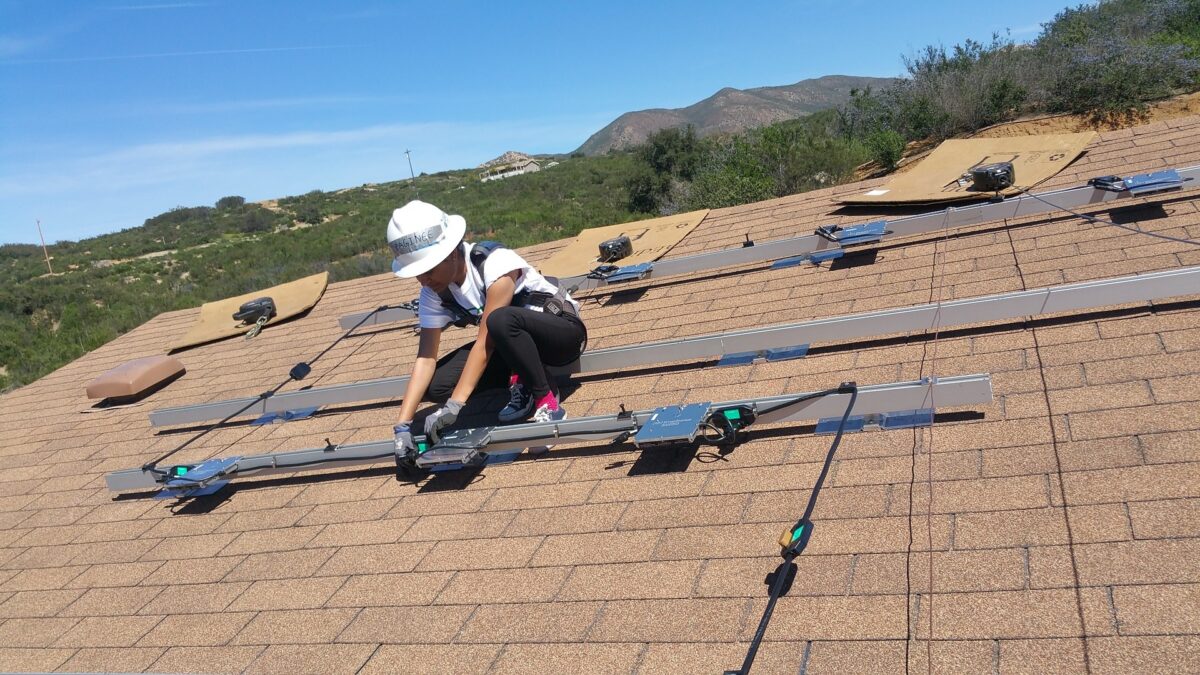





A new report from HelioVolta, an independent solar and energy storage software and technical advisory services company, details critical safety issues linked to the use of module-level solar rapid shutdown devices (RSDs).
Such devices, which are mounted under each module in a solar array, are commonly used by U.S. solar installers to comply with rules in the National Electrical Code (NEC) that require rapid shutdown of PV systems installed on buildings.
The report, entitled “Unintended Consequences: Rapid Shutdown Devices And Safety In Commercial Rooftop Solar Systems,” covers 74 high-risk safety incidents in installations that use RSDs, occurring between 2021 and early 2026, and sourced from HelioVolta’s field inspections of commercial rooftop PV systems, information reported to HelioVolta by third parties and legal filings.
The report’s authors assert that while RSDs were developed and deployed with the best of intentions, they add multiple points of failure to systems, which can have the opposite of the intended safety effect.
They point out that while no firefighter deaths associated with PV system fires have been documented in the US to date, systems with RSDs and other module-level power electronics (MLPEs) have 66% higher rates of critical safety issues than installations that do not employ these devices, actually leading to more — not less — fire risk.
“Faulty RSDs are operating on buildings across the U.S., unintentionally putting people at risk. As these devices age, worst-case scenario failures are more likely to occur,” said James Nagel, CTO of HelioVolta. “No one wants to acknowledge safety risks hidden in solar portfolios, but we can only eliminate the dangers of RSDs with transparent, informed technical discussions.”
The data gathered by the company include 40 incidents of RSDs melting or overheating, 13 incidents in which there was evidence of a contained fire that damaged one or more RSDs and 21 rooftop fires.
While the number of incidents involved does not represent a large proportion of the total number of solar installations that use RSDs, the report asserts that the details of PV thermal events are usually protected by non-disclosure agreements, and points out that there is no national database for the root causes of solar installation fires.
“Since publishing this report, we’ve heard from developers in the UK and Latin America who recently began installing RSDs as a proactive safety measure.” said David Penalva, CEO of HelioVolta in comments to pv magazine USA. “Instead of exporting best practices globally, we’ve exported problems. All because vital data is locked inside of NDAs.”
A full version of the report is available for download from the HelioVolta website.
Alternatives to RSDs
The report includes several recommendations to improve outcomes, urging system designers to avoid using RSDs in new construction projects, or to exercise caution in sourcing connector hardware and specifying requirements for proper mounting.
For existing systems, the authors recommend system owners implement careful, proactive operations and maintenance checks that include regular visual and thermal inspections and voltage checks.
“Many US asset owners with large-scale C&I fleets now prohibit RSDs in new construction. Some have even retrofitted portfolios to remove RSDs at great expense,” Penalva told pv magazine USA. “Our goal is not to promote a single technology pathway for PV systems,” he added. “It is to help the industry build safer, more reliable systems that benefit everyone.”
One alternative to module-level RSDs that is compliant with the NEC is the installation of a PV hazard control system, as defined by the UL 3741 standard.
These systems allow designers to use a list of approved components to meet the NEC rapid shutdown requirements using more robust string rapid shutdown devices that reduce complexity and the number of connectors necessary to complete a compliant system.
Derek Mast, a solar technician and content creator who runs a website dedicated to information about PV hazard control, celebrated the release of the HelioVolta report.
“This white-paper makes it clear that rapid shutdown, in its current form, must be reassessed from the ground up,” Mast told pv magazine USA. “Those of us who have lived this reality on the ground for years are feeling extremely vindicated by finally seeing this data. There’s a reason that the rest of the world doesn’t use rapid shutdown – it’s unreliable, dangerous, and makes solar worse.”
This content is protected by copyright and may not be reused. If you want to cooperate with us and would like to reuse some of our content, please contact: editors@pv-magazine.com.



Interesting article. However, the title is misleading and imprecise. The data shown in the graphs on page 9 points to installer error with field made connectors as the #1 leading root cause rather than the RSD or MLPE device failure itself. Why not use a title that relates to the data you have presented? Your article shows that a segment of the commercial rooftop industry is still having issues following NEC and UL rules regarding intermating connectors and using the right crimpers and torque specs etc The article accurately points out those field mistakes are the leading causes of thermal events on page 9 constituting 92% and 85% of the total issues shown in the bar graphs.
*Cross-threaded Connector
*Improper Tooling
*Inter-mated Connector Under/Over torqued
*loose connector
*WireBending Radius
*SharpEdges
*Insufficient MLPE Clearance
NEC and the UL safety standards UL 1741 and UL 3741 address these in the instructions included in the listing and labeling of the products. A “qualified person” as defined by the NEC should have knowledge of these instructions. In an effort to productively improve the standards in future revisions please consider the following request:
1. I’d like to see Heliovolta present precise data about the training and skill level of the installers installing the connectors and RSD and MLPE per the instructions included with the listing and labeling of the product (UL 1741 and/or UL 3741). This would include connector specs, bending radius, locations, clearance, torques, wire securement and routing, etc. If all of these things were followed by a qualified person, and there is still an incident with the RSD / MLPE device itself, then I’m interested that precise subset of data for the UL technical panel.
2. The article talks about PLC communications and cross talk as “issues”. Are these not addressed in the instructions included with the listing and labeling of the products referenced in your article? Both UL 1741 and UL 3741 require that the RSD/MLPE device shut down the controlled conductors if the “keep alive” signal is lost. Or the RSD self-test fails. Instructions to avoid crosstalk and improve fidelity of the PLC signal should also be part of the NRTL evaluation of the listing of the product. Are these instructions not being followed in the field? or are you claiming that there an inherent problem with PLC coms in general? I only know of one specific model of MLPE/RSD device that had internal PLC problems unique to their design but no general issues with PLC which is ubiquitous in several industries and has a well proven track record in PV applications. Again, precision on what your talking about in the article here would help vs. generalized conclusions about PLC and it’s use in MLPE and RSD devices. Can Heliovolta share this data?
As an informational note. Systems listed to UL 3741 for PV hazard control that do not use MLPE to reduce voltage lean on protecting the fully energized conductors from fire fighter interactions. Products in the market today that do this require more complex wire management, precise conductor placement and securement, bending radius control, more wire guarding and protection, more mechanical failure points, and require periodic visual in person inspection of conductors to ensure they remain protected from potential fire fighter interactions for 25 years after the date of installation. That’s a heavy lift for passive systems, but our industry is known for innovation. Passive UL 3741 listed systems by nature actually increase human touch points, wiring complexity, inspection, and O&M labor compared to MLPE since they are not electronically monitored today. UL 3741 also allows for MLPE or RSD devices to reduce the energy in the conductors rather than depend on wire management and passive protection. Both of these approaches increase parts and connections both physical or electrical in the system and thus potential failure points of that safety system. The trade-off is not the number of points be it physical or electrical since a passive PVHC system’s failure points far exceed the number of MLPE electrical PV connectors. The trade-off is between passive conductor protection and active conductor protection. Both work to protect fire fighters regardless of the number of physical or electrical connection points. Passive systems require rigorous ongoing visual inspection and maintenance per UL 3741 to ensure the passive system and it’s fasteners remain intact at every module or racking part interface and effective over the life of the system. Many active protection systems like MLPERSD do not require a periodic visual inspection because they actively test the rapid shut down function daily and can be monitored, tested, and diagnosed remotely for safe RSD operation. If no comms signal like a PLC message is present the system must automatically shut down per UL 1741 and 3741. In practice this drastically reduces the required periodic human inspection time and error. Again, human error has been highlighted in this article’s data as the #1 root cause of thermal events on page 9.
I’d like to see more data around the human error involved in the installation and operation and maintenance of 25 year passive PVHC system (no MLPE) and the human work like annual physical inspection repair required by NPFA and UL to maintain the efficacy of that critical fire fighter safety system compared to an active PVHC system (with MLPE) using daily automatic RSD self-test and remote diagnostics to maintain the efficacy of the critical fire fighter safety system as required by NFPA and UL. I believe the latter reduces field trips, truck-rolls, human touch points, etc. which all contribute to reducing human error as this article highlights in page 9.
I do agree with the author that in a general FMEA analysis increasing connections may increase failure points in any circuit which puts pressure on the quality of those connection points. However, by this logic of “more connectors = less safe” we would not have Anti-lock brakes or Airbags in our cars, or AFCI or GFCI receptacles in our house or interconnected fire and smoke alarm systems in the offices where we work and a myriad of other safety systems we use every day. Not to mention passenger jets which have about 150 miles of wiring and 200,000 electrical connections. The reason this all works is because safety systems in passanger jest or PVHC / RSD, or airbags are designed to a rigorous industry developed safety standard that specifies the quality and efficacy of the connection points and fail safe behavior of the communications logic.
Further, some manufacturers of MLPE go above and beyond the UL standards for PV systems and incorporate additional sensing technology that monitors connector and conductor temperature in case there was a crimping error, intermating error, or damage, or soiled connector, etc. This technology can send an alarm when connectors or conductors get hot before a thermal event occurs. This is where MLPE can act as a platform to incorporate advanced predictive safety features for building owners and emergency responders. This is analogous to the evolution of safety systems in cars from passive to active systems. Minimum safety requirements evolved over time. Bumpers, crumple zones to seatbelts (passive) evolve to airbags and antilock brakes (active), evolve to pedestrian sensing, automatic braking, collision avoidance, etc (active). All of these have increased the number of electrical connection points and sensors in cars as active systems are implemented to improve safety. In the automotive industry this has successfully reduced fatalities. Safety systems in PV and ESS systems have also followed this trend over the past 20 years as these systems have evolved with distributed intelligence, sensing, and active controls to increase safety.
Let me sum the report up for everyone: They cite a few legal filings against Generac and Tigo and some complaints on social media (see pages 4 & 15). They lump ALL MLPE devices together and make it sound like it’s some giant issue across the industry when this is confined to a much smaller group of components.
C’mon Ben, did you read the actual report? The data sample set is tiny, the terminology used in the report looks intentionally deceptive (see the disclaimer). The sources cite Reddit and Facebook. This looks like marketing fearmongering to sell more system inspections. And suggesting PV hazard control? All those critical system components and gods know how many zipties should be inspected regularly – a service they provide. They even have a sales call to action embedded in the report. This reads like a sales pitch buried in a sea inconsistent technical language.
Seriously folks download the report rather than read the webpage. HelioVolta must be hurting for sales right now to publish this rambling mess. They even state that the stats don’t include data from resi micros – but they just lump them in later anyway in the paper.