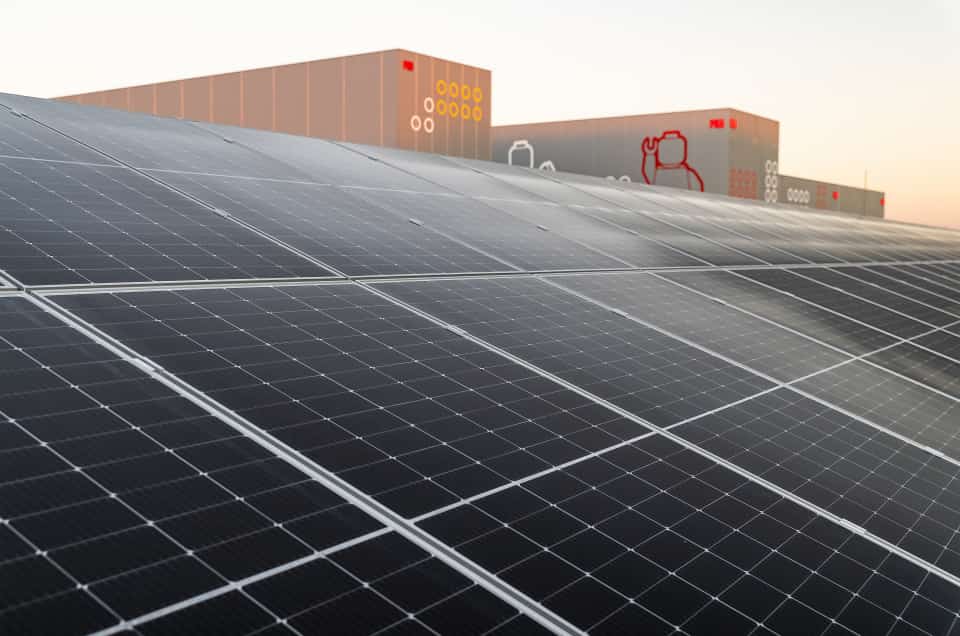





The LEGO Group has unveiled plans for a massive on-site solar buildout at its first U.S. manufacturing facility, a move that will accelerate the site’s transition to 100% renewable energy.
The project, located in Chesterfield County, Virginia, will integrate over 40,000 solar panels into the 340-acre campus as the company scales its domestic production footprint.
According to a company announcement, construction on the solar infrastructure is slated to begin this summer. The project features two distinct components: a 22 MW ground-mounted solar park spanning 80 acres and a 6.1 MW rooftop array. Combined, the installations will provide more than 28 MW of peak capacity to support the facility’s annual energy needs.
This capital investment comes as surging electricity rates have slashed commercial solar payback periods by 33%, according to a recent report by Wood Mackenzie. The solar initiative is part of a broader $1.5 billion investment in the Virginia site, which is currently undergoing rapid construction.
The project includes 30,752 ground-mounted panels and 10,080 rooftop panels to reach its 28 MW peak capacity.
The site is pursuing LEED Platinum certification and leveraging advanced materials to minimize embodied carbon.
This follows the steel topping out of the main factory buildings in October 2025. Jesus Ibañez, General Manager of LEGO Manufacturing Virginia, stated that these initiatives are key to increasing the use of renewable energy and supporting sustainable operations.
The Virginia plant is designed as a carbon-neutral facility from the outset, aligning with LEGO’s global mandate to achieve zero waste to landfill. By generating a substantial portion of its own power on-site, the company avoids the volatility of marginal energy markets while strengthening its regional supply chain in North America.
The project represents a shift in industrial development where renewable energy is treated as a core utility rather than a secondary retrofit. As the facility moves toward its projected 2027 opening, it serves as a benchmark for large-scale distributed generation in the consumer goods sector, pairing automated manufacturing with aggressive decarbonization targets.
This content is protected by copyright and may not be reused. If you want to cooperate with us and would like to reuse some of our content, please contact: editors@pv-magazine.com.


By submitting this form you agree to pv magazine using your data for the purposes of publishing your comment.
Your personal data will only be disclosed or otherwise transmitted to third parties for the purposes of spam filtering or if this is necessary for technical maintenance of the website. Any other transfer to third parties will not take place unless this is justified on the basis of applicable data protection regulations or if pv magazine is legally obliged to do so.
You may revoke this consent at any time with effect for the future, in which case your personal data will be deleted immediately. Otherwise, your data will be deleted if pv magazine has processed your request or the purpose of data storage is fulfilled.
Further information on data privacy can be found in our Data Protection Policy.