





Researchers at the University of Western Ontario in Canada have proposed using polycarbonate (PC) as an encapsulant for solar module assembly to replace ethylene vinyl acetate (EVA), which is difficult to remove during recycling without damaging fragile, high-value solar cells.
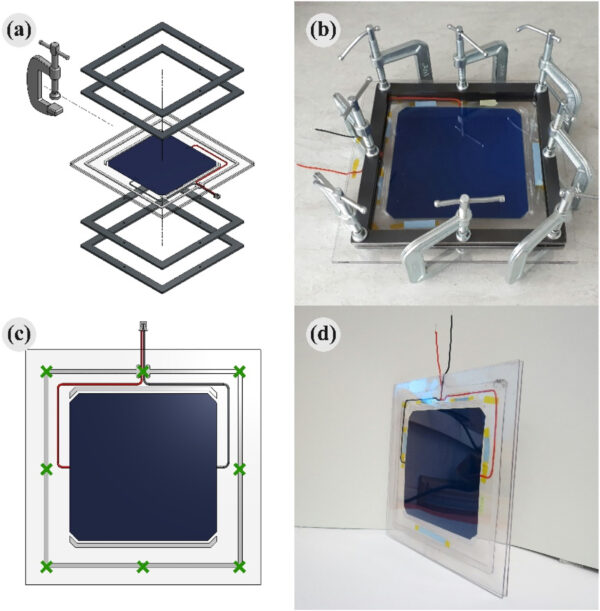
The scientists explained that in the proposed laminate-free, plastic-encapsulated solar module design, PC sheets replace glass, while a pressure- and heat-based process with a 3D-printed PC seal encapsulates the module and holds the cells in place without EVA. The approach enables scalable, lightweight PV modules that can be fabricated with accessible do-it-yourself (DIY) tools, while recycling requires only mechanical separation of the plastic housing followed by material sorting.
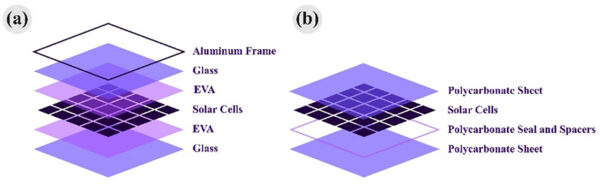
The PC 3D printed seal was used instead of polyisobutylene (PIB) and silicone, which are commonly used in other laminate-free designs. It was fused to the two outer sheets by heating the PC close to its glass transition temperature and applying pressure. The seal also included an opening for the wires and its width was increased near the wire exit so that excess PC could deform during encapsulation and flow around the wires to improve sealing. After encapsulation, ethyl cyanoacrylate adhesive was applied to close any remaining gaps around the wires.
The single-cell modules were fabricated with monocrystalline cell provided by Sunpower.
The research team noted that conventional PV modules typically use 3–4 mm thick glass and EVA layers that together transmit about 95% of incoming light to the solar cell. By comparison, the PC cover tested in the study showed a lower transmissivity of 80.38%. Over a 20-year lifetime, a single-cell module could therefore generate about 102 kWh with a glass cover but only around 86 kWh with the PC cover, resulting in an energy loss of roughly 16 kWh due to reduced light transmission.
However, the PC-based design enables easy recovery and reuse of PV cells and other components. This could extend system lifetimes beyond 20 years, as recovered cells could be refurbished, upgraded, or reused in new modules with relatively low additional embodied energy. Initial durability tests also showed promising results, including good mechanical integrity and strong water resistance comparable to an IP68 rating.
According to a preliminary techno-economic analysis, the prototype module can generate 2.12 W under sunny conditions and be produced at a cost of about $3.11/W. This is significantly higher than the current average U.S. module price, although the difference largely reflects the use of retail-priced materials and small-scale fabrication in the study.
The researchers said costs could drop substantially if PC were sourced from recycled materials and PV cells were purchased at industrial-scale prices. Under these conditions, scaled production could reach an estimated $0.06–0.30/W, potentially making the design competitive with commercial modules. Distributed manufacturing could further reduce costs by lowering transportation needs and enabling localized production, particularly in regions with abundant recycled plastics.
“Future work should focus on scaling the design to multi-cell modules, optimizing PC transmissivity, and incorporating impact-resistant materials by moving to a hybrid model,” the academics concluded. “Further testing under thermal cycling, damp heat, and prolonged UV exposure is also needed to validate long-term durability.”
The new encapsulation technique is presented in “Open-source distributed production of polycarbonate solar photovoltaic modules designed for disassembly,” published in the Journal of Cleaner Production.
This content is protected by copyright and may not be reused. If you want to cooperate with us and would like to reuse some of our content, please contact: editors@pv-magazine.com.





By submitting this form you agree to pv magazine using your data for the purposes of publishing your comment.
Your personal data will only be disclosed or otherwise transmitted to third parties for the purposes of spam filtering or if this is necessary for technical maintenance of the website. Any other transfer to third parties will not take place unless this is justified on the basis of applicable data protection regulations or if pv magazine is legally obliged to do so.
You may revoke this consent at any time with effect for the future, in which case your personal data will be deleted immediately. Otherwise, your data will be deleted if pv magazine has processed your request or the purpose of data storage is fulfilled.
Further information on data privacy can be found in our Data Protection Policy.