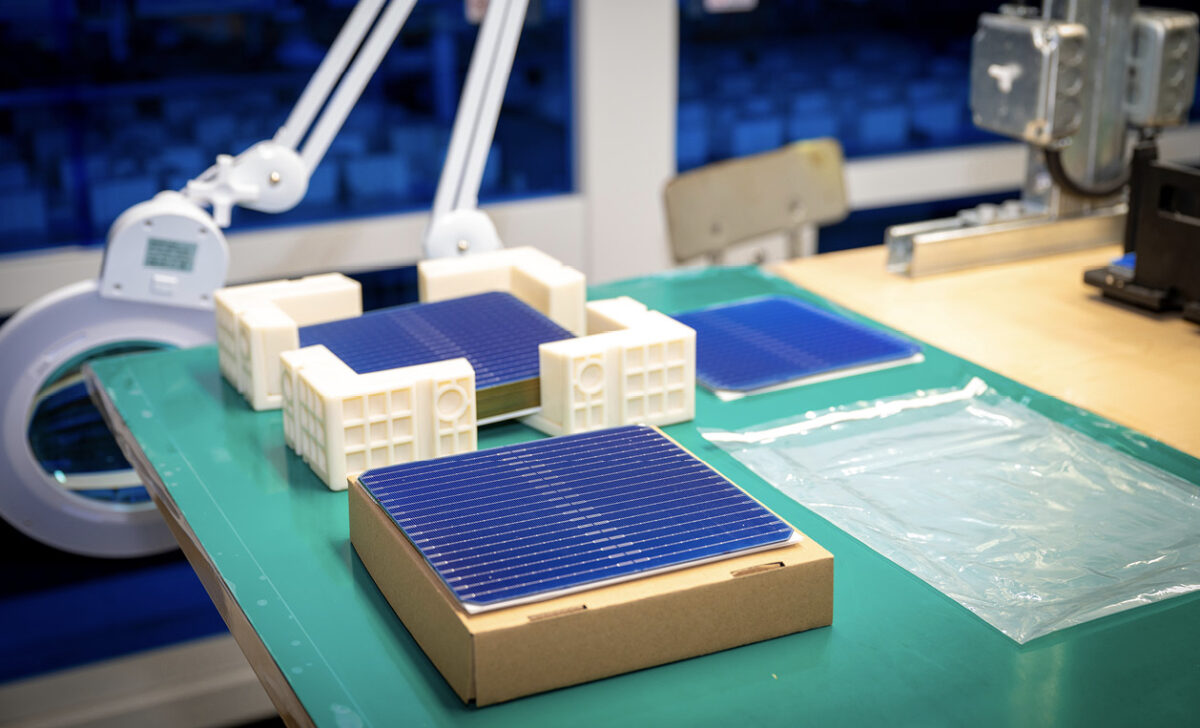





At the end of 2024, the United States had around 42.5 GW of manufacturing capacity for PV modules, according to numbers from market intelligence provider Wood Mackenzie. By September 2025, that had increased by 35% to just over 60 GW, and Wood Mackenzie research analyst Elissa Pierce expects theyear-end 2025 figure to come in at 64 GW.
“We expect a little bit of continued growth in module capacity for 2026 and 2027, with a couple more factories scheduled to expand or come online,” Pierce told pv magazine. “But we’ll see less now, because we have enough capacity in theory to supply the domestic market, especially as we expect installations to start dropping after 2026.”
Pierce explained that manufacturers are now shifting their focus to making cells as well as solar modules in the United States, as policy shifts make it more difficult to meet expected demand for PV using imported components.
Tax credits
Manufacturers expect a rush to get U.S. solar projects underway in 2026 ahead of the removal of various federal incentives, creating sufficient demand for PV modules out to 2030. Wood Mackenzie forecasts 246 GW of PV installations in the United States between 2025 and 2030.
The 45X tax credit, which offers a $0.07/W subsidy for U.S. solar manufacturing, has been key to the buildout of module capacity, and remains in place. Pierce noted that this support has become even more important as module capacity in the United States has grown and prices have fallen. “We’re seeing U.S.-made modules being sold in the mid to high twenties in cents per watt, and we believe the cost of manufacturing is a little higher than that,” she said. “It’s pretty important to have these manufacturing credits.”
Foreign entity of concern (FEOC) rules introduced in 2025 mean that module manufacturers that rely too heavily on components imported from China or using Chinese technology will not be eligible for the 45X credit, and projects using those modules will not be eligible for other incentives, including the 45Y and 48E credits supporting clean energy production and investments. These credits also include a 10% bonus for projects using U.S.-made components, specifying that a percentage of manufactured products used in a PV project must be “mined, produced, or manufactured in the United States.” The requirement stands at 40% for projects that began construction in 2024 or earlier, increasing to 45% for 2025, 50% for 2026 and 55% for 2027 and after.
Import restrictions
In July 2025, the U.S. Department of Commerce initiated a Section 232 investigation into polysilicon imports, which is set to result in restrictions for polysilicon components coming from China and potentially other regions as well. Pierce explained that the scope is not yet known, but may include exemptions for countries like Malaysia and Germany that have some polysilicon production capacity. “But there is definitely potential to make it very difficult to import polysilicon components into the U.S.,” she added.
The investigation must publish its report by March 28, 2026. If it concludes there is a threat, the administration then has 90 days to consider the findings, and a further 15 days to implement trade remedies.
Cell and module manufacturers in China previously relocated facilities to Southeast Asia to avoid U.S. import duties, but since April 2025, antidumping and countervailing duties (ADCVD) have been placed on cell imports from Cambodia, Malaysia, Thailand and Vietnam. Another trade case is expected to give a preliminary decision in early 2026 and be finalized later this year, and will likely add Indonesia, Laos, and India to that list.
Canada-based module maker Heliene operates 1.3 GW of module manufacturing in the United States. CEO Martin Pochtaruk explained that the company had been sourcing cells from Laos and India up to the beginning of the AD/CVD investigation in August 2025. He noted that Turkey has cell manufacturing capacity that can access the U.S. market, and that several manufacturers previously operating lines in Southeast Asia have relocated to countries including Egypt, Morocco, Ethiopia and Kenya – chosen for the combination of good availability of skilled engineers and very low overall imports into the United States. However, those cells supplied by Chinese companies from any region would likely be subject to the FEOC restrictions.
Cell manufacturing
With uncertainty surrounding import allowances, module manufacturers in the United States are now looking at establishing their own cell production. Wood Mackenzie puts current U.S. manufacturing capacity for crystalline silicon solar cells at 3 GW and expects this to grow to around 20.5 GW by the end of 2027.
“The manufacturers planning to build their own cell factories in the US will be in a stronger position than those who have to import cells or buy from other U.S. manufacturers,” said Pierce.
In South Carolina, ES Foundry currently operates 1 GW of cell capacity and expects to have an additional 2 GW online by July 2026. “This expansion is driven by strong multi-year demand, a maturing U.S. supply chain and continued momentum around domestic content procurement strategies,” said ES Foundry CEO Alex Zhu.
PV manufacturers in the United States are broadly supportive of restrictions on imports, but note that they will be unable to meet demand without exemptions for certain upstream components.
“Certain trade measures, especially Section 232 tariffs on polysilicon and semiconductor-related products, represent significant challenges to U.S. manufacturing economics. These could increase the cost of key components in 2026, raising domestic production costs at precisely the moment when the industry is trying to scale,” said Zhu. He added that a sharp rise in component prices could reduce downstream demand, putting U.S. manufacturers under additional pressure.
IP dispute
The FEOC requirements are also impacting technology pathways for U.S. cell production. Tunnel oxide passivated contact (TOPCon) cells have become mainstream for manufacturers in China, and increasingly in India and other regions as well. In the United States though, intellectual property restrictions have kept manufacturers focused on the previous generation of passivated emitter rear contact (PERC) solar technology.
First Solar operates 14 GW of PV manufacturing capacity in the United States for its cadmium telluride thin-film modules and expects to expand to 17.7 GW by 2027. It also holds several patents for silicon TOPCon technology resulting from its 2013 acquisition of startup cell maker Tetrasun. Early in 2025, the company announced it had licensed its TOPCon technology to Texas-headquartered Talon PV, which has announced plans for a 4 GW TOPCon cell manufacturing facility in the state to begin operations in early 2026 and reach full capacity by the start of 2027.
Announcing the agreement with Talon PV in February 2025, Jason Dymbort, First Solar’s executive vice president, general counsel and secretary, stated that “our decision to license our intellectual property reflects our willingness to work with companies that respect the law.” But it’s unclear whether the company plans to issue further licenses. First Solar did not respond to multiple requests to comment for this article.
Other patents for TOPCon technology are held by Chinese companies, although First Solar has also sent warning letters to several of these and begun legal proceedings against at least one arguing that its patents are being infringed. There are also multiple other intellectual property disputes between manufacturers in China and other regions regarding TOPCon technology.
In any case, licensing IP from a Chinese company may bring U.S. manufacturers into conflict with the FEOC rules. The industry is still awaiting clear guidance on this issue. “There are ongoing questions about FEOC effective-control rules and how future guidance will define compliant practices,” said Zhu. “Timely policy clarification will be essential to ensuring U.S. manufacturers can expand without unintentionally triggering FEOC restrictions.”
Zhu confirmed that while ES Foundry is evaluating other cell technologies including TOPCon, heterojunction and back contact, its focus for now remains on PERC, for which it sees plenty of demand, having presold its full capacity up to the end of 2027. “U.S. module makers continue to prioritize bankability, reliability, U.S. traceability and FEOC compliance – all areas where PERC performs exceptionally well,” he added. “Any future technology migration will be grounded in a domestic-content strategy and predictable production economics.”
Heliene, meanwhile, was considering expansion into cell manufacturing, but put those plans on hold in April 2025 when U.S. Congress began discussing new budget priorities and removal of incentives for renewable energy. Pochtaruk said the company is now looking to revive the project but sees finding a suitable location and energy supply as an early hurdle. “We need 25 MW of power. When you build a new building from scratch, you might wait a year and a half or more for a transformer. Existing facilities that have availability of power and water would be ideal.”
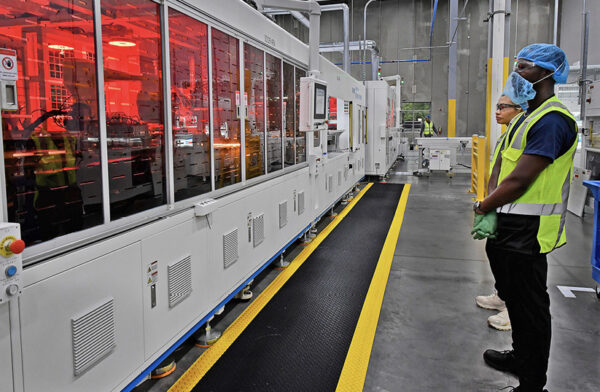
Poly and wafer
The upstream supply chain for silicon PV in the United States has so far seen less activity than cell and module manufacturing. Technical barriers and investment costs are higher in this sector, and requirements for the domestic content bonus outlined in the tax credit legislation can be met with U.S.-made cells and modules alone.
Pierce estimates the United States currently has polysilicon manufacturing capacity sufficient for around 17 GW of modules, from two facilities operated by Hemlock Semiconductor in Michigan and German company Wacker Chemie in Tennessee. Whether this may start to increase depends on the outcome of the Section 232 investigation, but even with increased demand for domestic product it may prove difficult. “With polysilicon there are so many challenges. It’s very energy intensive, lots of regulations regarding the chemicals involved, and it’s very expensive,” Pierce explained.
Corning, the majority owner of Hemlock Semiconductor, has invested $1.5 billion in a wafer production plant located in Michigan. South Korean owned Qcells is also building out 3.3 GW of ingot, wafer, cell, and module capacity in Georgia, and while a few other wafer projects have been announced, Pierce said there has been little recent activity on any of these.
Corning subsequently announced a deal with Heliene and cell manufacturer Suniva for a full polysilicon to module supply chain in the United States, claiming that modules manufactured under this partnership would have up to 66% domestic content. Zhu also confirmed that ES Foundry has plans in place to begin using US-made wafers in 2026.
Bill of materials
U.S. manufacturing for other module components is developing alongside the silicon supply chain. Pochtaruk confirmed that Heliene has been using U.S.-made backsheets, encapsulants, and frames since 2023, noting that several manufacturers for cables and junction boxes are present in the United States. “I would say that everything except glass is available in the U.S. today,” he said.
Similar to wafer and polysilicon factories, building new manufacturing facilities for solar glass comes at a very high investment cost, and solar glass has particular requirements for light transmission properties and low or zero iron content – meaning that securing long-term supply of suitable silica sand and other input materials is an additional challenge. Solarcycle is planning a facility in Georgia to produce solar glass from recycled PV module materials and has signed supply agreements with U.S. manufacturers including Silfab and Illuminate. In an August 2025 press release, the company described this facility as “shovel ready,” and said it is working to finalize remaining investments necessary to begin construction and targeting early 2028 for initial solar glass deliveries. Other solar glass facilities have been announced but appear to be struggling with financing, although First Solar has different glass requirements for its thin-film technology and is able to source glass within the United States.
Canadian Premium Sands had been planning a 4 GW solar glass facility in the United States, as well as a 6 GW facility in Manitoba, Canada. On Dec. 17, 2025, the company announced it would pause the development of these projects, citing uncertainty in both U.S. solar energy policy and U.S.-Canada trade relations. The company stated that it still expects strong demand for U.S.-made solar glass, and “will continue to monitor and evaluate the solar energy policy landscape in the U.S. to determine the appropriate time to re-engage with potential customers to advance its pattern solar glass manufacturing plans.”
The United States hosts some aluminum manufacturing, meaning that module frames can be sourced domestically. Though aluminum is the mainstream material for module frames, manufacturers are increasingly seeing benefits in switching to steel, creating a potential opportunity for the country’s well established steel industry. Tracker supplier Nextpower (formerly Nextracker) spotted this opportunity, and in September 2025, moved to acquire startup steel frame producer Origami Solar in a transaction worth $53 million.
“Modules have become larger, construction automation is underway, and advanced roll forming techniques enable Nextpower to design features that will greatly accelerate installation speed. Factor in the robust supply chain for U.S. steel manufacturing, and steel frames will be common in the U.S. in the coming years,” said Jenya Meydbray, vice president of PV module frames at Nextpower.
Although frame manufacturing is not included in the 45X tax credit, Meydbray noted that the demand for module components created by these incentives has been enough to attract investment, and that sourcing U.S.-made steel frames can add up to 6% to the domestic content requirements for project tax credits.
On the cell manufacturing side, Zhu confirmed that ES Foundry can source some input materials from suppliers in the United States, but mentioned metallization pastes as a particular challenge. “For silver and aluminum paste, no U.S. suppliers currently offer commercially viable products, and there is no clear roadmap for near-term localization. While progress is being made, some upstream materials will remain global for the foreseeable future,” he explained.
This content is protected by copyright and may not be reused. If you want to cooperate with us and would like to reuse some of our content, please contact: editors@pv-magazine.com.





By submitting this form you agree to pv magazine using your data for the purposes of publishing your comment.
Your personal data will only be disclosed or otherwise transmitted to third parties for the purposes of spam filtering or if this is necessary for technical maintenance of the website. Any other transfer to third parties will not take place unless this is justified on the basis of applicable data protection regulations or if pv magazine is legally obliged to do so.
You may revoke this consent at any time with effect for the future, in which case your personal data will be deleted immediately. Otherwise, your data will be deleted if pv magazine has processed your request or the purpose of data storage is fulfilled.
Further information on data privacy can be found in our Data Protection Policy.