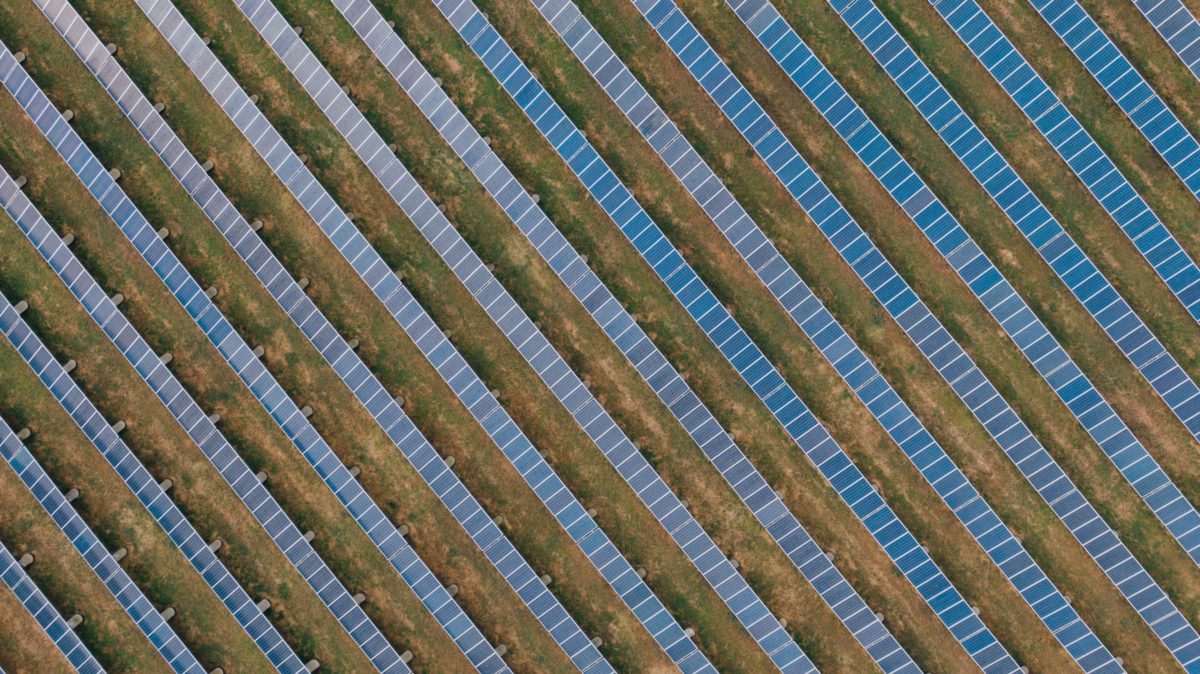





Many see a solar farm as a project centered on foundations, grid layouts, GPS positioning, permitting, access roads, pile driving, torque tube assembly, gear installation, module mounting, and the integration of battery energy storage systems (BESS) for electricity storage and transfer.
However, beneath these visible elements lies a much more elaborate system.
A modern solar field is more than a civil project with steel structures and modules. It is a precisely engineered system designed to withstand dynamic ecological loads, metallurgical constraints, geometric tolerances, and durability requirements for 25 to 35 years. What appears repetitive and simple from a distance is actually a large-scale exercise in precision engineering.
Structural geometry at utility scale
Tracker rows may look uniform, with identical steel posts, repeating spans, and symmetrical module arrays. However, maintaining geometric accuracy across thousands of tracker tables presents a complex tolerance management challenge.
Each roll-formed section has dimensional variation, and every punched hole has positional tolerance. Pile embedment varies with soil density, refusal depth, and driving alignment. Over hundreds of meters, these small deviations can cause structural misalignment, affecting torque tube straightness, bearing alignment, and motor loading.
A 0.5° misalignment deviation at a splice connection may be negligible on its own, but across a 100-table row, it results in measurable angular distortion. This increases torsional stress, causes uneven load distribution, and accelerates fatigue at connection points.
Solar trackers are rotating structural assemblies that are repeatedly subjected to wind loading. Precision is not cosmetic; it is essential for structural integrity.
Metallurgy: The silent backbone of durability
Steel grade selection in a solar field is intentional. Various types of High-strength low-alloy (HSLA) steels or Structural Steels are selected for their yield strength-to-weight efficiency, but higher strength introduces trade-offs such as reduced ductility, greater sensitivity to residual stress, and concerns about fatigue properties.
Roll forming introduces cold work and residual stresses into thin-walled sections. These stresses interact with the following factors:
- Wind-induced cyclic bending
- Thermal expansion and contraction
- Connection clamping forces
- Coating constraints
Over time, these processes determine whether a structure remains stable or develops microcracks in high-load areas.
Galvanizing thickness is also critical. While a thicker zinc layer improves corrosion resistance, excessive buildup can affect fit tolerances at slip connections. In humid or corrosive soils, localized corrosion near ground line interfaces is a key design concern. Microstructural consistency is important. Grain refinement, precipitation strengthening, and inclusion control all influence long-term fatigue resistance, especially in areas exposed to repeated loading.
Although solar fields differ from aerospace systems, their durability requirements require similar metallurgical foresight.
Environmental loading is not theoretical
Design calculations consider wind zones, soil classifications, and corrosion categories, but actual field conditions introduce variability.
Wind distribution varies across terrain, with gusts amplified at elevation changes. Soil moisture shifts seasonally, drainage channels cause localized corrosion, and thermal cycling leads to daily expansion and contraction, which stresses bolted joints.
Ultraviolet exposure in arid climates accelerates polymer degradation in bushings and wire insulation. In humid or coastal areas, chloride exposure reduces coating longevity. Freeze-thaw cycles cause soil heave, increasing bending stress on embedded piles.
Each environmental factor interacts with structural design, making the solar field a long-term test of material behavior under uncertainty.
The interface between manufacturing and installation
Precision manufacturing must extend through installation. Fastener torque affects clamping force: under-torqued bolts may loosen, while over-torqued bolts can strip threads or cause damage. Misaligned piles create eccentric loads on torque tubes, and misaligned bearings increase motor energy use and wear.
Automotive production uses strict geometric dimensioning and tolerancing (GD&T) to prevent cumulative errors. Solar projects, with tighter budgets and schedules, must maintain structural integrity quickly and efficiently.
Quality assurance must extend beyond the steel mill or fabricator shipment to include installation, calibration, and commissioning.
Fatigue: The long-term variable
Wind is not a single load event but a continuous source of oscillation throughout the system’s life. Single-axis trackers rotate daily and, under wind conditions, move to stow positions to minimize uplift and torsion. However, each wind gust produces stress cycles in:
- Pile-to-post connections
- Torque tube splices
- Bearing housings
- Gear interfaces
Fatigue failure develops gradually, often at stress concentration points created by minor geometric defects or coating disruptions. Designing for static load alone is insufficient. Long-term performance requires understanding stress range, mean stress, and the material’s resistance to crack initiation and propagation.
This is where metallurgical insight intersects directly with structural engineering.
Engineering beyond the visible
Public discussions about solar energy often focus on modules, inverters, tariffs, and battery storage. However, the supporting structural system determines the project’s long-term viability. Steel selection affects embodied carbon and cost. Coating thickness impacts maintenance intervals. Dimensional precision influences motor reliability, and soil interaction determines long-term stability. Solar decarbonization is often measured in gigawatts installed, yet these results depend on microns of coating thickness, millimeters of alignment, and metallurgical decisions made long before panel installation.
The structural engineering of the panels determines whether a project meets its expected lifespan without costly repairs. As solar installations expand across diverse regions and climates, the need for attention to structural and metallurgical details will grow. While panels generate electricity, it is steel, carefully designed, shaped, coated, installed, and aligned, that supports the load for many years. Achieving this level of precision is a significant challenge.
The views and opinions expressed in this article are the author’s own, and do not necessarily reflect those held by pv magazine.
This content is protected by copyright and may not be reused. If you want to cooperate with us and would like to reuse some of our content, please contact: editors@pv-magazine.com.

By submitting this form you agree to pv magazine using your data for the purposes of publishing your comment.
Your personal data will only be disclosed or otherwise transmitted to third parties for the purposes of spam filtering or if this is necessary for technical maintenance of the website. Any other transfer to third parties will not take place unless this is justified on the basis of applicable data protection regulations or if pv magazine is legally obliged to do so.
You may revoke this consent at any time with effect for the future, in which case your personal data will be deleted immediately. Otherwise, your data will be deleted if pv magazine has processed your request or the purpose of data storage is fulfilled.
Further information on data privacy can be found in our Data Protection Policy.