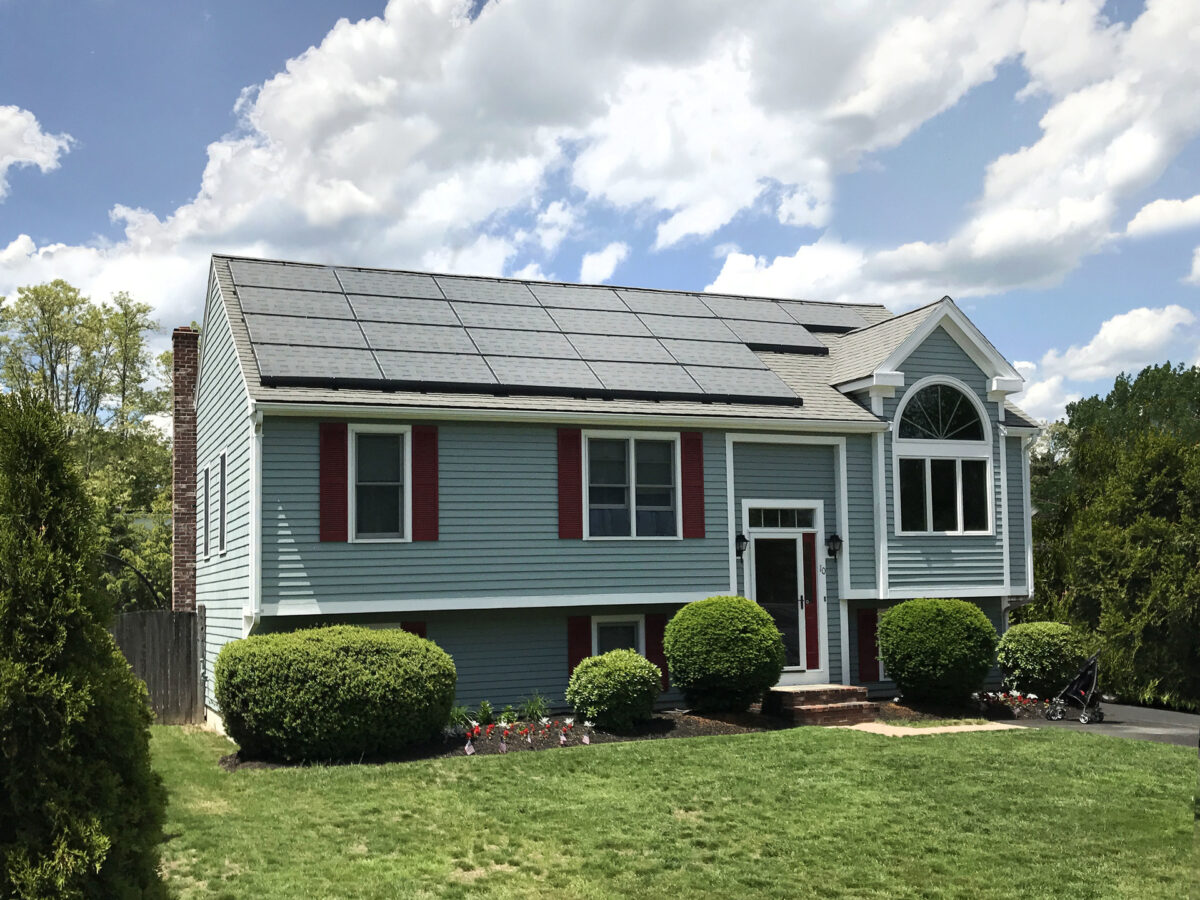





Massachusetts climate bill H 5151, which passed in the House 128-27, has conservation and renewable energy groups saying it doesn’t go far enough to boost affordability or quell use of fossil fuels.
The redraft of a bill originally released in November 2025 retains provisions that will advance solar and storage by cutting interconnection and deployment bottlenecks by streamlining permitting. Furthermore, it expands municipal net metering by increasing capacity to 20 MW and supports implementation of virtual power plants. However, it also cuts funding to Mass Saves, paves the way for more nuclear development and delays an offshore wind deadline.
One group that is lauding the bill for its pro-solar components is the Coalition for Community Solar Access (CCSA), a national trade national trade association working to expand customer choice and access to solar for all. CCSA thanked the House Ways & Means Committee and Chair Michlewitz, along with Chair Cusack and the Telecommunications, Utilities and Energy Committee, for their hard work advancing the bill.
“Importantly, it recognizes that clean energy is not the cause of high bills, but part of the solution to lower them,” CCSA said in a statement.
Vote Solar, a non-profit policy advocacy organization with the mission of making solar more accessible and affordable across the United States, found fault with the $1 billion in cuts to Mass Save. The group sees these cuts as short sighted and believe the bill should instead have focused instead on a “long-term solution to address energy affordability.”
Mass Save is a collaborative effort of Massachusetts’ electric and natural gas utilities and energy efficiency service providers to enable residents, businesses and communities to make energy efficient upgrades by offering services including rebates, incentives and training. An incentive for solar, for example, includes a 0% financing offer for solar battery backup storage for residential customers.
“The bill includes many forward-thinking measures to advance local solar and work towards a distributed, resilient, and affordable grid; however, it excludes solutions that address the true costs of rising utility bills,” Vote Solar said in a statement.
Conservation Law Foundation Vice President for Climate and Energy Caitlin Peale Sloan also found fault with cuts to the Mass Save program, calling it a “ruinous attack… that doesn’t make any attempt to rein in gas system costs.” Sloan added that, “In a time when the federal government is doing all it can to bow down to expensive, price-volatile fossil fuels, we need state leaders to have the courage to lead. The reality is that clean energy is affordable energy. We have to go all in on building clean energy and leveraging energy efficiency – that’s what families and businesses are asking of our legislature.”
Acadia Center, an organization with a mission to advance clean energy solutions, also released a statement about what it calls “devastating, billion-dollar cuts to the Commonwealth’s energy efficiency program, Mass Save.” It also disputes the claim that the cuts will come from marketing, advertising and program administration costs, stating that the planned spend during its three-year planning cycle is less than $150 million.
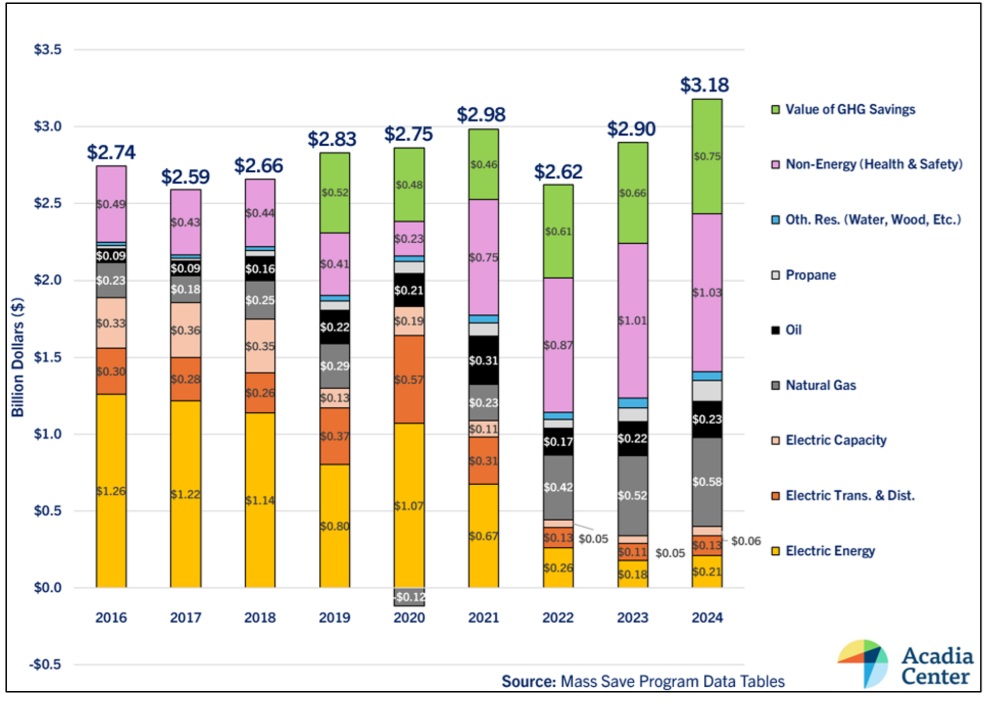
Value of savings (in billions) of the Mass Save program. Source: Acadia Center
“What this $1 billion reduction would therefore mean is deep cuts to energy efficiency incentives and slashed customer access, effectively shutting down many parts of the program and harming one of our best tools to deliver affordable energy bills and achieve our climate goals,” the Acadia Center said in a statement.
In addition to cutting the Mass Save budget, the redraft doesn’t include the committee’s proposal to change the state mandate to reducing carbon emissions by 50% below 1990 levels by 2030.
Vote Solar’s Northeast regional director, Lindsay Griffin believes the bill missed the mark by not holding utilities accountable “for prioritizing their profits over the communities they serve.”
The Massachusetts Senate is expected to draft its own version of the bill.
This content is protected by copyright and may not be reused. If you want to cooperate with us and would like to reuse some of our content, please contact: editors@pv-magazine.com.







By submitting this form you agree to pv magazine using your data for the purposes of publishing your comment.
Your personal data will only be disclosed or otherwise transmitted to third parties for the purposes of spam filtering or if this is necessary for technical maintenance of the website. Any other transfer to third parties will not take place unless this is justified on the basis of applicable data protection regulations or if pv magazine is legally obliged to do so.
You may revoke this consent at any time with effect for the future, in which case your personal data will be deleted immediately. Otherwise, your data will be deleted if pv magazine has processed your request or the purpose of data storage is fulfilled.
Further information on data privacy can be found in our Data Protection Policy.