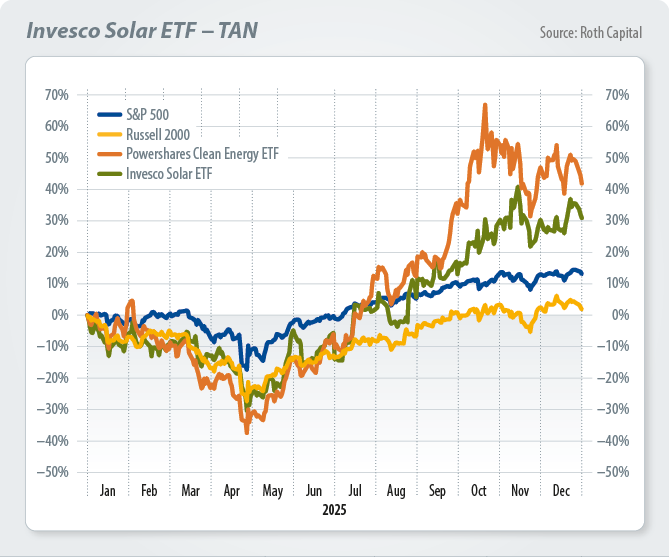





The U.S. solar market is entering a period of adjustment driven by policy uncertainty, the expiration of residential tax incentives, and changes in customer financing structures. Based on recent discussions with contacts in Washington, DC, residential and commercial and industrial (C&I) market participants, and installer surveys, visibility remains limited, but several directional themes are becoming clearer.
Recent checks indicate that there is no clear consensus on the timing of potential Section 232 action related to polysilicon imports. Several contacts believe the Department of Commerce is unlikely to issue a ruling before the upcoming US-China leadership meeting in April, with some suggesting May as a more realistic window. That view appears to be informed by a belief that the administration is avoiding additional trade friction ahead of the meeting.
Views are not uniform. Other informed observers said external political developments could lead to an earlier decision, particularly if a Supreme Court ruling constrains tariff authority under IEEPA, prompting a more immediate response. Importantly, contacts consistently emphasized that visibility into the final structure remains low, with no clear indication yet whether tariffs, quotas, or another mechanism will be pursued. Policy-related uncertainty around sourcing, pricing, and supply chains is likely to persist through at least the first half of 2026.
Residential headwinds
Residential solar participants indicate 2026 is expected to be a down year for the segment, although the scale of installation decline is still debated. Several noted it is still early, with better visibility expected later in the first quarter or early in the second quarter.
There is also disagreement on the quarterly profile. Some installers expect the first quarter of 2026 to be difficult, with potential stabilization or recovery in the second half of the year. Others believe the slowdown is already underway and that expectations for strength carrying from late 2025 into early 2026 may be overly optimistic. Market participants in California and the Northeast report more stable conditions, but those serving other regions describe sharper deterioration. Most expect some degree of recovery in 2027, though they generally describe it as modest growth off a weaker 2026 base rather than a strong rebound.
C&I stability
Compared to residential, the C&I segment is viewed as more stable, though not immune to pressure. Industry participants generally expect C&I demand in 2026 to range from flat to modestly down.
Timing effects related to safe harboring are expected to play an important role. Some anticipate shipments will be pulled forward in early 2026, tied to projects safe harbored in late 2025. This could be followed by another wave later in the year as additional projects are positioned to preserve tax credit eligibility. As a result, C&I demand may appear uneven over the course of the year rather than consistently strong.
With the residential investment tax credit under Section 25D no longer available, installers and financiers are increasingly focused on prepaid structures as an alternative. That said, there remains confusion in the market around product definitions.
Not all prepaid offerings are leases. Some providers offer prepaid power purchase agreements that have been in the market for several years and are supported by institutional capital. These products are generally viewed as well understood and operationally proven, and are now receiving increased attention as installers look to offset lost 25D driven volume.
Market signals
Other recent checks point to continued pressure in residential. Some hardware providers appear to have been removed from third-party ownership approved vendor lists, which could further constrain installer options. Service providers for residential and smaller C&I markets report demand softness tied directly to the expiration of consumer tax incentives.
Visibility remains limited, particularly around Section 232 and residential demand trajectories, and views across the industry remain mixed. What is clear is that the removal of 25D is having a meaningful impact on residential solar, accelerating the industry’s reliance on alternative financing structures. While 2026 is widely expected to be challenging for residential installations, most participants still anticipate stabilization and modest growth in 2027, assuming policy conditions do not deteriorate further. Jesse Pichel and Lev Seleznov
The views and opinions expressed in this article are the author’s own, and do not necessarily reflect those held by pv magazine.
This content is protected by copyright and may not be reused. If you want to cooperate with us and would like to reuse some of our content, please contact: editors@pv-magazine.com.

By submitting this form you agree to pv magazine using your data for the purposes of publishing your comment.
Your personal data will only be disclosed or otherwise transmitted to third parties for the purposes of spam filtering or if this is necessary for technical maintenance of the website. Any other transfer to third parties will not take place unless this is justified on the basis of applicable data protection regulations or if pv magazine is legally obliged to do so.
You may revoke this consent at any time with effect for the future, in which case your personal data will be deleted immediately. Otherwise, your data will be deleted if pv magazine has processed your request or the purpose of data storage is fulfilled.
Further information on data privacy can be found in our Data Protection Policy.