




The levelized cost of electricity (LCOE) of solar energy is set to fall 30% by 2035, according to analysis from BloombergNEF.
The analyst’s Levelized Cost of Electricity 2026 report says that while benchmark costs for solar all rose in 2025, due to a combination of supply chain constraints, poorer resource availability and market reforms in China, innovation and competition will lead to declining costs over the next decade.
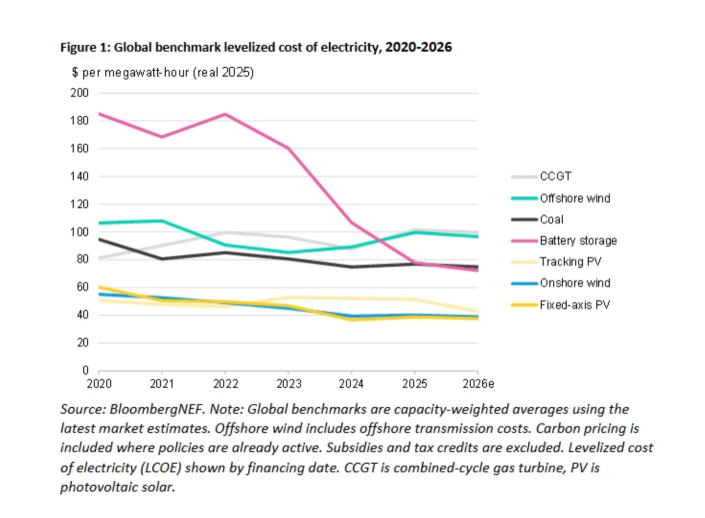
The global benchmark LCOE for a typical fixed-axis solar farm increased by 6% year-on-year to stand at $39/MWh in 2025, according to Bloomberg’s data. At the start of the decade, fixed-axis solar had a global benchmark LCOE of a little over $60/MWh. Its current costs compare to a $40/MWh LCOE for onshore wind and $100/MWh for offshore wind.
Bloomberg’s latest analysis adds that while most clean power technologies became more expensive last year, the cost of battery storage projects fell to new lows.
The global benchmark LCOE for a four-hour battery project fell 27% year-on-year to $78/MWh, a record low since BNEF began tracking costs in 2009. At the start of the decade, the global benchmark LCOE for these projects was over $180/MWh, and was still above $100/MWh in 2024.
Last year’s LCOE decline for battery projects was attributed to lower pack prices, increasing competition among manufacturers and improved system designs. BNEF is expecting battery storage LCOE to fall by a further 25% over the next decade.
Bloomberg also found that developers added 87 GW of combined solar and storage last year, delivering power at an average LCOE of $57/MWh.
“As costs continue to drop, we expect battery storage to strengthen solar project revenues, support broader renewable deployment and accelerate the shift toward storage‑led system balancing over fossil-fuel‑based peaking capacity,” commented Amar Vasdev, lead author of the report.
Last month, an international research team found Capex-driven strategies can help to reduce solar LCOE by 20%.
This content is protected by copyright and may not be reused. If you want to cooperate with us and would like to reuse some of our content, please contact: editors@pv-magazine.com.



By submitting this form you agree to pv magazine using your data for the purposes of publishing your comment.
Your personal data will only be disclosed or otherwise transmitted to third parties for the purposes of spam filtering or if this is necessary for technical maintenance of the website. Any other transfer to third parties will not take place unless this is justified on the basis of applicable data protection regulations or if pv magazine is legally obliged to do so.
You may revoke this consent at any time with effect for the future, in which case your personal data will be deleted immediately. Otherwise, your data will be deleted if pv magazine has processed your request or the purpose of data storage is fulfilled.
Further information on data privacy can be found in our Data Protection Policy.