





Technically, all batteries can be run as ‘long duration’ batteries, and they can run for twenty four hours so long as the power output is limited relative to the stored energy. However, when some batteries run overnight it means a little more.
On Sunday February 1, 2026 in the California Independent System Operator (CAISO) power grid region, batteries gave just a little more. CAISO, which serves 80% of the state’s electricity needs, never stopped feeding the grid with batteries, staying on till the sun came up. Additionally, since the batteries are charged mostly by cheap – would have been curtailed – solar electricity, one can reasonably argue that sunlight at least partially powered the state for well beyond 24 hours straight.
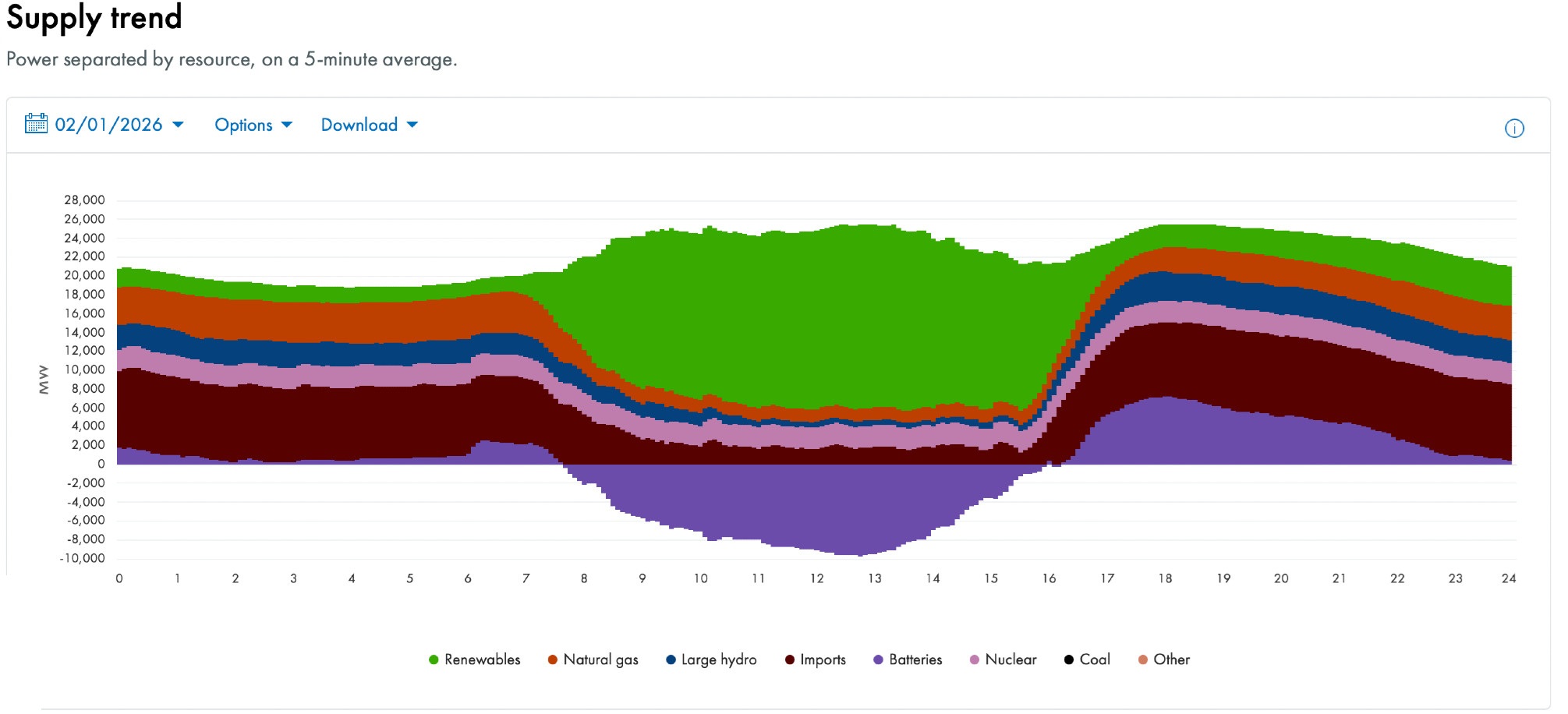
Image: CAISO Supply Trend chart from February 1, 2026
The large green swath represents the renewables, which are mostly solar, that take over for the entirety of California’s daytime electricity needs. During the day, the batteries (represented by the purple portion dipping deep into the ‘negative supply’ region of the chart) charged from excess solar power right until the solar generation dropped around 4:15 PM. Taking their cue, the batteries again started powering the state, exporting electricity through midnight until 12:30 AM the next day.
The State of California was to some degree powered directly by solar and indirectly via batteries, starting at 4:05 am on January 31st through February 2nd at 12:30 am for a total of 44 hours and 25 minutes straight.
While technically none of the batteries followed the exact same charging/discharging schedule as the entire battery fleet, it is impossible to say “one battery” powered the state all day. In fact, during the periods where we celebrated that batteries were exporting to the grid, there were probably batteries also charging.
California’s aims in deploying their battery fleet are to blend together many energy resources, including soon to be integrated New Mexican and eventually offshore wind – to rid the state of fossil fuels. These batteries coupled with such a massive solar initiative are expediting the gaa to solar process.
Additionally, batteries are becoming the greatest source of electricity in the morning hours.
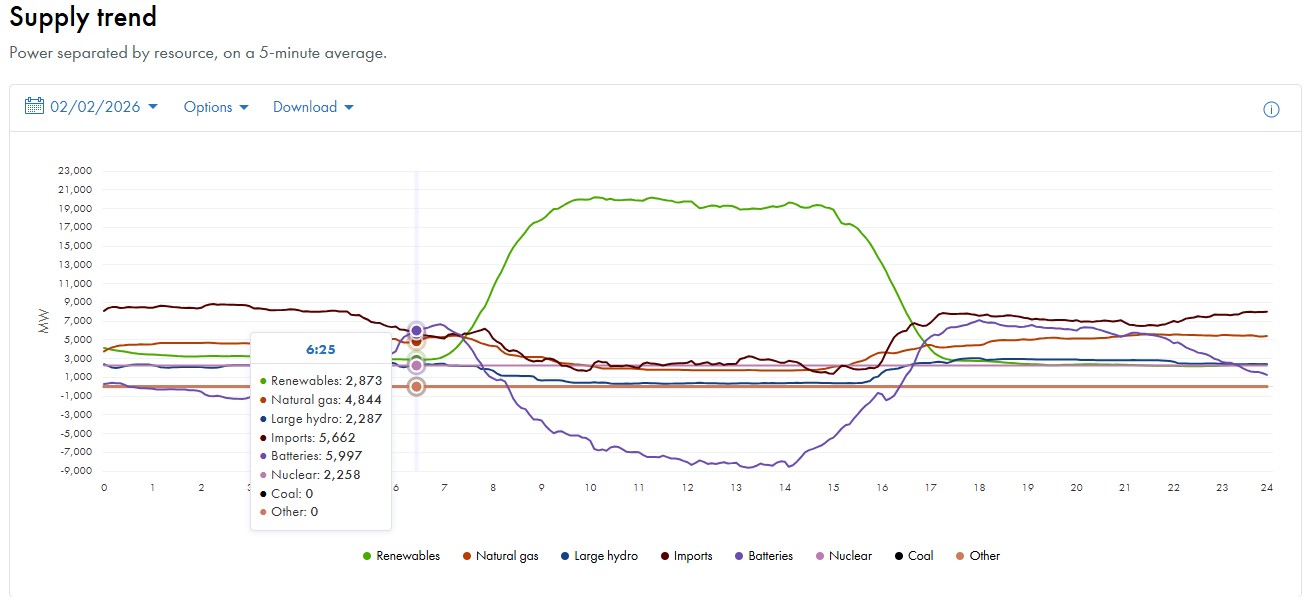
Image: CAISO Supply Trend chart from February 2, 2026
While batteries have been the greatest source of electricity on the CAISO evening grid since the first half of 2024, this may be one of the first times they are taking over before the sun rises. The batteries are exporting during this period because of elevated pricing driven by people waking up and getting to work and school before the sun gets going, and the instantaneous solar generation starts picking up.
Starting at 6:25 AM on February 2nd, batteries took over as the main source of electricity feeding the power grid. They remained as the primary source for about an hour before trailing off over the next hour and transitioning to charging at 8:20 am. On the same day, the batteries came close to being the number one source of electricity in the evening as well.
How long until solar or batteries are the number one source of electricity for a whole day?
This content is protected by copyright and may not be reused. If you want to cooperate with us and would like to reuse some of our content, please contact: editors@pv-magazine.com.




“Technically, all batteries can be run as ‘long duration’ batteries, and they can run for twenty four hours so long as the power output is limited relative to the stored energy.”
Finally, someone debunks the long duration battery myth. Thanks John!
As well, just like flow batteries, a utility scale lithium ion battery can ‘simply’ add on more energy storage capacity (ie more kWhs) behind the same battery inverter gear. And this would expand hte battery storage capacity behind hte same output.
The original installation needs to be able to handle it of course (ie via a busbar or some other place where connections can land and electrons co-mingle), but that’s another ‘sales pitch’ I hear from flow folks.
This is great news but let’s not get carried away with ourselves. I does provide a “proof of concept” but now California needs to get on with finishing the transition. I check the CAISO current conditions site frequently and natural gas still powers 40% or more of the grid at times during many days. Given that the California economy is the 5th largest in the world, they are still burning more gas than most countries. C’mon CA, lets get that New Mexico and Wyoming wind, that offshore floating wind, more solar, more batteries and show the world what can be done! Those of us living in deep red states need to be able to point to that.
Agree with everything there Joe.
The more important result here is that most of the power was ‘zero emissions’. Other than the thin orange band for natural gas and the wider burgundy one for electricity imported from other states, which presumably was partially generated by fossil fuels, this was a full day of mostly ‘clean’ power for the state with the largest economy… in the middle of winter. Obviously, demand will increase as we move towards summer, but so will the amount of electricity generated by solar.
Basically, the chart shows that there is no reason we cannot get to zero GHG emissions. Just increasing solar, wind, and battery in California and surrounding states will get us there. Battery storage especially is becoming a game changer… it can be ‘deployed’ orders of magnitude more quickly than any other electricity source and can eliminate the ‘intermittency problem’ of solar and wind power.