





When sustainable engineering firm PAE and energy tech company SolarEdge set out to build Portland, Oregon’s first fully certified Living Building in the city’s historic Skidmore district, the primary objective was to make it entirely net-zero energy. The Living Building Challenge is one of the most ambitious green building standards in the world and requires buildings to adopt sustainable practices related to water, energy, equity and beauty, among other factors.
Now, five years after the end of construction, the PAE Living Building boasts 133 kW onsite and 215 kW offsite solar coupled with 280 kWh of battery storage and is one of few projects capable of acting as a grid-forming microgrid in a downtown area where two-way interconnection is usually prohibited.
Though the companies determined early on that rooftop solar would be the best path for onsite generation, Craig Collins, an associate at PAE, explained that pursuing that option seemed challenging.
First, historical preservation rules in the neighborhood prevented any modules from being installed that were visible from the street level; while facade-integrated PV glazing was considered, Collins noted it would have provided “minimal additional annual energy generation” at “extreme additional expense.”
That reality pushed PAE toward a hybrid onsite/offsite approach. Still, regulatory red tape also made things tricky.
“The project siting required taking electrical service from Portland General Electric’s (PGE) ‘downtown area network’ grid,” he said in an exclusive interview with pv magazine USA, explaining that this type of utility grid topography is a normal site in US urban areas. While this does provide high levels of reliability, Collins noted, it’s not designed for distributed generation.
Interconnection for customer renewables is tightly capped to avoid reverse power flow that could trip protective relays on network transformers. When PAE applied to interconnect, the remaining hosting capacity was just 57 kW, which was later reduced to 49 kW during Covid as downtown loads fell. At the time, the utility’s largest concern centered on how PAE and SolarEdge would ensure the onsite array and battery inverter wouldn’t export more than their allowance.
SolarEdge’s vice president of sales, commercial and industrial, Chuck Ellis, explained that projects like Portland’s Living Building require “precise coordination” between system components. Inverters had to be capable of responding reliably to real-time curtailment commands from the microgrid controller while still maintaining performance.
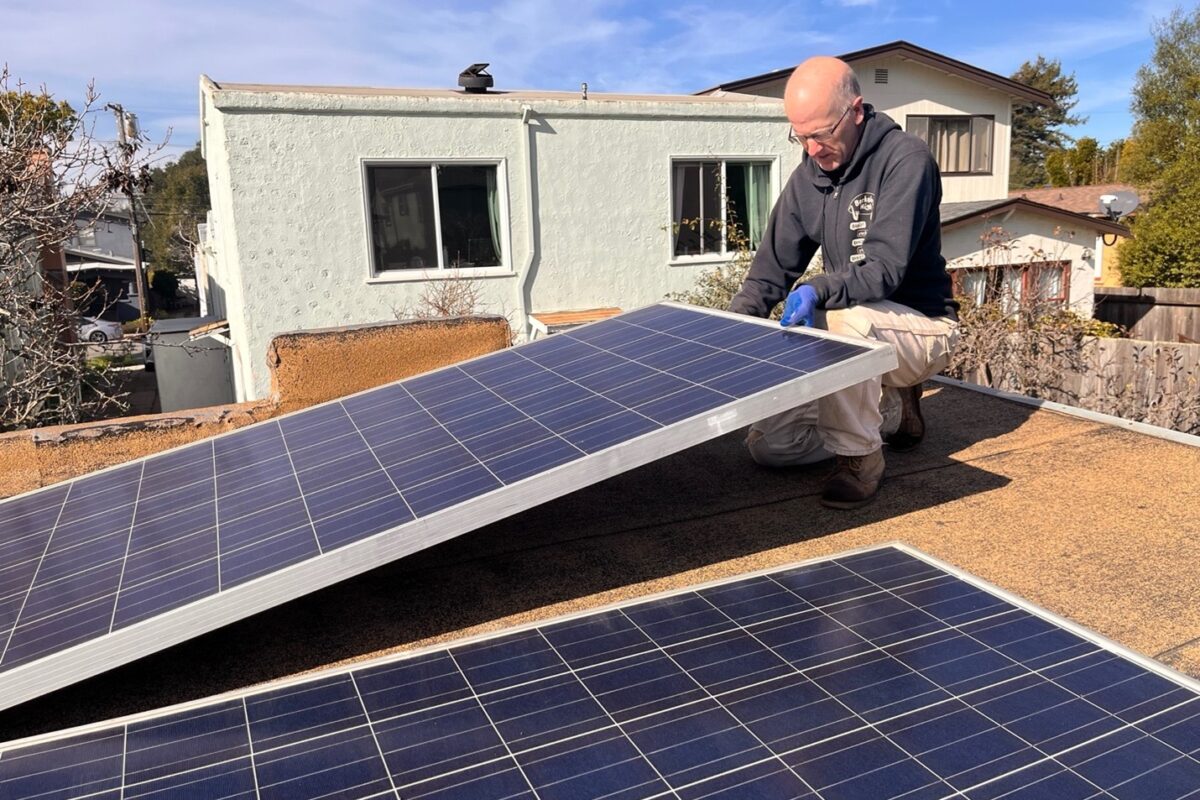
“That is a fundamentally different technical requirement than a standard grid-tied system,” he said. Ultimately, the companies installed a 132.6 kWdc rooftop array alongside the battery and a Schneider Electric microgrid controller that ensures the export cap is never exceeded even when the system produces far more power behind-the-meter than is used.
In total, the assets deliver about 113% of the building’s annual energy needs from renewables, with all extra energy being delivered to the PGE grid onsite at the PAE Living Building grid connection or at the Renaissance Commons Apartments grid connection. The latter array, according to Collins, was “purely a donation to that low income housing community” that helps offset its operating costs.
The building is also capable of running entirely islanded operations, though at reduced capacity. During outages, the microgrid intentionally waits several seconds before separating from the grid and then sheds load softly instead of going dark immediately.
At a critical low state of charge, Collins explained, all mechanical space conditioning systems are stopped and lighting is dimmed to low levels for safety reasons. Only the in-building compost ventilation fans are allowed to continue to operate, he said, and the companies “estimate that the building will operate with minimal function lighting and ventilation function for at least one week” even during a mid-winter outage.
Five years in, real-world performance has largely validated the original modeling. According to PAE senior principal Marc Brune, the building’s energy use has hovered around 5% of what was anticipated, and solar generation has also tracked closely with predictions.
“The battery storage system has been the most variable,” he said, as there’s been a learning curve around the best ways to efficiently use, meter, charge and discharge the battery. Even so, both companies consider the project a success.
“PGE deserves a lot of credit for working with us to make the PAE Living Building project a reality,” Collins said, pointing out that the project highlights that “it’s possible to deploy onsite PV at every building on an area network without causing any issues with over-export to the grid.”
This content is protected by copyright and may not be reused. If you want to cooperate with us and would like to reuse some of our content, please contact: editors@pv-magazine.com.




By submitting this form you agree to pv magazine using your data for the purposes of publishing your comment.
Your personal data will only be disclosed or otherwise transmitted to third parties for the purposes of spam filtering or if this is necessary for technical maintenance of the website. Any other transfer to third parties will not take place unless this is justified on the basis of applicable data protection regulations or if pv magazine is legally obliged to do so.
You may revoke this consent at any time with effect for the future, in which case your personal data will be deleted immediately. Otherwise, your data will be deleted if pv magazine has processed your request or the purpose of data storage is fulfilled.
Further information on data privacy can be found in our Data Protection Policy.