




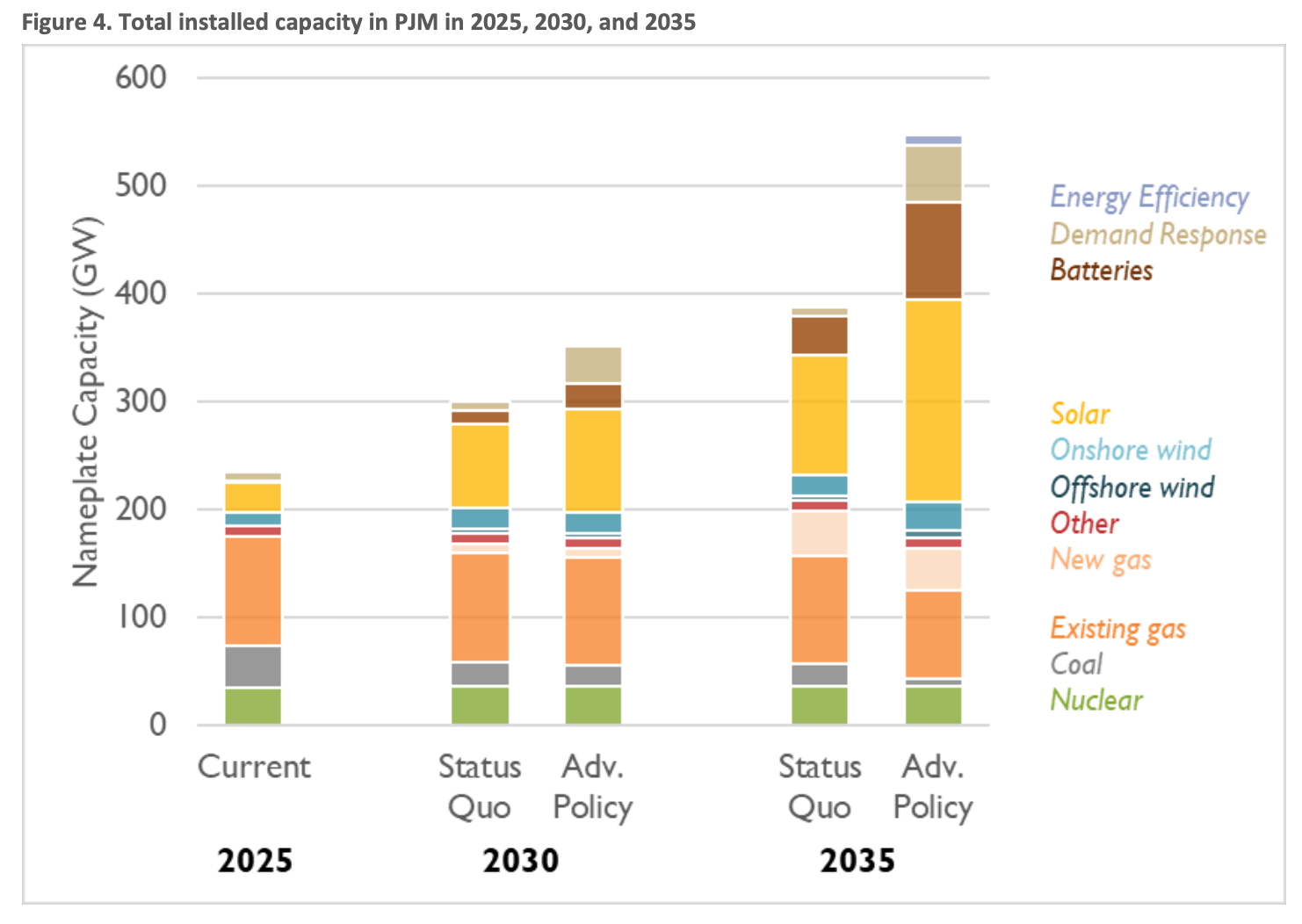
A study by Synapse Energy Economics prepared for Advanced Energy United found that doubling the current pace of deployment of solar, wind, storage in the PJM grid region through 2030, and increasing that pace through 2035, would drive $178 billion in savings compared to a status quo scenario.
That outcome is “realistic and doable,” said AEU’s Senior Director of Wholesale Markets Jon Gordon. AEU worked with Synapse to “envision an ambitious but achievable policy, regulatory, and market reform pathway,” he said, that can be accomplished “given the appropriate focus and priority by PJM and the states.”
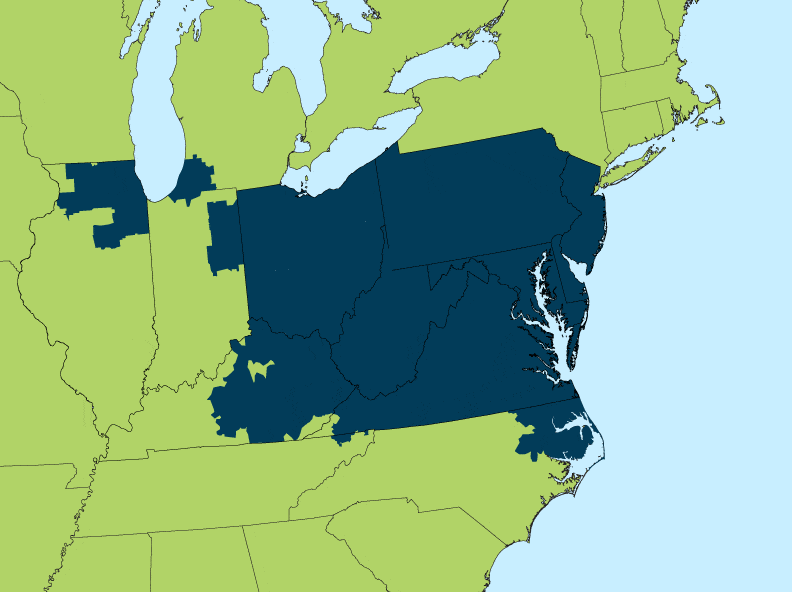
All or parts of 13 states plus Washington, DC are included in the PJM region, which stretches from Chicago to New Jersey.
The “advanced policy” scenario in Synapse’s study would deploy 78 GW more solar and 54 GW more battery storage than the status quo scenario by 2035, as well as added demand response, as shown in the last two columns of the graph below from the Synapse report.
The study focused on achieving a low-cost generating portfolio that meets reliability standards.
Synapse’s reliability modeling showed that in both 2030 and 2035, the advanced policy scenario has “fewer power outages, with shorter durations, and affecting fewer customers,” than the status quo scenario.
Synapse used the Encompass model for developing resource portfolios and the SERVM model to check the reliability of potential portfolios.
Enabling policies
The study observes that PJM reported last summer that 46 GW of projects had interconnection service agreements but had not yet reached commercial operation.
Gordon of AEU called for streamlining siting and permitting processes “via state legislative and regulatory action.”
He also called on PJM to “achieve the FERC-mandated 150-day timeline for interconnection studies” and to “manage the queue in an unbiased fashion without preferential treatment for large-scale thermal generation.”
Gordon said “PJM has expressed confidence” that its reformed queue process, set to launch in April, “will yield significantly faster interconnection timelines,” and that PJM “has demonstrated an ability and willingness to expedite the interconnection process for certain resources.”
“Those data points indicate that a faster process and higher completion rates are possible if PJM follows through on current reforms and focuses on further improvements to the interconnection process,” he said.
As for distributed energy resources, Gordon called for “fully leveraging” distributed resources “across PJM states and at PJM via expanded PJM market access for those resources, and new retail programs in states that fully compensate distributed resources for the value they provide to the grid.”
PJM’s response
PJM was asked whether it is possible to achieve a doubling of the “advancement rate” for large-scale renewables and storage—that is, progressing from the “active” phase in the interconnection queue to commercial operation—through 2030, as postulated in Synapse’s “advanced policy” scenario.
A PJM spokesperson said “PJM’s reformed interconnection process uses a first-ready, first-served cycle-study method with investment milestones designed to expedite the most viable projects. This new process should result in approved projects that are stronger from a financial and constructability standpoint because of the milestones that have to be met to advance through the process. Whether those more robust projects can surmount the challenges awaiting them beyond PJM, like state and local permitting, supply chain and financing, remains to be seen.”
Asked whether it is possible to achieve an even greater pace of deploying large-scale renewables, storage and other “advanced energy technologies”—termed AET in the study—from 2031-2035 as modeled in the study, the spokesperson said “PJM has more than 55 GW of projects with signed agreements that should be ready to build. Most of these would fall under the AET description. We have another 25 GW of mostly renewable projects that will be processed this year, and in April an undetermined number of new projects will come in through our new interconnection process and be completed in 1-2 year be completed this year.”
The spokesperson added that “the Federal Energy Regulatory Commission on January 29 approved the timing aspects of PJM’s new study process, and we continue to work with Google/Tapestry on ways to leverage AI to further streamline the process. So there will be plenty of these projects coming through the PJM process by 2030, including many that are already cleared to build; the challenge is actually turning those planned projects into functioning generation resources that are contributing to the PJM grid.”
PJM first announced its work with Tapestry in April 2025.
The Synapse study is titled “The next decade in PJM: A path to reliability and affordability.”
This content is protected by copyright and may not be reused. If you want to cooperate with us and would like to reuse some of our content, please contact: editors@pv-magazine.com.




By submitting this form you agree to pv magazine using your data for the purposes of publishing your comment.
Your personal data will only be disclosed or otherwise transmitted to third parties for the purposes of spam filtering or if this is necessary for technical maintenance of the website. Any other transfer to third parties will not take place unless this is justified on the basis of applicable data protection regulations or if pv magazine is legally obliged to do so.
You may revoke this consent at any time with effect for the future, in which case your personal data will be deleted immediately. Otherwise, your data will be deleted if pv magazine has processed your request or the purpose of data storage is fulfilled.
Further information on data privacy can be found in our Data Protection Policy.