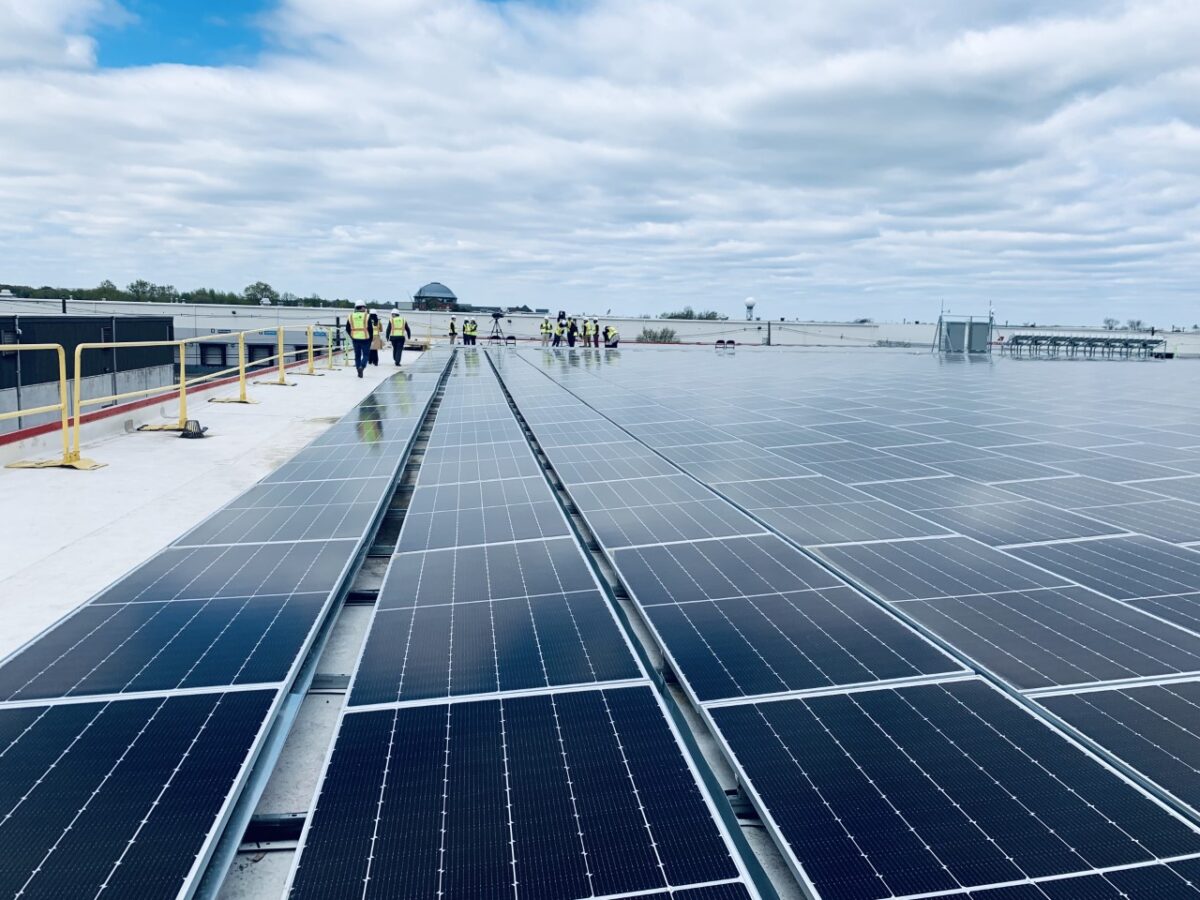





New Jersey has improved its policies for interconnecting distributed solar and storage, earning the state a top ten ranking on the “Freeing the Grid” scorecard published by the renewables-focused group IREC, said David Golembeski, senior program manager at IREC.
New Jersey’s new policy streamlines the review processes for smaller projects, expands the number of projects that qualify for the most streamlined reviews, and includes provisions that “open the door for flexible interconnection,” IREC said in a statement. The regulation also clarifies that battery storage qualifies for the new interconnection processes.
While applauding New Jersey’s progress, IREC also called for state regulators to make further improvements. New Jersey could consider adopting the IEEE 1547-2018 smart inverter standard, which enables more solar on distribution circuits, IREC said, and consider “strengthening” the quality of grid data in the hosting capacity maps published by utilities, to clearly show where more solar may be deployed without incurring grid expense.
Export capacity
Several of the improvements to interconnection policy changed the basis of a requirement from a project’s nameplate capacity to its export capacity. The policy also specifies acceptable export control methods.
These changes “are important,” Golembeski said, because many energy storage systems or solar-plus-storage systems will use export controls to avoid or reduce the need for grid upgrades.
Before the changes, only projects with a capacity of up to 25 kW could qualify for New Jersey’s simplest, Level 1 interconnection review process. Now, projects with a nameplate capacity of up to 50 kW and an export capacity of up to 25 kW could qualify.
Projects that could qualify for the next simplest, Level 2 interconnection process were formerly those sized at up to 2 MW. Now, projects could be eligible if they have an export capacity of up to 2 MW.
Two screens that apply to both Level 1 and Level 2 now qualify projects based on the resulting total export capacity on a circuit, rather than the total generation capacity. One screen applies to a facility connecting to a radial line segment, and the other to a facility connecting to a single-phase shared secondary circuit.
Projects that do not qualify for Level 1 or Level 2 interconnection review default to Level 3 interconnection review.
Fixed export limits
By considering export capacity in the interconnection screening criteria, the new policy provides “a streamlined pathway for export-limited projects to enter the queue and operate on the grid,” said Golembeski.
But the policy does not authorize flexible interconnection, he said, “because the project export limits must stay the same for the entirety of the project life,” while “true flexible interconnection would allow the project’s export values to vary based on hourly, daily or seasonal variations in grid hosting capacity.”
Among the states advancing flexible interconnection for distributed energy resources are Colorado, California and New York.
Siting tools
Golembeski said that under New Jersey’s new policy, customers also have access to “robust pre-application reports to help them make informed decisions, minimizing speculative interconnection requests and queue backlogs.” The policy also creates a process for timely dispute resolution that includes a third-party facilitator, he said.
IREC participated in the New Jersey rulemaking process, providing 26 technical comments recommending specific improvements.
New Jersey last updated its interconnection rules in 2010. Sky Stanfield, lead regulatory counsel for IREC, said that IREC encourages New Jersey regulators to consider more frequent updates.
This content is protected by copyright and may not be reused. If you want to cooperate with us and would like to reuse some of our content, please contact: editors@pv-magazine.com.


By submitting this form you agree to pv magazine using your data for the purposes of publishing your comment.
Your personal data will only be disclosed or otherwise transmitted to third parties for the purposes of spam filtering or if this is necessary for technical maintenance of the website. Any other transfer to third parties will not take place unless this is justified on the basis of applicable data protection regulations or if pv magazine is legally obliged to do so.
You may revoke this consent at any time with effect for the future, in which case your personal data will be deleted immediately. Otherwise, your data will be deleted if pv magazine has processed your request or the purpose of data storage is fulfilled.
Further information on data privacy can be found in our Data Protection Policy.