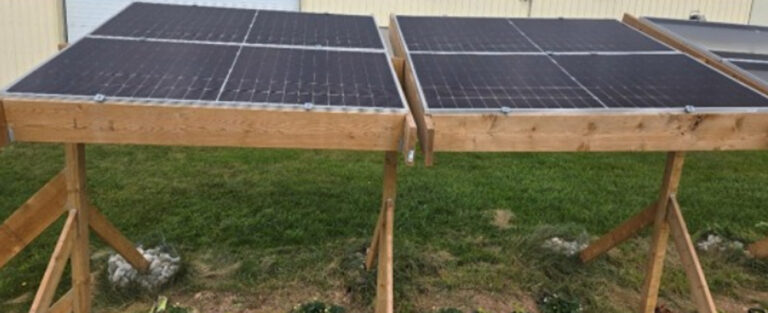





A research group from Canada’s Western University has investigated the performance of organic romaine lettuce, a heat-sensitive crop, under a broad range of agrivoltaic conditions. The test was conducted in London, Ontario, in the summer of 2025, during which 18 days had temperatures over 30 C.
“Our study explores how agrivoltaic systems can be tailored to optimize crop growth, especially under extreme heat conditions, while contributing to sustainable energy generation,” corresponding researcher Uzair Jamil told pv magazine.
“This becomes especially relevant in the context of climate change, where we are experiencing temperature extremes across the world,” Jamil added. “We examined the performance of organic romaine lettuce under thirteen different agrivoltaic configurations – ranging from crystalline silicon PV to thin-film-colored modules (red, blue, green) – in outdoor, high-temperature stress conditions.”
More specifically, the experiment included c-Si modules with 8%, 44% and 69% transparency rate; blue c-Si modules with transparency of 60%, 70%, and 80%; green c-Si modules with transparency of 60%, 70%, and 80%; and red c-Si modules with transparency of of 40%, 50%, 70%, and 80%.
All agrivoltaics installations had a leading-edge height of 2.0 m and a trailing-edge height of 2.8 m, and the modules were oriented southwards at 34◦. Pots with organic romaine lettuce were placed under all configurations, along with three pots fully exposed to ambient sunlight without shading, used as controls.
In addition to measurements against the control, the scientific group has compared the results to the national average per-pot yield for 2022, which included less high-temperature days and was therefore considered typical. Those data points were taken from agricultural census data, which later enabled the researcher also to create nationwide projections of their results.
“Lettuce yields increased by over 400% compared to unshaded control plants, and 200% relative to national average yields,” Jamil said about the results. “60% transparent blue Cd-Te and 44% transparent crystalline silicon PV modules delivered the highest productivity gains, demonstrating the importance of both shading intensity and spectral quality in boosting plant growth.”
Jamil further added that if agrivoltaic were to scale up to protect Canada’s entire lettuce crop, they could add 392,000 tonnes of lettuce.
“That translates into CAD $62.9 billion (USD $46.6 billion) in revenue over 25 years,” he said. “If scaled across Canada, agrivoltaics could also reduce 6.4 million tonnes of CO2 emissions over 25 years, making it a key player in reducing the agricultural sector’s environmental footprint.”
The results of the research work were presented in “Enhancing heat stress tolerance in organic romaine lettuce using crystalline silicon and red, blue & green-colored thin film agrivoltaic systems,” published in Solar Energy.
This content is protected by copyright and may not be reused. If you want to cooperate with us and would like to reuse some of our content, please contact: editors@pv-magazine.com.


By submitting this form you agree to pv magazine using your data for the purposes of publishing your comment.
Your personal data will only be disclosed or otherwise transmitted to third parties for the purposes of spam filtering or if this is necessary for technical maintenance of the website. Any other transfer to third parties will not take place unless this is justified on the basis of applicable data protection regulations or if pv magazine is legally obliged to do so.
You may revoke this consent at any time with effect for the future, in which case your personal data will be deleted immediately. Otherwise, your data will be deleted if pv magazine has processed your request or the purpose of data storage is fulfilled.
Further information on data privacy can be found in our Data Protection Policy.