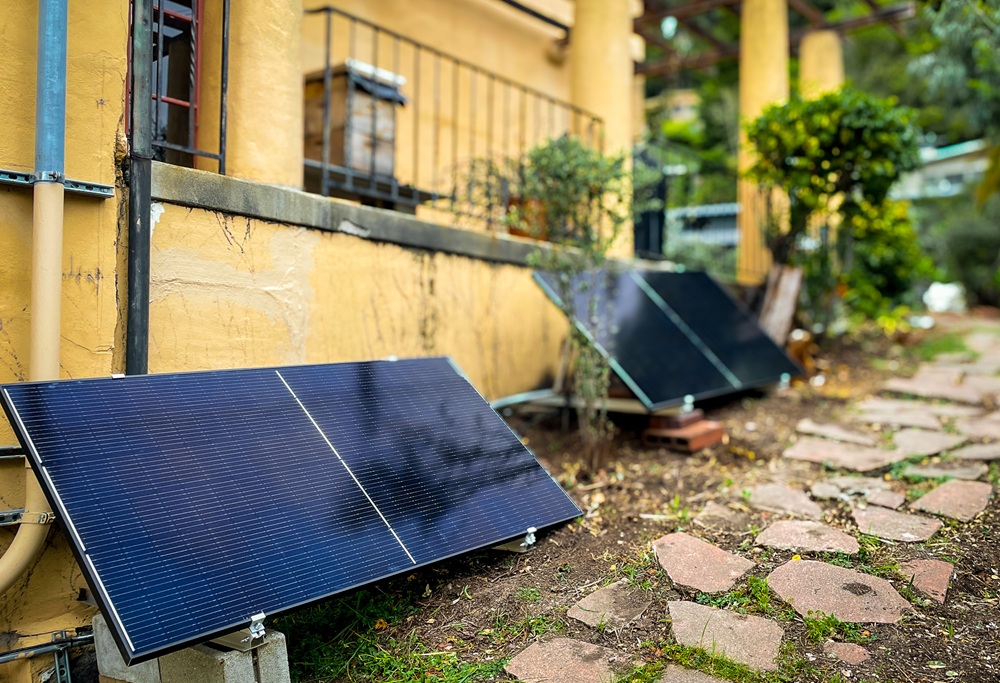





Utah State Representative Raymond Ward, who sponsored the state’s plug-in solar law, said the safety certification body UL knows “they’re going to have to” develop a standard for plug-in solar. Ward spoke on a webinar hosted by nonprofit groups Bright Saver and Solar United Neighbors.
Ward’s reasoning starts with the Utah law’s requirement that a plug-in solar device must be certified “by Underwriters Laboratories or an equivalent nationally recognized testing laboratory,” as well as meeting National Electrical Code standards.
Ward said UL is “careful to do their job carefully,” and was “waiting to see if anyone was going to push on” the issue of plug-in solar.
Now that Utah has referenced UL certification in its law, that has brought “friends to UL,” he said, “which is normally how UL takes action—if industry comes to UL and says, ‘We’ve got a product, we want to sell it. UL, help us make a safety standard so we can sell it.’” Ward added that a few companies were willing to start selling plug-in solar in Utah.
“Every single one” of the companies that sell plug-in solar in Germany, he said, “also want to sell here in the United States. So we just need to collect friends as we go along and look forward to a lot of other great things happening because of that.”
Although one division of UL known as UL Solutions can certify a plug-in solar system to its UL 3700 “outline of investigation,” a UL Solutions spokesperson said that another UL division, UL Standards & Engagement, has not yet developed a UL standard for plug-in solar. Such a standard would result from a consensus-based process with stakeholders.
The nonprofit Clean Energy States Alliance has outlined the safety considerations for plug-in solar in a guidebook for state-level policymakers.
Twenty-two states
Twenty-two states “are moving” plug-in solar legislation, said Bright Saver Co-founder Cora Stryker, on the webinar. She projected that the cost of plug-in systems would decline dramatically as more states legalize the technology, as shown in a Bright Saver white paper.
Other testing laboratories
Stryker spoke in favor of the language in Utah’s law requiring plug-in solar systems to be certified either by UL or by an equivalent nationally recognized testing laboratory. “We want new technical answers to the safety considerations to be permissible as time goes on,” she explained, “without passing new legislation.”
The U.S. Occupational Safety and Health Administration’s website lists 22 nationally recognized testing laboratories, including UL Solutions.
Utility didn’t oppose
Utah State Representative Ward said the state’s plug-in solar law passed unanimously largely because some engineers with the state’s largest utility, Rocky Mountain Power, helped “craft the language in such a way that they wouldn’t oppose it. That didn’t mean they supported it; they just didn’t care. And that’s all we needed was for them not to oppose it.”
Since the law’s enactment, Ward said “it’s been so great seeing so many other places look at that and say ‘Oh, hey, we could do that too, and we want to do that too.’”
This content is protected by copyright and may not be reused. If you want to cooperate with us and would like to reuse some of our content, please contact: editors@pv-magazine.com.



The deployment of solar power could be a lot easier and simple with fewer bureaucratic hoops to jump through. Let’s keep these great ideas moving forward!
As long as the “plug and Play” system is on a dedicated, fused for the correct wire size and UL certification circuit and is anti-islanding, meaning it must see utility power first before operating, the only hold back is the utility also certifying the system as safe. Utilities do not want systems that could accidently send power back while lines are down for maintenance and workers could get electrocuted by back feeds. The idea of a “Dedicated circuit” is to provide protection against a double feeding of a device on the same Cricut overriding the fusing that could cause a fire in the power cord or undersized internal wiring of the home or business. In a “plug in” system, the plug and receptacle provide a manual disconnecting means just like unplugging a toaster or other appliance from a wall outlet. Since the National Electrical Code wants disconnects between 24inches (2 feet) and 72inches (6 feet) from the ground or floor, they may require the outlet used be at that height. “Countertop” receptacles, dedicated appliance height receptacles in a garage or other dedicated receptacle at the appropriate height would work. Many new style GFI cord caps come with a push button disconnect and reset and would also work and would cover “grounding” of the metal frames on the panels themselves. This would be part of obtaining the UL approval for the grounding requirements since without sensing a grounding conductor present, would not re-set or turn on.
Well written by Ed.
Pretty well covers what the standards should be.
Daniel Keiley
Solar advocate and energy consultant – North American Board Certified.