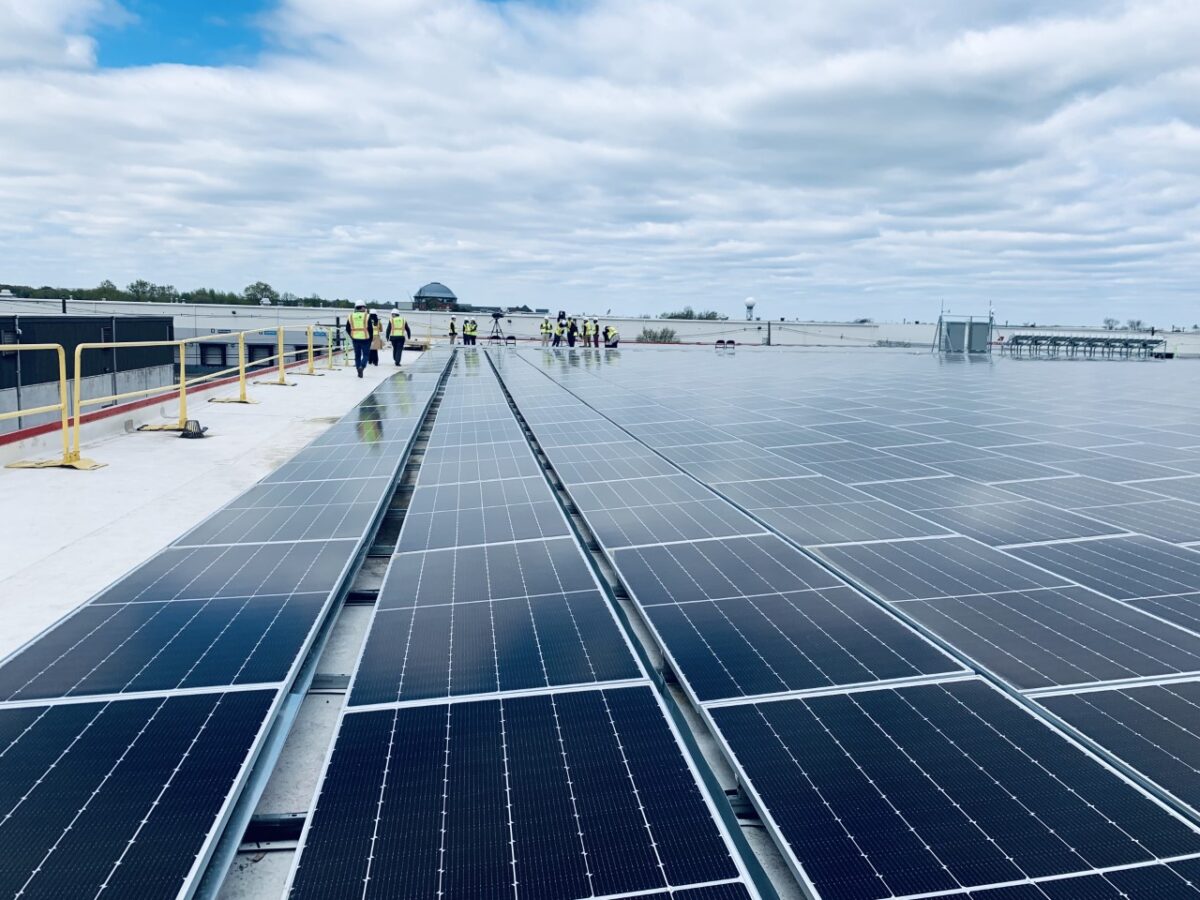





On her first day in office, New Jersey Governor Mikie Sherrill signed Executive Order No. 1 and No. 2, which focus on maintaining electricity prices and providing solar and energy storage, respectively.
Governor Sherrill enacted Executive Order No. 1 to address the rising prices of electricity, and then guided her Board of Public Utilities(BPU) to freeze or limit electricity supply rate increases. Sherrill addressed that demand – which is projected to grow twenty percent by 2030 – is outstripping supply. She subsequently enacted Executive Order No.2 to resolve the slower growing supply.
Executive Order No.2 directs two solar programs and an energy storage program to take effect within 45 days. The first solar program is the Competitive Solar Incentive (CSI), which sells solar into wholesale markets. Projects through this program have a capacity greater than 5 MWdc on average.
Concurrently, the Community Solar Energy Program was directed to make 3 gigawatts of solar capacity available. The program allows for solar power plants of up to 5 megawatts AC capacity. The program’s website now has the above notification, noting they are readying for the registration of the new capacity.
No.2 then requires that an energy storage asset must be run through the Garden State Energy Storage Program within 45 days. The capacity of Tranche 1, first launched in 2025, is projected to have a capacity between 350 and 750 MW. Phase 2 of the program must be launched within 90 days of No.2.
Lastly, No.2 directs the BPU to begin development of a virtual power plant power program within 180 days. The document notes that “aggregate distributed energy resources such as rooftop solar with battery storage, electric vehicles, and smart home and building controls into “virtual power plants” presents an opportunity to harness community power to reduce peak demand by 10 to 20%.”
A report from Independent Market Monitor says that Independent System Operator PJM’s massive increase in power capacity costs– which shot up from a couple of billion dollars just a few years ago, to over $16 billion in 2026– were nearly 70% because of data centers. In No. 2, multiple comments are made in reference to recent PJM price increases, including a projected 4.5 GW shortfall in capacity.
Serving 65 million customers from Chicago to New Jersey, the PJM grid region needs to add 16 GW of four-hour battery storage by 2032 in order to remain serviceable because of dwindling electricity supply according to a Brattle study.
An ACORE report showing how an expedited interconnection of utility-scale batteries could increase the accredited capacity available to PJM by almost 8 GW.
No.2 also referenced President Trump’s energy emergency executive orders, as well the various construction start and completion dates (July 4, 2026, and December 31, 2027) are required to receive the investment tax credit for solar power.
New Jersey recently moved forward with a program to deploy 65 MW of agrivoltaics.
This content is protected by copyright and may not be reused. If you want to cooperate with us and would like to reuse some of our content, please contact: editors@pv-magazine.com.




By submitting this form you agree to pv magazine using your data for the purposes of publishing your comment.
Your personal data will only be disclosed or otherwise transmitted to third parties for the purposes of spam filtering or if this is necessary for technical maintenance of the website. Any other transfer to third parties will not take place unless this is justified on the basis of applicable data protection regulations or if pv magazine is legally obliged to do so.
You may revoke this consent at any time with effect for the future, in which case your personal data will be deleted immediately. Otherwise, your data will be deleted if pv magazine has processed your request or the purpose of data storage is fulfilled.
Further information on data privacy can be found in our Data Protection Policy.