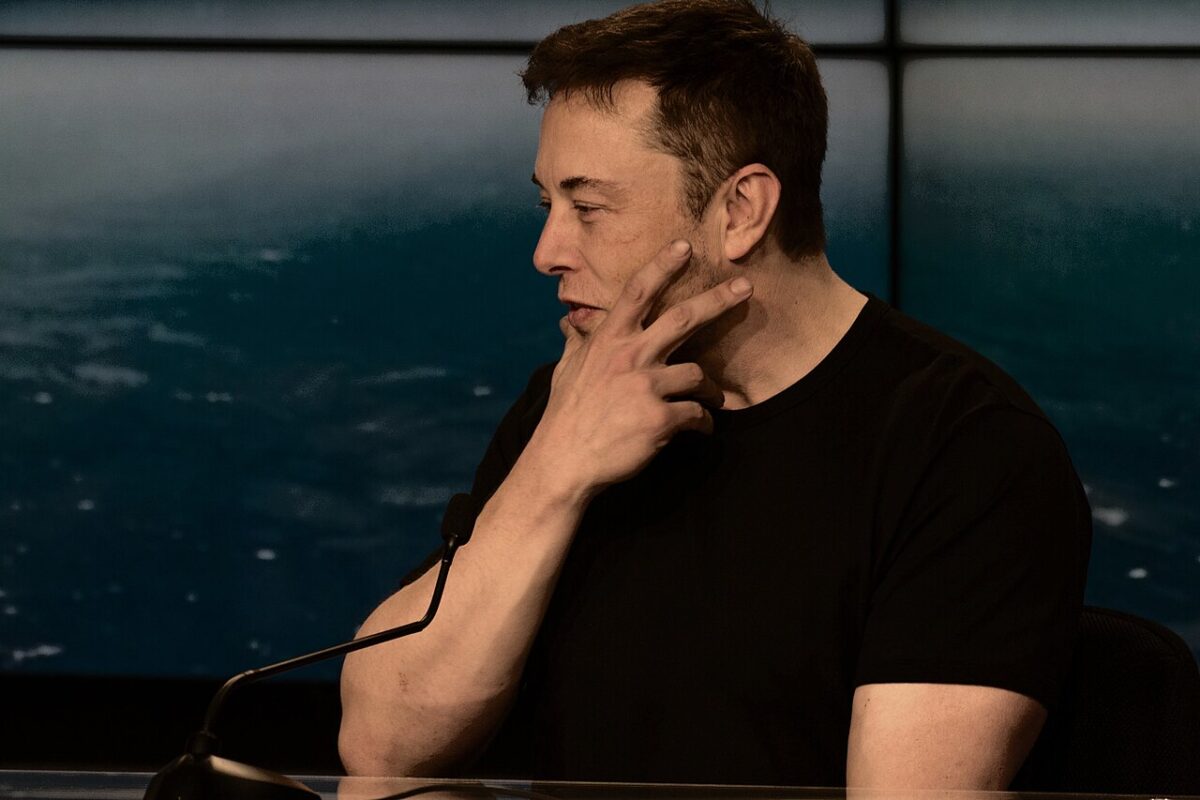





In addition to championing solar-powered space-based AI at the World Economic Forum (WEF) in Davos, Switzerland, last week, Tesla founder and CEO Elon Musk also shed light on earth-based plans at Tesla and SpaceX to produce PV technology in the U.S.
He presented both his space-based vision and his earth-based plans during an interview on the main WEF stage with Larry Fink, founder and CEO of the global investment firm Blackrock, who is also serving as the WEF’s interim co-chair. Although the interview centered on AI, solar technology quickly became the focus, since the bottleneck of the AI revolution is sufficient energy, specifically low-cost electricity. While the rate of AI chip production is increasing exponentially, the rate of electricity being brought online hovers at a measly four percent per year.
For Musk, the solution is solar energy, both here on earth and in space. He singles out China as the one country that gets it: “Later this year we will produce more [AI] chips than we can turn on, except for China. China’s growth of electricity is tremendous.” He rebuffs Fink that nuclear is the solution: “Actually solar is the biggest thing in China. I believe China’s production capacity for solar is 1,500 GW a year and they’re deploying over 1,000 GW a year of solar. For continuous solar load you divide that by roughly 4 or 5, that’s around 250 GW of steady state power paired with batteries. That’s a very big number. That’s half of the average power usage in the U.S. The U.S. power usage on average is 500 GW. China – just in solar – can provide steady state power and batteries can do half of the U.S. electricity output per year.”
While he might be on the mark in terms of China’s annual PV production capacity, he overstates the level of annual PV deployment. In fact, a policy shift in mid-2025 should dramatically cut China’s PV deployment rate from around 300 GW in 2025 to less than 250 GW this year. On the other hand, China remains by a very large margin both the biggest PV manufacturer and the biggest builder of PV power plants. So yes, China gets it. Solar is the solution to achieve abundant low-cost energy, not least to fuel AI adoption.
Subscribe to monthly pv magazine Global edition
Subscribe here to secure your monthly copy.
Fink then asks Musk why Europe and the U.S. cannot take the same path. Musk blames trade tariffs in the U.S. for stifling solar adoption: “Unfortunately, in the U.S. the tariff barriers for solar are extremely high and that makes the economics of deploying solar artificially high, because China makes almost all the solar.” With the right policies both Europe and the U.S. could generate a massive amount of low-cost solar power with not all that much land.
He paints a nice picture: “I guess a rough way to think about it is: a hundred miles by a hundred miles, or call it 160 km by 160 km, of solar is enough to power the entire U.S. A hundred mile by a hundred mile area is, I mean you could take basically a small corner of Utah, Nevada, New Mexico – obviously you wouldn’t want it all in one place – it is a very small percentage of the area of the U.S. to generate all of the electricity that the U.S. uses. The same is true for Europe: You could take relatively unpopulated areas of, say, Spain and Sicily and generate all of the electricity power Europe needs.”
It’s not inconceivable that the Trump administration adopts a policy U-turn on solar tariffs to ease the electricity bottleneck in the U.S. In Davos Musk revealed that he is pushing ahead with U.S.-based PV production even without any easing: “The SpaceX and Tesla team, both separately, are working to build to 100 GW a year of solar power in the U.S., of manufactured solar power. That’ll probably take us 3 years or something. These are pretty big numbers and I’d encourage others to do the same.” Given his comments on space-based solar, SpaceX will most likely produce panels to go with its new solar-powered AI satellites. We will have to see what shape and form the Tesla PV products take, but whether it’s just 100 GW collectively or 100 GW Tesla and 100 GW SpaceX, that is indeed a sizeable annual production rate, especially for the U.S. that is still in the early stage of building a robust solar supply chain.
This content is protected by copyright and may not be reused. If you want to cooperate with us and would like to reuse some of our content, please contact: editors@pv-magazine.com.


Since China’s power is 50% coal and 58% of world coal burning, they should use the PV, batteries there first.
Which also makes everything they export made with coal.
This is why he is known as the TeknoKing.