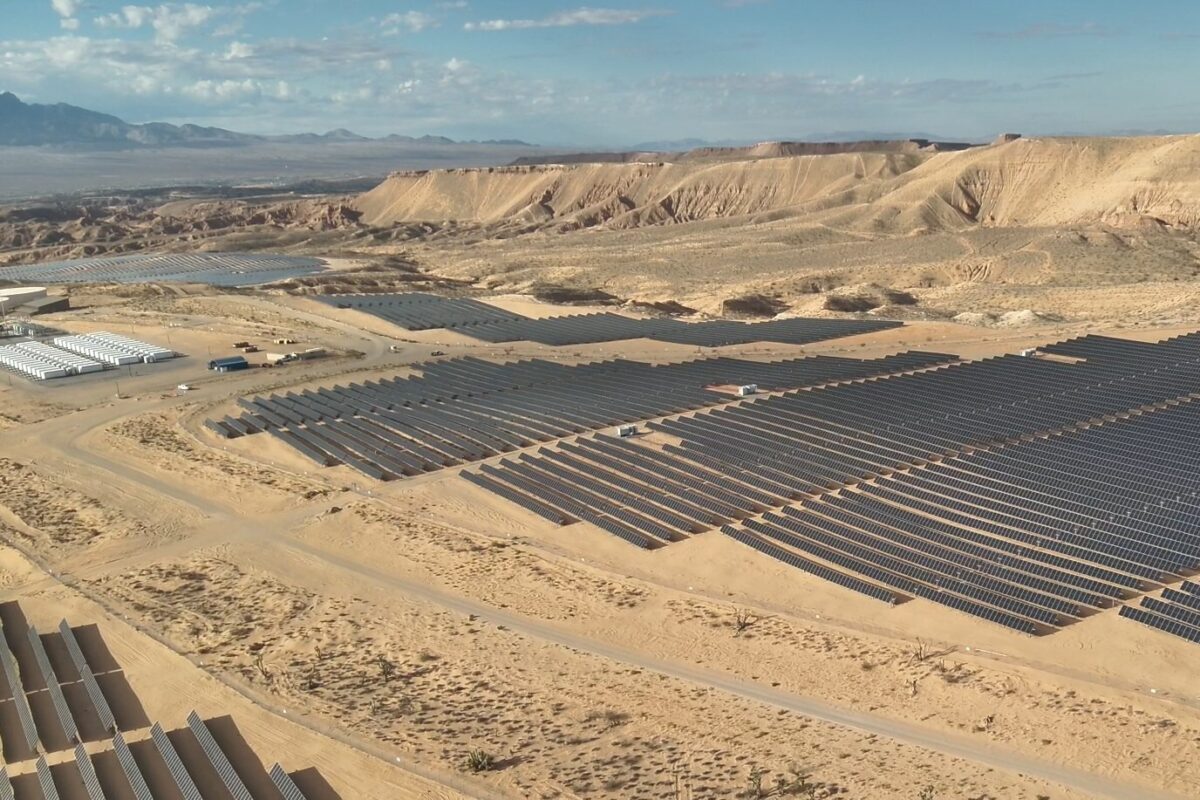





MGM Resorts International, which operates fourteen hotels on the Las Vegas Strip, is now receiving power under a 25-year power purchase agreement (PPA) from a recently-completed 115 MW solar and 400 MWh energy storage facility in Lincoln county, Nevada, about 90 miles northeast of Las Vegas.
The 115 MW solar array is the latest addition to the Escape Solar and Storage facility, which was developed by site owner Estuary Power, with the solar farm constructed by Bechtel Infrastructure and Power Corporation and the battery energy storage yard constructed by Stiles Renewables. The facility has a total peak power output of 185 MW and also serves Overton Power District No. 5, Caesars Entertainment and Wynn Las Vegas under long-term agreements.
In addition to the new PPA, MGM Resorts receives power from several other solar installations, including a 100 MW Mega Solar Array developed by Invenergy, an 8.3 MW rooftop array on the Mandalay Bay Convention Center, and a 100 kW rooftop array on T-Mobile Arena.
The company says it can now power up to 100% of its daytime electricity needs on the Las Vegas Strip with solar energy. But it has its sights set on a loftier goal.
“With this new project coming online, we are accelerating progress toward our goal of using 100% renewable electricity domestically by 2030,” said Bill Hornbuckle, CEO and President of MGM Resorts. “Together with our Mega Solar Array, the new Escape Solar and Storage Project reflects our focus on scalable, impactful clean-energy solutions. It also demonstrates that our industry can operate more sustainably while delivering long-term cost stability, strengthening our business and supporting a more resilient energy future.”
MGM Resorts first began to purchase power outside of Nevada’s regulated energy market in 2016, after the Public Utilities Commission of Nevada (PUCN) allowed the hotel group to exercise retail energy choice under NRS 704B. Several other large Nevada energy buyers have similarly exited the market, but the process often results in high “exit fees” that limit the method’s appeal. These buyers continue to receive distribution service from NV Energy, but purchase power from independent suppliers.
State continues to allow only large energy buyers to exercise the right to purchase power from outside suppliers. In 2018, a “yes” vote on ballot Question 3 would have required the state to establish a deregulated energy market in the state, but the measure was soundly defeated by the public.
This content is protected by copyright and may not be reused. If you want to cooperate with us and would like to reuse some of our content, please contact: editors@pv-magazine.com.





By submitting this form you agree to pv magazine using your data for the purposes of publishing your comment.
Your personal data will only be disclosed or otherwise transmitted to third parties for the purposes of spam filtering or if this is necessary for technical maintenance of the website. Any other transfer to third parties will not take place unless this is justified on the basis of applicable data protection regulations or if pv magazine is legally obliged to do so.
You may revoke this consent at any time with effect for the future, in which case your personal data will be deleted immediately. Otherwise, your data will be deleted if pv magazine has processed your request or the purpose of data storage is fulfilled.
Further information on data privacy can be found in our Data Protection Policy.