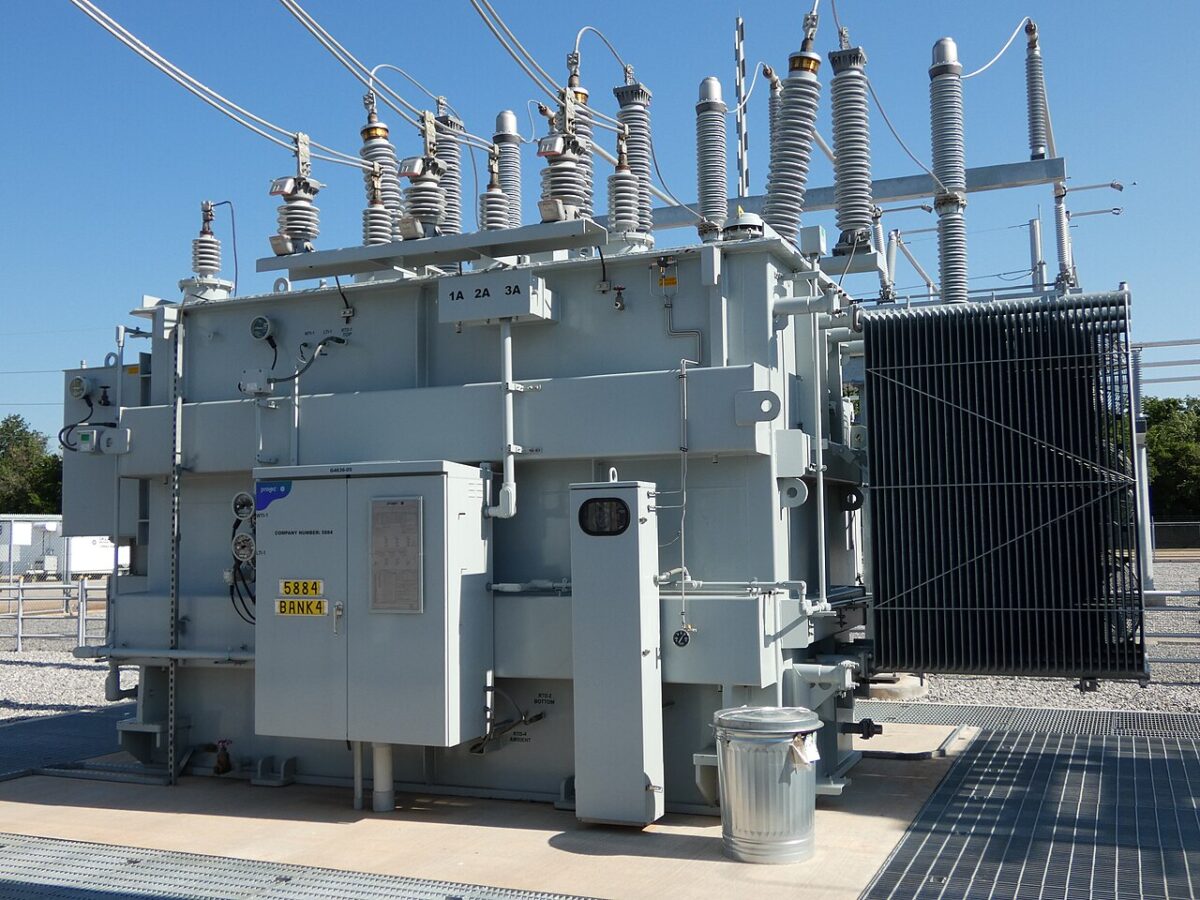





The energy storage and solar development and procurement platform, Anza, launched a Transformer Procurement Service to help developers, independent power producers, utilities, EPCs and data center developers procure medium- and high-voltage transformers.
Transformer procurement is a challenge due to shortages and price increases that have plagued the solar market for several years and now, added to that, are the new deadlines for equipment from Foreign Entities of Concern (FEOC).
In 2024, the report Major Drivers of Long-Term Distribution Transformer Demand by the National Renewable Energy Lab (NREL), said reasons for transformer shortages and price spikes included increased raw material demand, pandemic-related shortages and backlogs, labor constraints, shipping issues, and geopolitical tensions. In 2026, the shortage and price spikes continue, and FEOC rules are added to the list of challenges.
To meet FEOC requirements, physical work must be completed by the end of this year for projects containing FEOC equipment, with an additional compliance window from January 1 to July 4, 2026 for all other projects.
Developers are hard pressed to find domestic transformers and especially in the new timeframe. According to a report by Wood Mackenzie, since 2019, imports accounted for an estimated 80% of U.S. power transformer supply and 50% of the distribution transformer supply.
In a recent webinar, Felicity Lunden, Anza’s director of transformer procurement explained that the service can help developers quickly create a developer contact list for an RFP, it can provide pre-negotiated supplier purchase agreements (SPAs) and Anza can help support the safe harbor qualification.
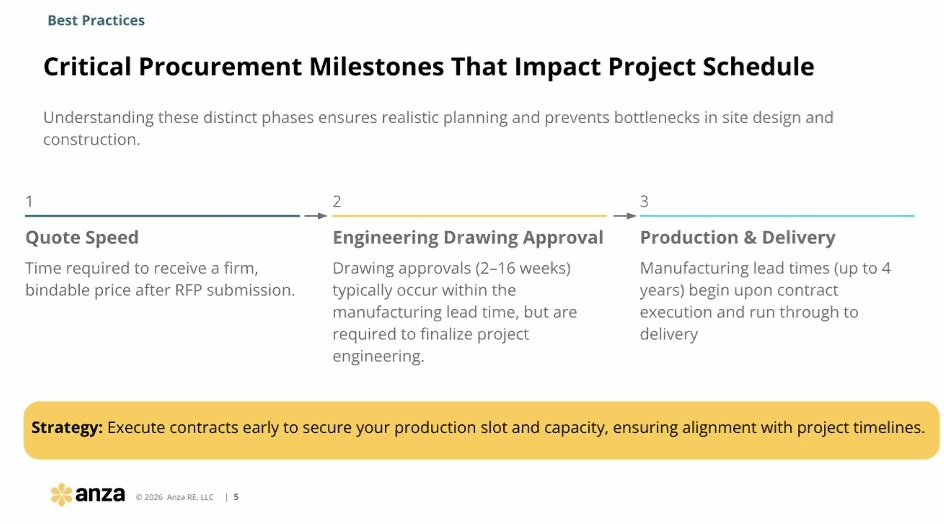
Lunden noted that Anza is monitoring costs, delivery risk and performance benchmarks for over 50 medium- and high-voltage suppliers across more than 12 countries, “including some in the U.S.”
With the solar ITC safe harbor deadline looming, Anza CEO Mike Hall said “the time crunch is already on.” However, according to Lunden, there is still time to act, but added that “while you can still currently safe harbor past February with some suppliers, that list is going to be limited.” She advised having contracts in place by the end of March at the latest as some sub-supplier manufacturers have reported lead times of 18-to-20-weeks. Hall added that lead times are critical “because it’s not just about ordering but they also have to make them.”
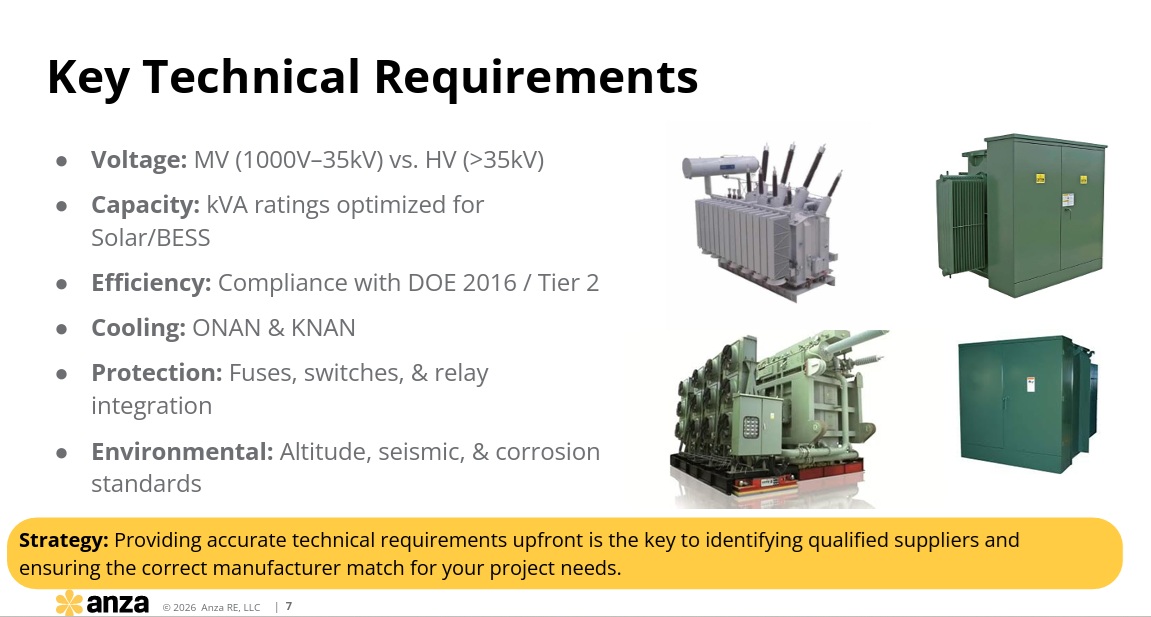
In working with Anza’s procurement team, the first step is to provide the specs such as voltage ranges and capacity, frequency, efficiency, cooling and protection. Also it’s important to note any environmental requirements. Then Anza will build a short list of vendors that are likely to meet the specs. In selecting suppliers Anza looks at experience in the industry, performance, price, manufacturing location and more.
“Besides the market challenges we’ve already mentioned, a lot of our clients are bandwidth constrained… and are juggling a lot of balls at once,” Hall said. “In addition, some are getting into transformer procurement for the first time.”
Lunden estimated that Anza can reduce supplier identification from three weeks to about 30 minutes, and because it has access to growing list of pre-negotiated supplier purchase agreements that can reduce the procurement cycle by two to six months. Hall added that Anza aims to help buyers through the procurement process and does not stand between the buyer and supplier.
This content is protected by copyright and may not be reused. If you want to cooperate with us and would like to reuse some of our content, please contact: editors@pv-magazine.com.






By submitting this form you agree to pv magazine using your data for the purposes of publishing your comment.
Your personal data will only be disclosed or otherwise transmitted to third parties for the purposes of spam filtering or if this is necessary for technical maintenance of the website. Any other transfer to third parties will not take place unless this is justified on the basis of applicable data protection regulations or if pv magazine is legally obliged to do so.
You may revoke this consent at any time with effect for the future, in which case your personal data will be deleted immediately. Otherwise, your data will be deleted if pv magazine has processed your request or the purpose of data storage is fulfilled.
Further information on data privacy can be found in our Data Protection Policy.