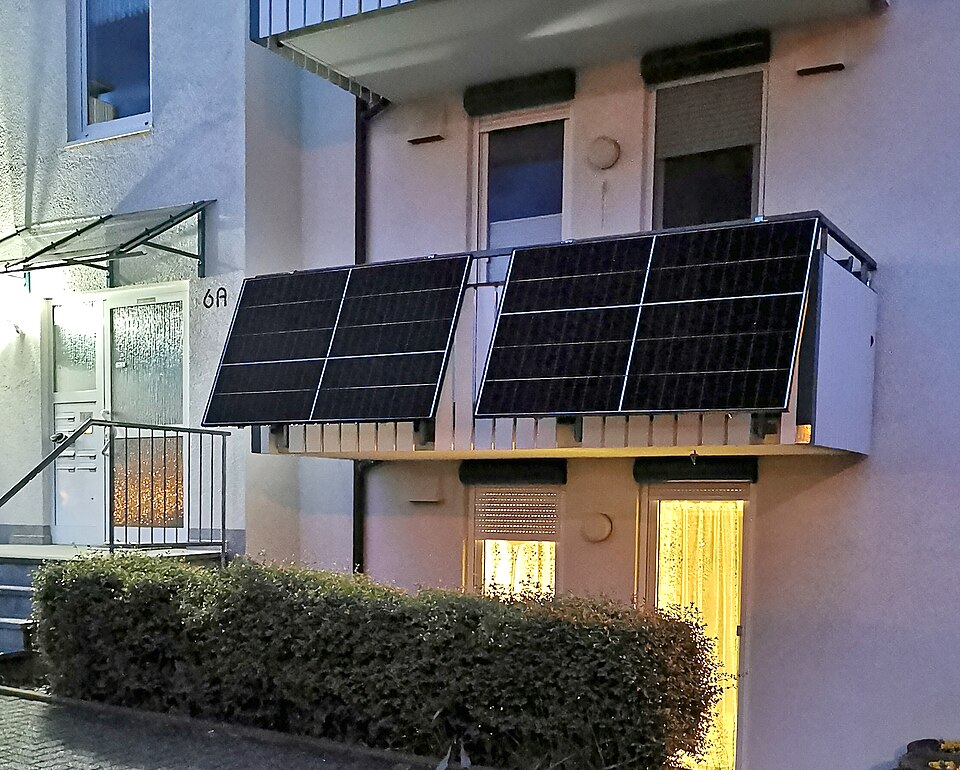





The Clean Energy States Alliance, in response to “increased legislative and public interest” in plug-in solar, has published a guidebook on the topic for state energy offices and state legislatures.
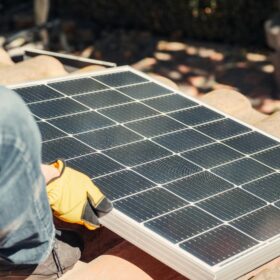
The guidebook presents in-depth technical and policy information on plug-in solar systems, which are small, portable systems that can plug into a household outlet. Paired with a battery, an 800 watt system “could power a refrigerator and a CPAP machine for 24 hours,” the guidebook says.
In Germany, where the systems are called balcony solar and limited to 800 watts capacity, an estimated 4 million systems have been installed totaling about 3 GW, compared to about 100 GW of distributed and utility-scale solar. Do-it-yourself installation, for example on balconies, is common in Germany, and the portability of systems make them suitable for renters. Ikea members in Germany can purchase a two-panel system with a microinverter for $540, the guidebook says.
Utah has enacted a law allowing a “portable solar generation device” sized at up to 1.2 kWac to be plugged into a household 120V outlet without any utility approval or fees, provided the device meets standards set by the National Electrical Code (NEC) and by the safety testing and certification body UL.
In California, a bill has been introduced in the state legislature to legalize plug-in solar, and the guidebook says similar legislation is under discussion in other states including Vermont and New Hampshire.
But as in Utah, where NEC and UL standards are referenced, state policymakers will encounter several hurdles to plug-in solar, the guidebook says.
Those hurdles start with three safety issues:
- “Touch safety,” or the risk, while unplugging an active solar system, of accidentally touching the prongs
- Potential interference with a type of outlet known as a ground fault circuit interrupter (GFCI) outlet
- Potential “breaker masking,” if the plug-in solar is plugged into an outlet located between the circuit breaker and a substantial load on the end of the circuit, which could cause the wiring to overheat.
Solutions to those issues, the guidebook says, are suggested in a white paper from the safety testing and certification body UL Solutions. The white paper, which is available for free, led to a UL Solutions “outline of investigation” that was released for sale this month.
A spokesperson for UL Solutions said the company can currently certify a plug-in solar system to that UL 3700 outline of investigation. The spokesperson explained that another UL division, UL Standards & Engagement, has not yet developed a UL standard for plug-in solar, as such a standard results from a consensus-based process with stakeholders. For that reason, an ultimate UL standard may differ from the specifications in the UL 3700 outline of investigation.
The guidebook says that the UL process could lead to a UL standard for plug-in solar systems “likely requiring a unique plug and receptacle, plus bidirectional GFCI and overcurrent protection.”
Policymakers will also need to decide, the guidebook says, whether to allow plug-in solar to export electricity to the grid, and if so, whether exports should be compensated at net metering rates, at net billing rates, or not at all.
A section of the guidebook describes how plug-in solar is regulated in Europe.
The Clean Energy States Alliance guidebook is titled “What states need to know about plug-in solar.”
This content is protected by copyright and may not be reused. If you want to cooperate with us and would like to reuse some of our content, please contact: editors@pv-magazine.com.


It’s curious how the regulatory farces…er…forces that be have stricter rules for solar installations than for many ordinary household electrical devices. Allowing this technology would enable many folks to lower their utility bill a bit, and offer additional insights to a science that many people know nothing about.