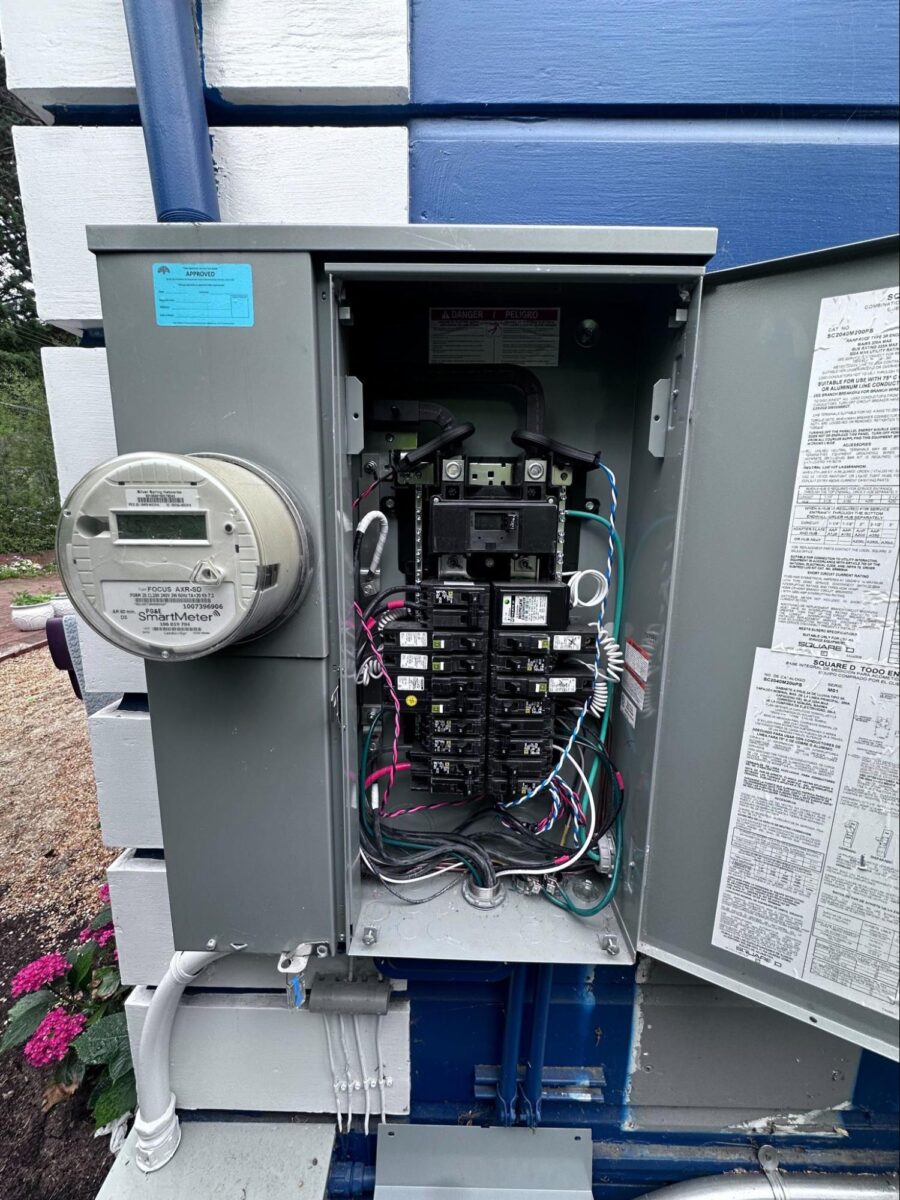





Electrical system design has been rooted in a fundamental principle for a long time: calculate the theoretical, worst-case-scenario load, then build a system robust enough to handle it.
Traditional load calculations are based on estimations, assumptions, nameplate ratings, and demand factors. But in an era of distributed generation, energy storage, and heavy but
controllable loads (like EV chargers), this model can result in oversized infrastructure or
expensive service upgrades that may not really be needed.
The 2026 National Electrical Code (NEC) signals a major paradigm shift, formally embracing a smarter approach: managing systems and providing overload protection based on actual, real-time power flow, rather than estimated or predicted load. Acronyms are key, and EMS (energy management system) and PCS (power control system) will become, if they aren’t already, key parts of your DERPS (distributed energy resource power systems!) lexicon.
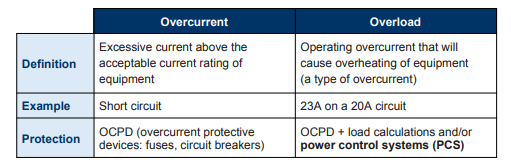
A change to facilitate power-flow based management in the 2026 NEC was the relocation of existing Articles: Branch-Circuit, Feeder, and Service Load Calculations are now in Article 120 (previously 220), and Energy Management Systems are governed by Article 130 (previously 750). Those are premium “front-of-the-book” locations, signifying their importance and, being sequential Articles, how they are interrelated. The relocation is also recognition that energy management is not a niche application but a common, foundational feature of modern power systems, especially those with on-site power sources and/or storage.
Leveraging these technologies is essential for designing and installing cost-effective, flexible, and powerful next generation electrical systems, and requires understanding the interplay between not just Articles 120 and 130, but also 702 (Optional Standby Systems) and 705 (Interconnected Electric Power Production Sources).
Background
The concepts behind EMS and PCS aren’t new, but code language has played a bit of catch-up. The 2023 NEC used the somewhat unclear phrase “EMS for overload control,” which raised the question: what’s the difference between a “regular” EMS and a special “overload control” version?
The 2026 NEC provides much needed clarification:
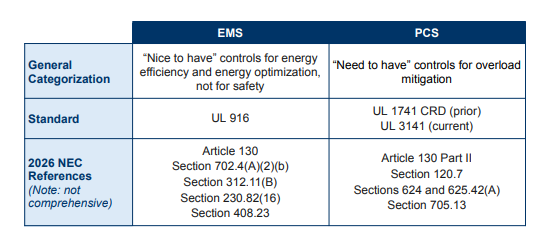
- Energy management system (EMS) is the “umbrella” category. An EMS monitors and controls power for reasons other than active safety. Its purpose is typically economic or for convenience – such as reducing energy consumption, saving money by shifting loads off-peak, or improving comfort.
- Power control systems (PCS) are a specific type of EMS with a critical, safety-focused functionality. A PCS is equipment that monitors and controls power specifically to prevent the overload of a service, conductor, or other distribution equipment. This is the active safety “overload control” function that the 2023 NEC was trying to describe.
These changes didn’t occur in a vacuum: safety certification standards played a key role. EMS are covered by UL 916 Energy Management Equipment, which addresses “nice to have” controls for energy efficiency and energy optimization for loads such as lighting and HVAC.
When the 2023 NEC went to print, PCS were listed to UL 1741, under a Certification Requirement Decision (CRD) for Power Control Systems (PCS) Functionalities. [A CRD is provided by UL staff; it is not a consensus standard, but is intended to become part of a full standard once incorporated through the consensus process.] However, the need for a separate standard became clear, and going forward PCS will be listed to UL 3141 Outline of Investigation for Power Control Systems. UL 3141 addresses “need to have” controls for overload mitigation. The second edition was published in October 2024, and while the final, consensus version is not yet complete, products can be listed to UL 3141 now.
The 2026 NEC aligns with this new evaluation and certification landscape, and just to be crystal clear, notes in Section 130.2 that “evaluation of an energy management system with PCS functionality is different than an evaluation of a general energy management system.”
Types of PCS
All PCS monitor and control power to prevent overload of an electrical service, conductor, and/or power distribution equipment, but there are essentially two flavors of PCS, as described in UL 3141 and defined in the 2026 NEC:
1.A single-source PCS is capable of load management only. This single-source PCS monitors current on the supply conductors from the primary source, and can control a load to prevent overload of those supply conductors and busbar.
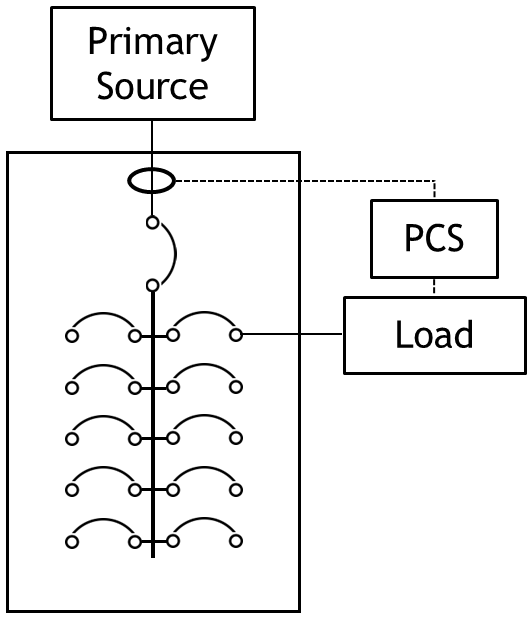
2. A multisource PCS can control power production sources (like PV, ESS, or an EV), with or without load management. This “multisource” capability is the key that unlocks powerful new system design and integration options working in conjunction with Articles 705, 120, and 702.

This multisource PCS monitors current on the supply conductors from the primary source, and can control power sources (such as PV or energy storage) to prevent overload of those supply conductors and busbar.
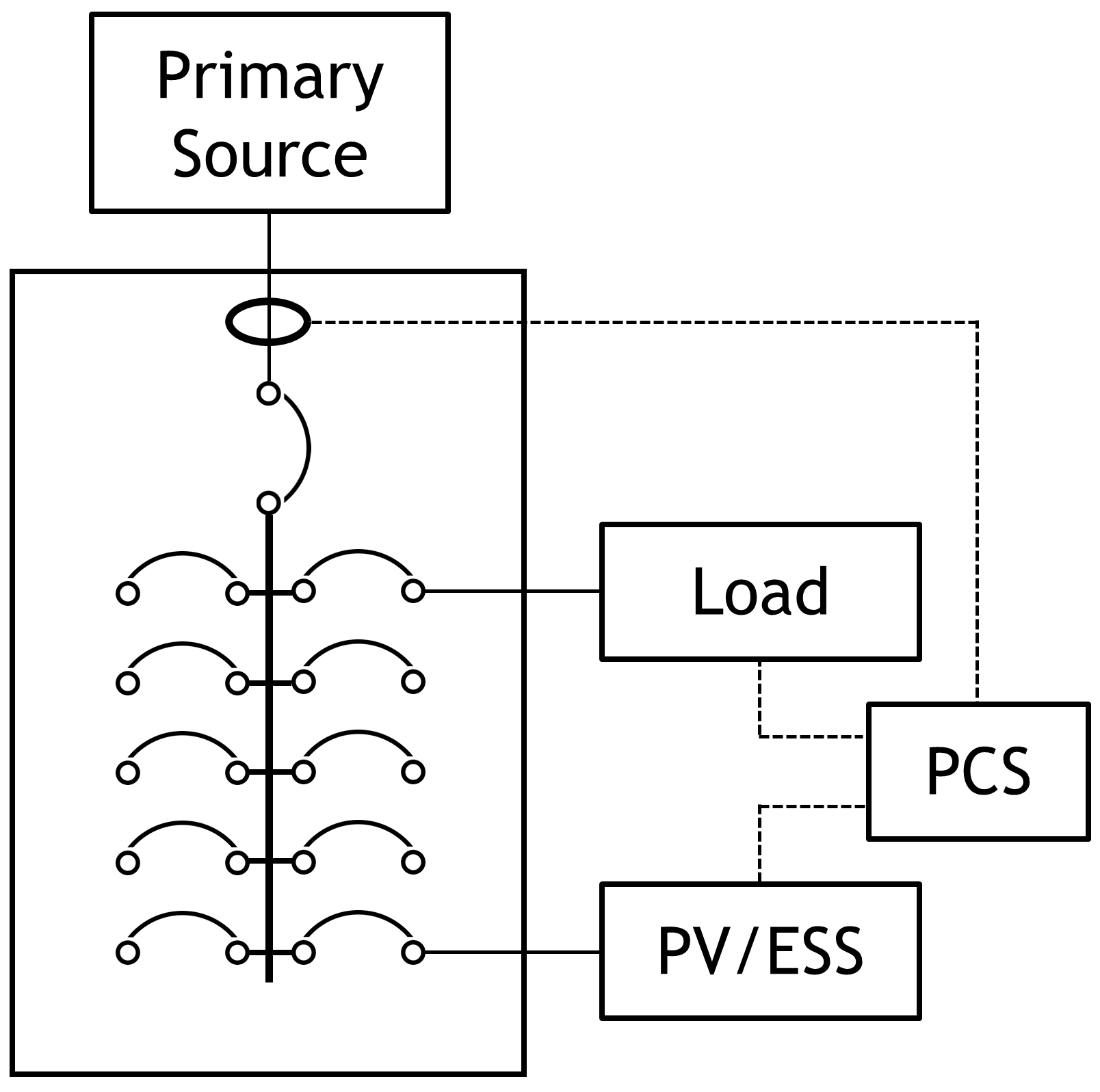
This multisource PCS can control power sources and loads to prevent overload of the supply conductors and busbar.
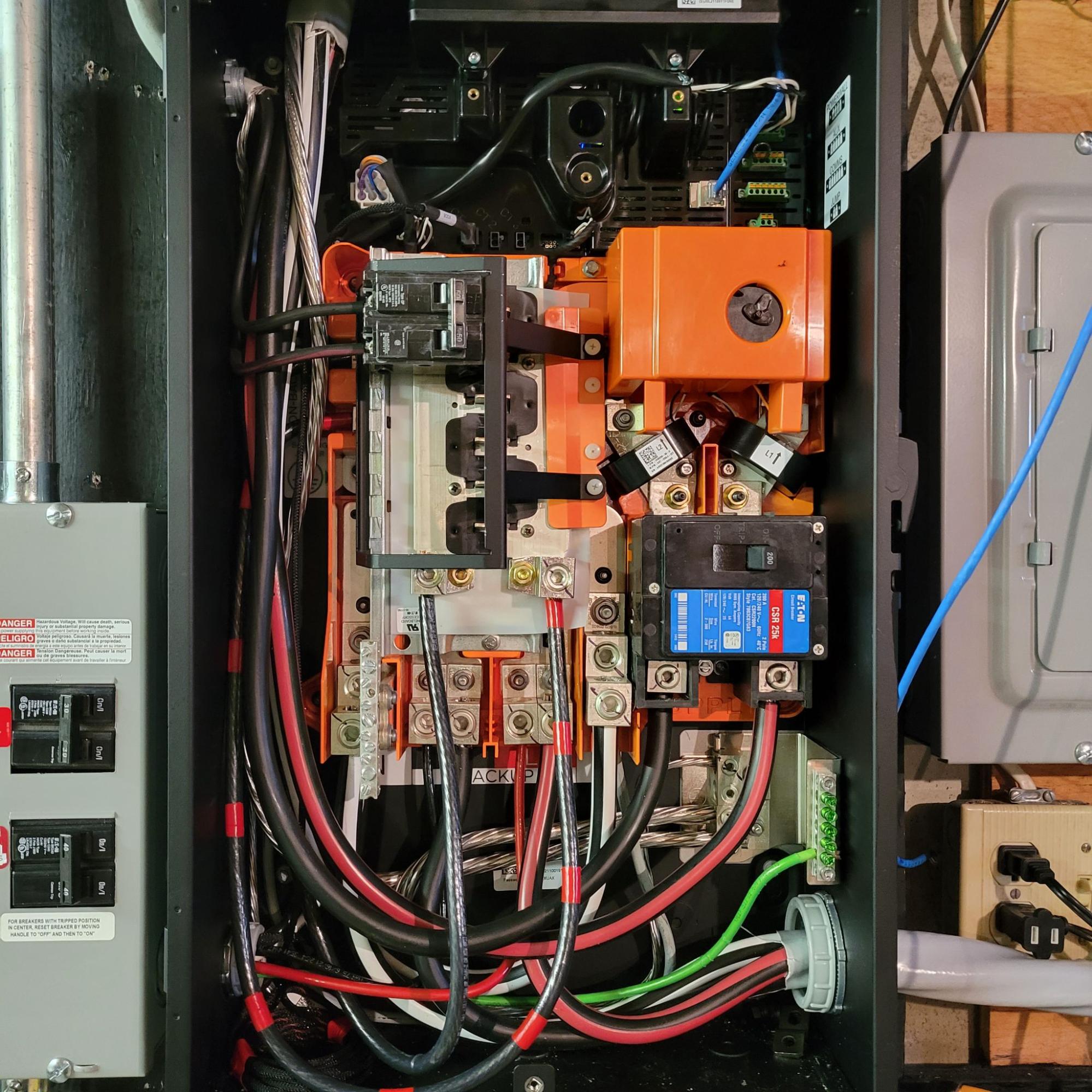 There’s a lot going on in this product, including it being listed as a power control system (PCS). A PCS requires active current monitoring, which typically requires CTs upstream of the device, and electronics capable of controlling current and/or disconnecting circuits. It may be a fully integrated product with overcurrent protection and other inputs and capabilities, or may be a separate device that works with external distribution and power production equipment.
The second part of this article series will address applications of PCS that are enabled by changes in the 2026 NEC.
Brian Mehalic is a Senior Consultant at Solar Tech Collective, specializing in consulting and
training on codes, standards, and O&M for PV, energy storage, and EV systems.
The views and opinions expressed in this article are the author’s own, and do not necessarily reflect those held by pv magazine.
This content is protected by copyright and may not be reused. If you want to cooperate with us and would like to reuse some of our content, please contact: editors@pv-magazine.com.





It’s interesting to see how the 2026 NEC is shifting towards real-time power flow for more accurate electrical design. The distinction between Energy Management Systems (EMS) and Power Control Systems (PCS) is a crucial step forward in optimizing efficiency. This approach could definitely help reduce waste and improve energy usage across systems.