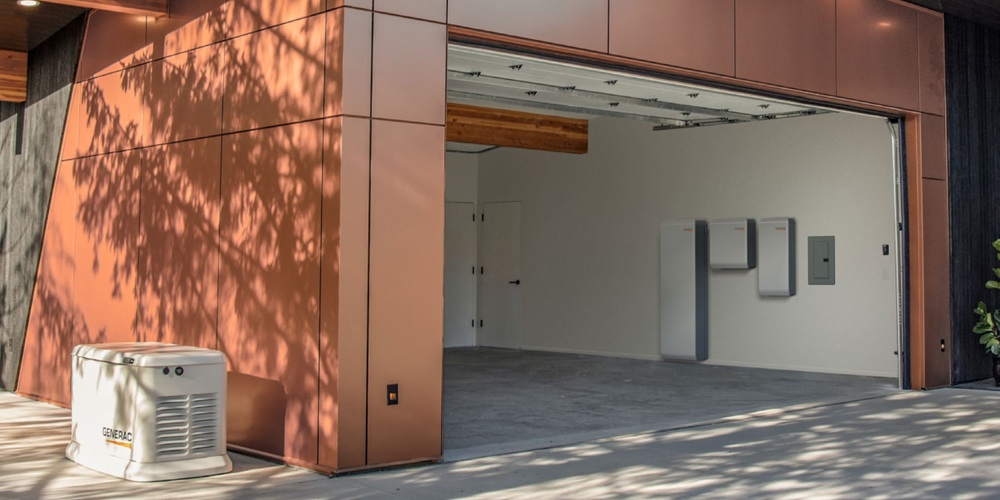





Backup, backup, backup: that’s the buzzword of residential storage installers but not necessarily of homeowners who want to add a battery. Resilience, rather than cost-savings-per-kilowatt-hour, is increasingly pitched by battery companies as one of the main reasons to install residential storage.
“There’s a need to de-emphasize cost per kilowatt-hour and focus on cost per hour of backup,” explained Rex Liu, the vice president of clean energy product management at Generac. He told pv magazine USA that instead, they need to understand the value proposition and the outcomes of their system: “Will the system keep the lights on? Will it save money?”
“Homeowners don’t need to master kilowatt-hour math or all the specs associated with home energy systems,” he added. The cost-per-hour of backup power and the ability to sail through grid outages is, from Generac’s perspective, a better reflection of the value homeowners want to derive from installing storage. While that’s true for some, many take a different tack.
According to EnergySage’s Solar & Storage Marketplace Report H1 2025, utility rate savings (30%) and solar self-supply (29%) are both cited by homeowners more often than backup power (26%) as a reason to install storage, though all three are on a relatively even playing field. Yet, based on the same survey, 67% of installers named resilience or emergency backup as a main motivation for residential solar installation, with only 11% even mentioning financial savings. Yes, backup power matters, but it’s not all that counts.
It’s a pit many installers fall into when trying to market their batteries: keeping the lights on during a storm is sexy, but cheaper electricity bills are sexier.
Liu noted that in policy-driven markets like California that have high utility costs, batteries are often an “economic necessity” to make residential solar pencil out. The EnergySage report points out that’s a large part of why residential storage attachment rates are highest in unfavorable export markets with high rates, including California (79% attachment) and Hawaii, which has a100% attachment.
It makes sense in those markets: storage is less for peace of mind and more for your pocketbook. Even so, backup remains the dominant sales narrative. This can, unfortunately, lead to homeowners’ goals for installing storage getting caught in the proverbial crossfire.
Many prospective battery owners-to-be will trust the recommendations of the installer about what system would be a good fit for their home. If backup is assumed to be the primary goal, installers are more likely to recommend larger, more expensive systems that are designed for long-duration outages.
Other options, like consumption‑only batteries that are designed not for full-home backup but rather for self-consumption and bill management, would likely meet the homeowner’s goals better, yet likely weren’t discussed due to the mismatch between real and perceived customer motivations. The EnergySage report notes that “installers who match system design to customer motivations could reduce costs and boost attachment rates.”
While EnergySage found that about three-quarters of residential solar customers express interest, only 42% ultimately attach batteries; for the first time in recent periods, that attachment rate dropped between 2024 and 2025 due to rising costs and system complexity. For many homeowners, the value proposition still hinges on bill savings and energy autonomy rather than worst-case outage scenarios. Even so, Liu remains bullish on resilience against outages as a key motivator for storage adoption.
“As the cost of systems decreases and the capability and feature set increases, we’ll start to see more people invest in larger systems that can minimize their need to be connected to the grid,” he said.
This content is protected by copyright and may not be reused. If you want to cooperate with us and would like to reuse some of our content, please contact: editors@pv-magazine.com.




The problem is i can buy quite a bit of sola panels for the cost of a battery – i may use the battery once a year maybe when he power goes out but i earn SREC’s from my solar all year around and SAVE constantly consuming my power in house vs from the grid!
I don’t have TOU rates either so i’m even less incentivized to buy a battery – never mind the eventual death of the battery no matter what i do, so buying a battery is NOT a good use of my money.
Unless batteries come down in prices from these vendors, I’m only inclined to buy and built my own battery packs for storage independently of buying one – at least it’ll be 50% cheaper to begin with.