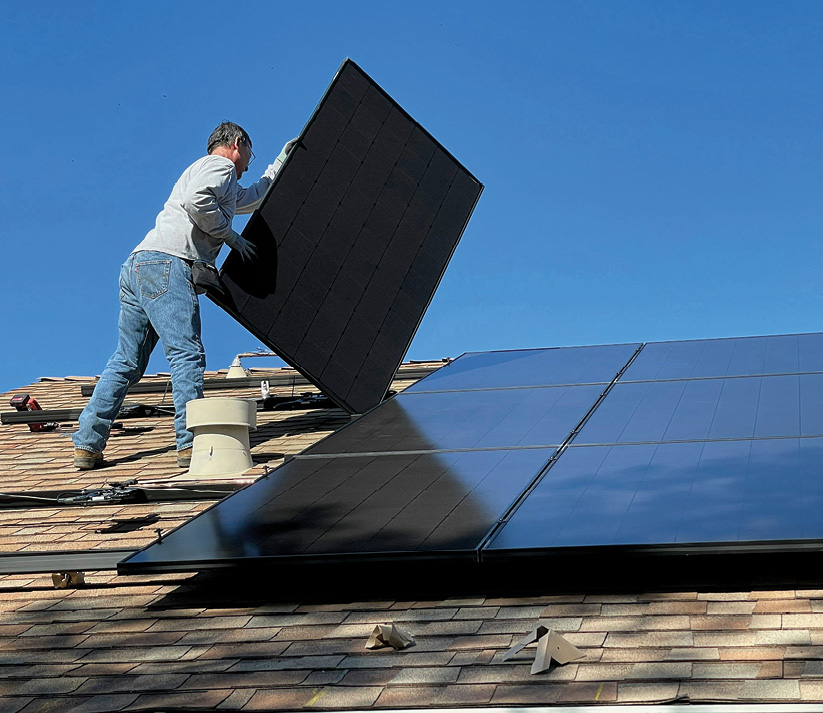





Residential solar in the United States has undergone a sustained downturn, hampered by high borrowing costs, the decline of net-metering programs in leading state markets, and the sudden loss of federal tax credits.
U.S. residential solar installations fell 31% in 2024, and the decline has continued in 2025. Industry titans like SunPower, Sunnova, and loan provider Mosaic Solar have filed for bankruptcy.
The industry has historically leaned on the value proposition of lowering customer electricity bills and providing predictable costs for the long term. However, that value has been increasingly difficult to provide. Gone are the days of low interest rates enabling attractive terms for loans or leased systems. In many major markets, such as California, bill credit rates to send excess electricity to the grid have been slashed by 75% or more.
Tariffs have posed challenges as well, increasing system costs for end users. In June, President Trump announced an increase on the aluminum import tariff from 25% to 50%, affecting materials costs for solar panel frames and racking systems. Solar cell and module import tariffs from Southeast Asia and other regions have also come in higher than expected this year, ranging from 125.37% to 3,403.96%.
Restrictions on projects that include content from foreign entities of concern (FEOC) are another issue. These generally apply to products sourced from Chinese companies. Projects found in violation of FEOC rules are made ineligible for federal clean energy tax credits.
Despite the 31% market contraction in 2024, according to data from the US Energy Information Administration (EIA), total installed capacity of residential solar systems in the United States grew by more than 11% in 2024, from 32.5 GW to 36.3 GW. Installers are still adding vast amounts of rooftop residential solar to grids all over the country, but newer challenges are emerging.
Tax credits
The One Big Beautiful Bill Act (OBBBA) takes a tough stance on residential solar, cutting the 25D residential solar tax credit suddenly at the end of 2025. The 25D credit covers 30% of installed system costs and is payable directly to homeowners who purchase solar via a loan or upfront cash.
This is particularly bad news for small solar installation businesses, which typically rely on installations paid with loans or cash. For providers of leases or power purchase agreements, which are typically larger, corporate businesses, the 48E Investment Tax Credit covers 30% of installed system costs for a bit longer.
Projects that started construction before July 4, 2026, must be in service by Dec. 31, 2029. Projects starting construction after July 4, 2026, must be in service by Dec. 31, 2027, and projects that begin construction after Dec. 31, 2027, will not be eligible for the 48E tax credit.
Standalone or paired battery energy storage systems are eligible for the Section 48E credit through 2032, with a phase-down starting from 2033 under the OBBBA.
Due to this change in tax credit availability, states that do not enable third-party ownership (TPO) deals, such as power purchase agreements and loans, could become “holes in the market,” warned Anders Alexander, vice president of business development and product at solar fintech company LoanTerra.
According to the Database of State Incentives for Renewables and Efficiency (DSIRE), 23 states either explicitly ban traditional residential solar power purchase agreements or have no known programs. Of those 23 states, six allow residential solar leases – Arizona, Florida, Louisiana, Mississippi, North Carolina, and South Carolina.
That leaves 17 states with no current residential TPO offerings. The table on page 28 shows capacity data for these states from the EIA through the end of 2024.
These states, most of which have electricity rates below the national average of $0.1648/kWh, have relatively long payback periods, according to residential solar marketplace operator EnergySage.
“Without the solar tax credit, those numbers increase significantly, and solar may no longer make financial sense for some homeowners, based on current electricity rates and solar prices,” said Emily Walker, director of insights at EnergySage.
Solar advocates have pushed for these states to quickly pass legislation enabling TPO business models for residential solar that could make it a more attractive prospect for customers. But some experts say they do not expect it to get done. “At a time when states are experiencing a budget crunch from the federal government, I don’t think they can react in time,” said Alexander. “For most state legislators, this is just not their focus. I think that there’s just going to be holes in the market.”
Four solutions
While some TPO-excluded markets may struggle, others are driving toward solutions that will extend beyond the life of either tax credit. “This could come in the form of tax credits, rebates, virtual power plant programs, or cutting red tape, like what’s being done in Florida and New Jersey,” said Walker.
In Florida and New Jersey, recent actions have been taken to address permitting delays, cut red tape and lower soft costs for installers. The Solar Energy Industries Association (SEIA) said more than 65% of the cost to install residential solar is related to soft costs like paying sales teams, securing permits, and grid connection fees.
Andrew Birch, chief executive officer at OpenSolar, a provider of open-source solar design and sales software, said the key to a successful market in the long term lies in the ability to cut costs. Birch points to Australia, where he said the average 7 kW solar array with a 7 kW battery costs $14,000. That equates to $2.02/W, with batteries included.
“You can sell it on Tuesday and install it on Wednesday. There’s no red tape, no permitting delays,” explained Birch in a video published on his YouTube channel.
As a result, Australian homeowners are saving roughly 50% or more on their electricity bills with rooftop solar, said Birch. In just 10 years, rooftop solar jumped from 7% to 33% of rooftops in Australia nationwide, he noted.
In the United States, that same $14,000 solar and battery installation averages $36,000, said Birch. Permitting alone can take two to six months, and the cost per watt of a solar-plus-storage installation is up to 2.5 times the Australian price, landing at $5.18/W. But Birch said that costs can be reduced dramatically with four market-proven steps.
Automated permitting
Permit applications can cause delays of six weeks or more, causing poor customer experience and higher project cancellation rates. Permitting also drives up costs. In New Jersey, for example, permit approvals and related barriers add an estimated $3,800 to $4,500 to average project costs. SEIA said the cost could be in excess of $6,000 to $7,000 for an average project.
New Jersey regulators, among other states, recently passed legislation to require automated permitting for residential solar, cutting timelines and costs. Tools like the US Department of Energy’s (DOE) SolarApp+ can facilitate permitting in any jurisdiction, and the DOE provides technical assistance for implementing the tool. Birch estimates an average US installation could shed $0.98/W from automated permitting fixes alone.
With the advent of AI-backed tools for lead management and project design, costs for sales can dramatically decrease, said Birch. Simplified permitting and faster project timelines lead to fewer customer cancellations, which can dramatically reduce customer acquisition costs. Birch estimates about $0.43/W can be removed from costs due to streamlined customer acquisition and sales costs.
Hardware and overheads
Birch identified hardware as another area where savings can be made. “Start with a smaller battery, keep it affordable today and scale the batteries later,” he said. Birch estimated that designing systems with affordability in mind – including using smaller battery capacities, rather than large whole-home backup systems – could save another $0.71/W on the average system price.
He further recommends adopting automated payment systems, ordering, and project management. His company, OpenSolar, offers a free platform for automating these systems. The platform also recently announced a new integration with SolarApp+.Birch said that as the investment tax credit goes away, project financing will become simpler. “Dealer fees shrink and capital costs will fall.” Birch estimates streamlined financing and overhead costs could lead to another $0.57/W of savings. All told, the cost savings estimates based on OpenSolar’s recommendations would enable a solar installer to sell systems at $2.49/W, with a battery included, down more than half from $5.18/W.
Fundamental drivers
Despite higher interest rates, a lack of net metering in major markets, and the loss of federal tax credits, the fundamental drivers of residential solar remain strong in most markets. Median standalone residential solar quoted prices fell to their lowest rate in the first half of 2025, tying the record low of $2.48/W that was set in the second half of 2024, according to marketplace operator EnergySage.
For a median residential system size of 11.7 kW, the quoted price represents $29,016 before incentives. In 2014, the average system cost per watt was over $3.75, leading to a before-incentives cost of $43,875 for the same 11.7 kW system.
While PV system costs are falling, residential electricity rates are rising rapidly. The EIA expects the nominal US average electricity price to increase by 13% from 2022 to 2025. In regions like the Pacific, the Mid-Atlantic and the Northeast, rates are forecast to rise 19% to 26% over that period.
“The market will eventually adapt, and the remaining players will diversify and find ways to cut costs. Further, rising retail rates will continue to make the residential solar value proposition more compelling,” said Zoe Gaston, principal at market intelligence provider Wood Mackenzie.
This content is protected by copyright and may not be reused. If you want to cooperate with us and would like to reuse some of our content, please contact: editors@pv-magazine.com.





By submitting this form you agree to pv magazine using your data for the purposes of publishing your comment.
Your personal data will only be disclosed or otherwise transmitted to third parties for the purposes of spam filtering or if this is necessary for technical maintenance of the website. Any other transfer to third parties will not take place unless this is justified on the basis of applicable data protection regulations or if pv magazine is legally obliged to do so.
You may revoke this consent at any time with effect for the future, in which case your personal data will be deleted immediately. Otherwise, your data will be deleted if pv magazine has processed your request or the purpose of data storage is fulfilled.
Further information on data privacy can be found in our Data Protection Policy.