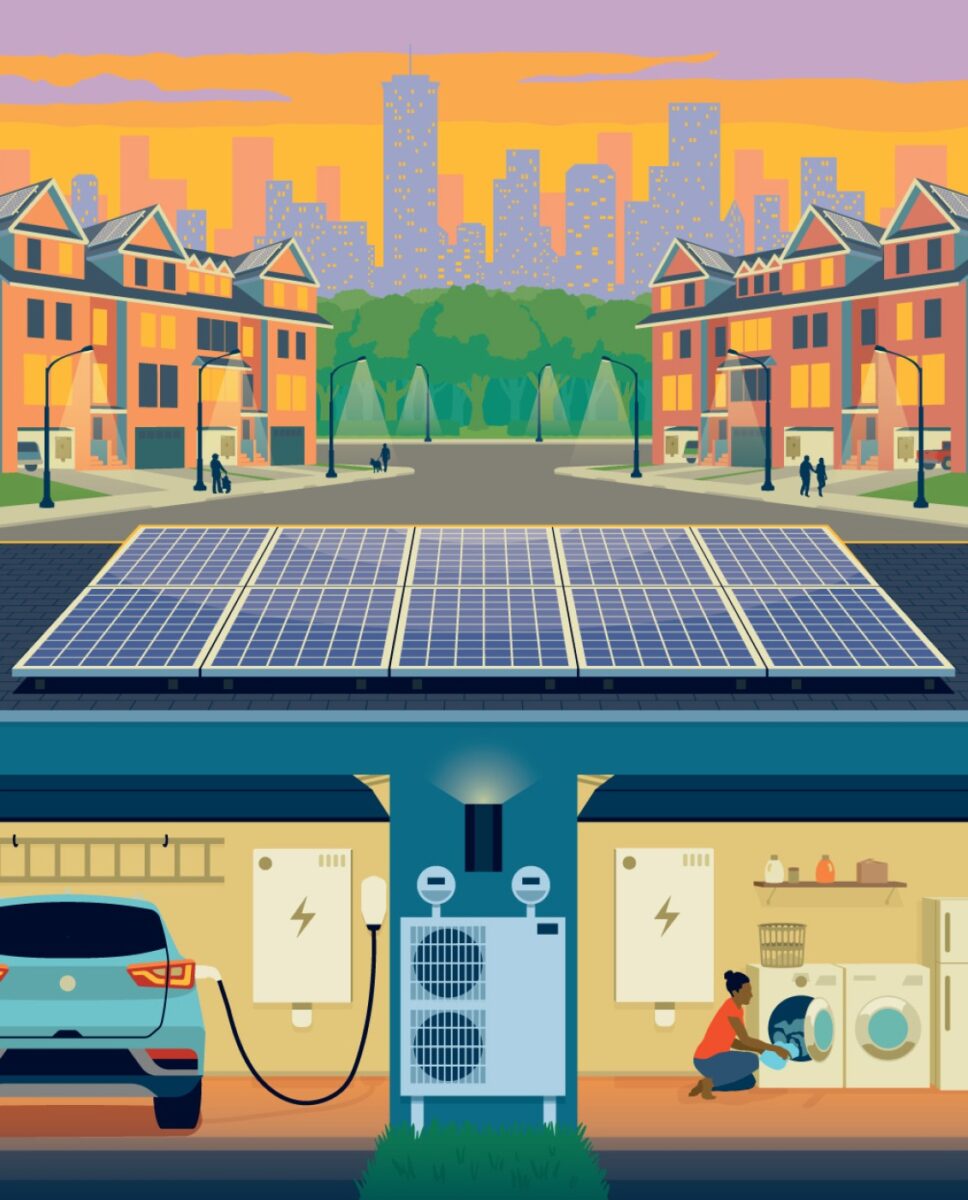





Instead of asking whether a tree makes a sound when it falls in a forest, we should be questioning if control room operators can tell the difference between peaker plants and virtual power plants (VPPs), which aggregate various small energy sources into one synchronized system.
According to a new report from grid tech company EnergyHub, “Building trustworthy virtual power plants: The VPP Maturity Model,” saying a VPP is as dependable as a conventional plant and can consistently meet energy demand is no longer enough for many grid operators. It has to be indistinguishable.
“Our goal is to build VPPs so capable, predictable, and responsive that grid operators call on them as confidently as they would a conventional peaker plant,” said the report authors.
The report lays out the framework for what the authors call the “Huels Test,” which is meant to determine when a VPP achieves parity with a peaker plant, in that it can be planned, credited or dispatched in the same way. It’s a simple but effective metric. The test questions: “If a grid operator is presented with two resources, one being a traditional peaker plant and the other a VPP, can they tell which is which in operation?”
“Passing the Huels Test does more than demonstrate technical competency,” the report stated. “It unlocks planner and operator confidence, market eligibility and capacity crediting that approaches or matches conventional resources.”
Huels isn’t the first test of its ilk, being inspired by Alan Turing’s “Turing Test,” which investigates whether a computer is artificially intelligent based on how well it can mimic a human. Still, reaching parity might not be as easy as the test’s binary yes-or-no structure makes it sound.
Per the report, three key factors will make or break a VPP’s parity pursuit: visibility, availability and schedulability. Like a traditional peaker, a VPP must provide at least five-minute telemetry (if not faster) directly to the operator’s control room and it must be an accurate estimate. Additionally, it must be available and ready to use across seasons and multi-hour flexibility windows in order to be an effective, reliable substitute for conventional plants. The VPP must also be capable of adapting in real-time to meet grid needs and of following complex schedules before, during and after an event.
If a VPP checks all three boxes, theoretically it should be on even footing with peaker plants. Still, the report questions whether today’s VPPs are capable of passing the test and lays out a framework for how those that might not be able to reach parity today could get there in the future.
The VPP Maturity Model analyzes a VPP’s capabilities and sorts them into one of five levels ranging from basic demand response (level zero) to enhanced demand response and finally to level four, grid-adaptive VPP. Most VPPs currently hover between a level one and two. Only the upper levels (automated and grid-adaptive VPPs) pass the Huels test, with grid-adaptive VPPs actually being able to outperform conventional peaker plants by “autonomously optimizing for multiple customer, bulk grid and distribution system objectives.”
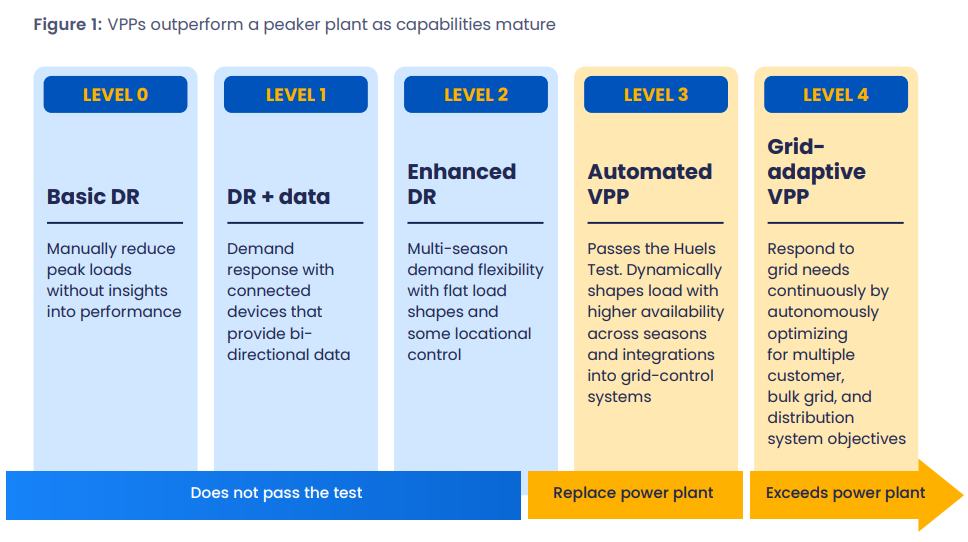
That makes the grid-services value of the VPP rise as well; level four VPPs deliver approximately $210/kW-year per unit of capacity compared to a level zero VPP’s $55/kW-year. The authors also note that grid operators are unlikely to fully trust level zero VPPs, hence their derating of the transmission and generation deferral benefits to what the report says is “roughly half the full capacity cost.” They also “estimate only minimal energy cost reductions since the 10 DR events per year shift load away from high-cost hours but have limited reach and flexibility.”
While it is possible to move from a level zero to a level four VPP, it requires tightening the data loop and improving telemetry. Providers must also automate for shaped load profiles of four or more hours rather than just for load shedding. Lowering the barrier to entry for customer enrollment and participation and scaling beyond local levels will also be critical.
This content is protected by copyright and may not be reused. If you want to cooperate with us and would like to reuse some of our content, please contact: editors@pv-magazine.com.





Grid operators are not stupid. They know that the injection of batteries with inverters and transformer would affect the frequency response of the network.
If utilities purchased, installed and maintained the battery systems as VPP and placed them at every home that gets a permit to install and run Rooftop Solar Systems and controlled the output to end curtailing of rooftop solar power this would be a good thing. Expecting homeowners to do that when it costs a lot to install and maintain yet homeowners mainly install them as “Back-up Power” and “Time of Day” usage reducers. My older off-grid system had to use batteries and to power my home off grid I needed a lot of them with my 8000 watts back yard system. Once I could connect to the grid with a “grid tied system”, I no longer wished to provide the $2,000.00 per years battery costs to replace and maintain the batteries. Batteries double the cost of a system and with the Federal Tax Rebates gone, there is no reason for homeowners to maintain a battery system when connected to the grid.