




Continued growth in solar and storage deployment in Massachusetts can save ratepayers $313 million per year through 2030, found a study by Synapse Energy Economics and the Solar Energy Industries Association (SEIA).
The analysis comes as Massachusetts officials are considering legislation and policy changes to manage the energy affordability crisis. Massachusetts has among the highest electricity rates in the United States.
The report finds that if Massachusetts meets its solar and storage deployment targets set by the SMART 3.0 incentive program, ratepayers can save $313 million per year by 2030. State policy targets roughly 3.5 GW of solar added by 2030. Across the greater New England benefits reach $684 million, said the report.
By bringing more solar and storage online, 80% of the savings come from reducing wholesale electricity prices, meaning every utility customer in Massachusetts sees a lower “supply charge” on their bill, regardless of whether they have panels on their own roof, said the report.
The report explains the wholesale market works like an auction. Each day, power plants submit bids to supply electricity. Grid operator ISO New England accepts the cheapest bids first (wind, solar, nuclear) and moves up to more expensive ones (gas, oil) until the state’s demand is met. The last, most expensive power plant needed to meet demand sets the price that everyone gets paid.
Solar and storage have nearly zero “marginal cost,” as the sun is free and the batteries are already charged. When they enter the auction, they sit at the bottom of the list.
By adding 3.5 GW of solar and storage ,as planned in SMART 3, the state “pushes” the most expensive power plants, often older, inefficient natural gas plants, out of the auction.
Instead of a high-priced gas plant setting the market clearing price at $0.10 per kWh, pushing it out with a cheaper resource could set it at $0.08 per kWh, said the report. Because that 2-cent drop applies to every single megawatt bought in the state at that hour, the savings add up to millions of dollars very quickly.
Program change
SMART 3.0 was established by the Healey-Driscoll administration in October 2025, changing the model from a “declining block” incentive in SMART 2.0 to a model where incentive values are adjusted on an annual basis.
Under the previous versions of SMART, the state set fixed “blocks” of capacity, (for example 100 MW). When a block was filled, the incentive rate automatically dropped for the next block. However, this model assumed that solar costs would always go down. In reality, inflation and supply chain issues caused costs to go up, but the incentives kept dropping. Eventually, the incentive became so low that new projects were no longer financially viable, causing the industry to “hit a wall.” Massachusetts as a result slipped from a top-5 solar state to 26th in deployment, said SEIA.
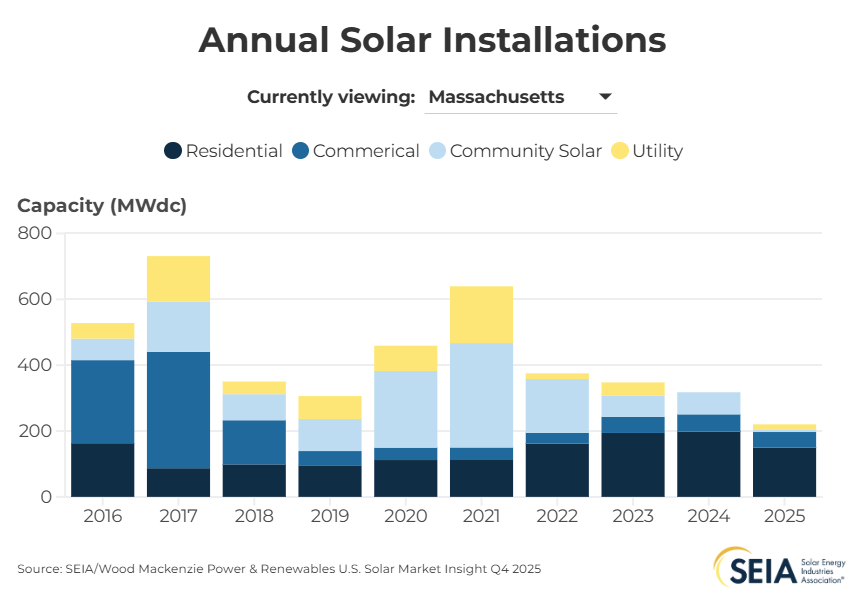
SMART 3.0 replaces the declining block incentive value with an annual adjustment model. During the annual adjustment, administrators survey developers to see the actual cost of steel, labor, and panels. If participation rates are too low in a given market segment (like canopy solar or low-income solar), the administrators can raise the rate to boost interest. And, if the state is behind on its 2030 climate targets, they can increase the total capacity allowed for that year.
Winter months
The study found that solar and storage can also greatly lessen Massachusetts’ reliance on natural gas and create significant savings over winter months.
Nearly 44% of the avoided energy-cost benefits resulting from solar and storage occur during the winter (November to March), when the grid is most stressed and natural gas prices are most volatile, it said. In the highest-load winter hours of 2030, solar and storage are projected to serve about 11% of total demand, significantly reducing the state’s reliance on expensive, gas-fired generation.
Continued solar and storage growth would avoid the use of 29 billion cubic feet of natural gas, which is equivalent to 25% of the natural gas currently used by the Massachusetts electric sector. By 2030, the planned expansion would avoid 1.6 million metric tons of CO2 emissions annually, or the equivalent of taking roughly 350,000 cars off the road. Find the full study here.
“Solar and storage resources reduce wholesale energy prices. This report quantifies the economic and reliability benefits of solar and storage additions in Massachusetts at a time when electricity affordability is of increasing concern,” said Selma Sharaf, Associate, Synapse Energy Economics.
This content is protected by copyright and may not be reused. If you want to cooperate with us and would like to reuse some of our content, please contact: editors@pv-magazine.com.







By submitting this form you agree to pv magazine using your data for the purposes of publishing your comment.
Your personal data will only be disclosed or otherwise transmitted to third parties for the purposes of spam filtering or if this is necessary for technical maintenance of the website. Any other transfer to third parties will not take place unless this is justified on the basis of applicable data protection regulations or if pv magazine is legally obliged to do so.
You may revoke this consent at any time with effect for the future, in which case your personal data will be deleted immediately. Otherwise, your data will be deleted if pv magazine has processed your request or the purpose of data storage is fulfilled.
Further information on data privacy can be found in our Data Protection Policy.