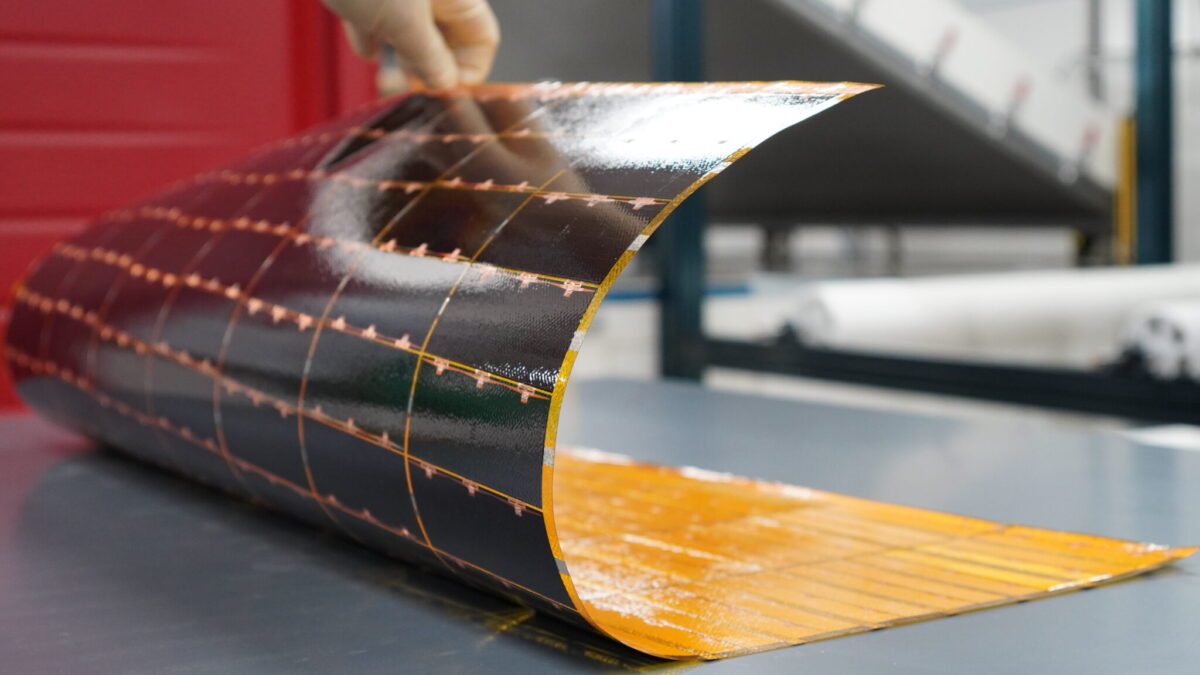





As there are no clouds in space, and no day-night cycle, solar energy is a common power source in spacecraft applications for continuous power. Two U.S. manufacturers recently made actions in both the public and private sectors for space-based solar.
First, Thornton, Colorado-based Ascent Solar Technologies announced it provided test modules of its thin-film PV technology to a “leading space company.” The modules are being tested for their ability to generate power for spacecraft in Cislunar space, the region of space between the Earth and the moon.
Reaching the moon requires significantly more energy than achieving low Earth orbit for space vehicles, said Ascent Solar. The company’s thin-film modules are being evaluated for use in this application due to their low weight to power ratio.
“Equipping a spacecraft with Ascent’s thin-film solar arrays that can endure the extreme radiation found in deep space enables mission designs that can go farther, accomplish more, and operate longer on the lunar surface and beyond,” said Paul Warley, chief executive officer of Ascent Solar Technologies.
Ascent Solar’s research and development center and 5 MW nameplate production facility is in Thornton, Colorado. The company develops copper indium gallium-selenide (CIGS) thin-film solar products. It announced this year a production scale module with a power density of 1,960 W/kg.
Tempe, Arizona based Solestial announced it signed a Space Act Agreement with NASA’s Glenn Research Center to advance ultrathin silicon solar arrays in space environments.
The collaboration will leverage NASA’s expertise in spacecraft charging and Solestial’s leadership in ultrathin silicon solar technology to better understand and mitigate the effects of spacecraft charging on thin film solar arrays.
Solestial will provide solar power modules that will undergo testing in NASA’s Glenn Research Center Plasma Interaction Facility. NASA will study changes in electrical performance and share resulting data.
The collaboration is expected to advance silicon solar cell as well as perovskite solar cell development for orbit and lunar applications.
The agreement will also support NASA’s Glenn Research Center in its broader campaign to develop passive and active electrostatic discharge (“ESD”) mitigation strategies for photovoltaic systems, which generate electrical power by converting sunlight into electricity. This work is intended to contribute to safer, more reliable power generation in space, said Solestial.
The company’s silicon solar cell is engineered to self-cure radiation damage under sunlight at operating temperatures as low as 65°C. Solestial solar cells are packaged in an ultrathin, low-mass, flexible solar power module designed to withstand up to 10 years in a variety of destinations in space, said the company.
This content is protected by copyright and may not be reused. If you want to cooperate with us and would like to reuse some of our content, please contact: editors@pv-magazine.com.




By submitting this form you agree to pv magazine using your data for the purposes of publishing your comment.
Your personal data will only be disclosed or otherwise transmitted to third parties for the purposes of spam filtering or if this is necessary for technical maintenance of the website. Any other transfer to third parties will not take place unless this is justified on the basis of applicable data protection regulations or if pv magazine is legally obliged to do so.
You may revoke this consent at any time with effect for the future, in which case your personal data will be deleted immediately. Otherwise, your data will be deleted if pv magazine has processed your request or the purpose of data storage is fulfilled.
Further information on data privacy can be found in our Data Protection Policy.